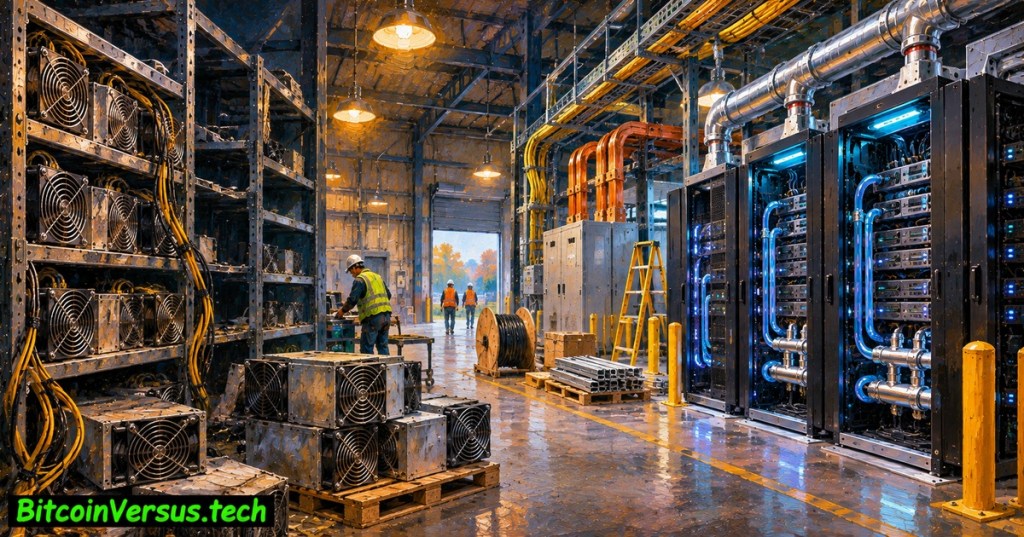
Hyperscale Data is betting its Michigan Bitcoin mining site on artificial intelligence, but a November 18, 2026 SEC filing reveals a major obstacle: $74.8 million of remaining estimated construction and equipment spending for the initial 20 MW AI deployment. Management says existing liquidity will not cover anticipated obligations over the next 12 months and warns of substantial doubt about the company’s ability to continue as a going concern.
The warning arrives after the company retired its Michigan mining rigs on September 1 and sold its remaining Bitcoin treasury. The change creates a direct test of whether a powered mining building can become a functioning AI colocation facility before its financing window tightens. Our earlier report covered the ASIC shutdown; the latest filing exposes the separate delivery and financing challenge.
Official Vertiv July 2026 technical overview of pre-engineered power and cooling infrastructure for AI deployments. Archival engineering context, not footage from the Hyperscale project. Watch on YouTube.
Twenty megawatts of AI power requires more than available floor space
Hyperscale’s Alliance Cloud Services subsidiary signed a master services agreement in June for approximately 20 MW of critical IT power at its Dowagiac, Michigan campus. The plan calls for 10 MW ready for service in December 2026 and another 10 MW by the end of March 2027. Critical IT capacity measures power delivered to computing equipment, not total facility electricity use including cooling and distribution losses.
The company cites approximately $1.2 billion of potential contract value, assuming an initial 10-year term plus both optional five-year extensions and fulfillment of its obligations. The amount is neither received revenue nor guaranteed future receipts. A customer option for an additional 32 MW could expand potential value further, but no additional deployment should be counted as operational.
The $74.8 million gap is a spending requirement, not a bank balance
Hyperscale estimates the 20 MW construction, power-module and commissioning program at $122.1 million. It had paid $47.3 million by October 31, leaving $27.4 million planned for November and December and $47.4 million for the first quarter of 2027. Equipment still unordered and installation work may alter the final totals.
| Michigan AI fit-out | Amount | Period |
|---|---|---|
| Total estimated cost | $122.1 million | Project estimate |
| Already paid | $47.3 million | Through Oct. 31, 2026 |
| Remaining planned spending | $74.8 million | Nov. 2026–Mar. 2027 |
At September 30, Hyperscale reported $17.3 million of cash and equivalents, plus $27.8 million of restricted cash that cannot be treated as unrestricted funding. Current liabilities stood at $231.2 million, exceeding current assets by approximately $128.1 million. Those dated balances are not a calculation of cash available after November financing activity.
Official Vertiv May 2026 video about integrating data-center electrical distribution, cooling, controls and services. Archival technical context, unrelated to Hyperscale’s particular equipment vendors. Watch on YouTube.
Bitcoin sales and new debt have not removed financing risk
A November 10 company announcement says Hyperscale sold approximately 1,113 BTC since late July for about $74.4 million, including 211.6 BTC sold for $16.0 million in early November. Part of the final sale funded repayment of approximately $12.8 million of principal and a $1.3 million premium. The firm still operates Bitcoin mining in Montana, so ending Michigan mining did not mean exiting Bitcoin production everywhere.
Two convertible-note closings on November 6 and 18 brought in $15 million in gross cash proceeds, with additional potential financing subject to agreement and shareholder approval. Notes carry interest and conversion terms, making new capital potentially dilutive or costly. Hyperscale’s earlier treasury update preceded the latest sale and filing.
The engineering challenge beneath the financing figures
ASIC mines emphasize inexpensive energy, ventilation and rapid miner replacement. High-density GPU colocation additionally requires customer-specific electrical protection, network connectivity, cooling reliability, redundancy and acceptance testing. Meeting a contractual ready-for-service date involves commissioning the entire delivery chain, not merely installing GPUs. Comparable infrastructure decisions also shape Core Scientific’s AI colocation transition and IREN’s reduction in mining capacity.
The opportunity remains real: contracted computing customers can support recurring revenue beyond mining rewards. However, deadlines, interest costs and liquidity restrictions can determine whether a planned conversion earns revenue. The next material milestones are the December 10 MW delivery target, additional financing disclosures, and the second 10 MW phase expected by March 2027.
Sources and verification
Primary evidence: Hyperscale Data Form 10-Q for September 30, filed November 18, 2026; Hyperscale November 10 Bitcoin sale announcement. Independent context: CoinDesk’s November 18 investigation. Amounts, schedules, obligations and potential contract value are reported or conditional, not guaranteed.
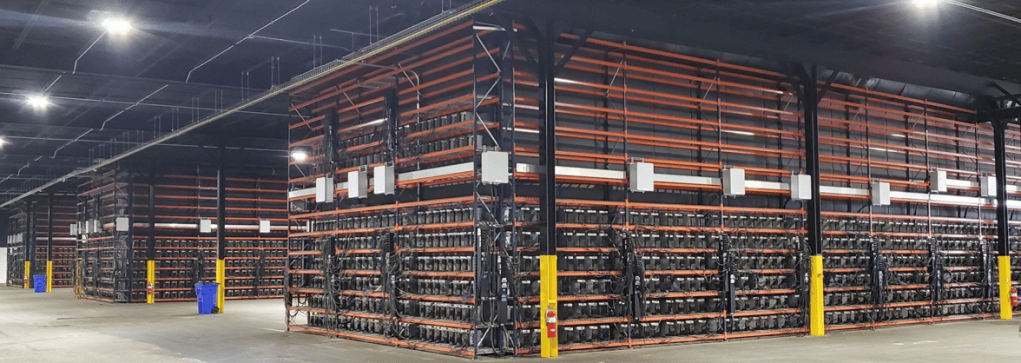
Reporting Note: The original featured oil painting represents a conceptual ASIC-to-AI conversion, not an actual current photograph. The in-story mining interior is an authentic older press image. Both Vertiv videos explain general data-center infrastructure and do not document construction or commissioning at the Michigan facility. Reporting is informational, not investment advice.
Editor’s Note: We volunteer daily to ensure the credibility of information on our platform is Verifiably True. Support our research by scanning the QR code below to donate 5,000 sats.

For mobile scanning, open the article on another display and scan the QR code with a Bitcoin wallet. Verify receiving address 3C9o19EH5HSiwEPyCTmEKzxhNCbo2X6TTb before sending.
BitcoinVersus.tech provides technical and financial journalism for informational purposes only and does not provide investment, legal or cybersecurity assurance.


Leave a Reply