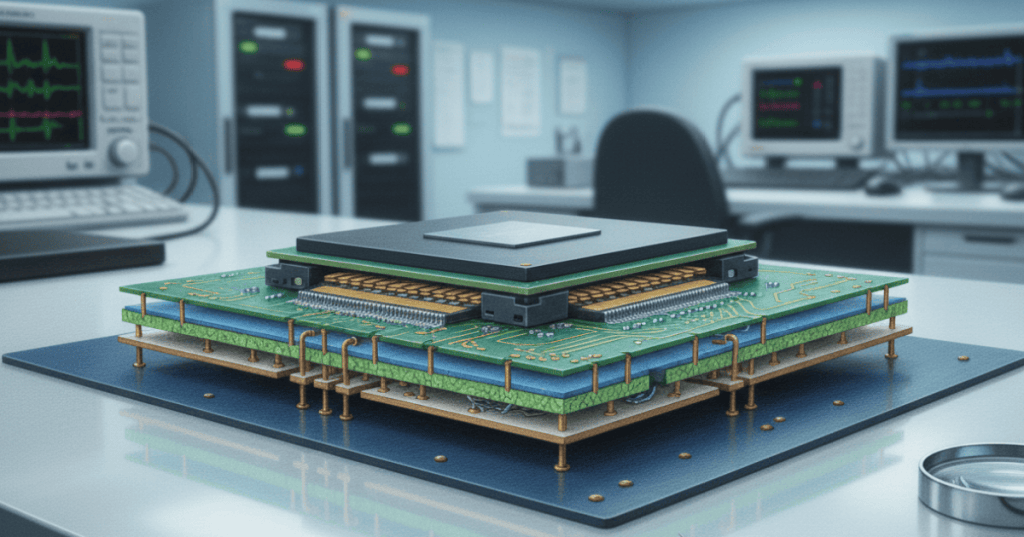
The AI chip shortage is reaching a component most people never see: the microscopic woven glass cloth inside printed circuit boards and semiconductor package substrates. Japan’s Nitto Boseki, better known as Nittobo, is expanding production of its low-expansion T-Glass as demand from advanced AI hardware tightens supply.
That matters because a modern accelerator is not just a silicon die. High-performance GPUs and custom AI processors depend on increasingly large, dense packages that must keep thousands of electrical connections mechanically stable while carrying enormous amounts of data and power.
Glass Cloth Is Structural Hardware For A Circuit Board
Printed circuit boards and package substrates are built from layers of insulating material, copper wiring and reinforcement. Fine glass fibers can be woven into cloth and embedded in resin, creating a strong dielectric layer that helps the board maintain its dimensions while copper traces and vias connect components.
For ordinary electronics this material is easy to overlook. In advanced AI systems, however, packages are getting larger and signal speeds are rising, so tiny dimensional changes can affect alignment, warpage and electrical performance.
Why T-Glass Matters For AI Chips
Nittobo describes T-Glass as a special glass composition with a lower coefficient of thermal expansion than conventional E-Glass. In simple terms, it changes size less as temperature changes. That stability is useful in semiconductor package substrates where silicon, copper, resin and reinforcement materials all expand at different rates.
As an AI accelerator heats and cools, those materials experience mechanical stress. Reducing substrate movement helps package designers control warpage and maintain the extremely fine interconnect geometry required by advanced devices.
AI Packaging Is Making The Material More Important
AI processors increasingly combine large compute dies with high-bandwidth memory and advanced packaging. Our CoWoS-L packaging coverage explains how these systems are growing beyond traditional reticle-size limits, increasing the importance of the package and substrate underneath the silicon.
The same trend is driving investment in substrate manufacturing itself. BitcoinVersus.Tech recently covered Singapore’s first high-end FC-BGA substrate factory, another sign that the AI hardware bottleneck extends well beyond leading-edge wafer fabrication.
The Supply Chain Goes Far Below The GPU
AI infrastructure discussions usually focus on GPUs, HBM and foundry capacity. But each finished accelerator depends on a stack of specialized suppliers: silicon wafers, lithography equipment, photoresists, packaging tools, substrates, glass cloth, copper foil, connectors, optics, power electronics and cooling hardware.
A shortage in any one of those layers can limit the number of finished accelerators that reach a server rack. That is why seemingly obscure material suppliers can become strategically important when the industry scales from thousands of AI accelerators to millions.
Packaging Is Becoming Part Of Chip Performance
Historically, packaging was often treated as what happened after a chip was manufactured. Modern AI hardware has changed that relationship. The package now determines how multiple dies, memory stacks and high-speed links fit together, how heat leaves the device and how power reaches it.
Our broader semiconductor packaging guide walks through the manufacturing steps that turn fabricated dies into usable electronic devices. T-Glass sits deep inside that chain, but the current capacity expansion shows why even the reinforcement material can become an AI-era constraint.
What To Watch Next
The important question is whether material capacity can expand as quickly as advanced packaging. More CoWoS-class systems, larger FC-BGA substrates and denser AI accelerators mean suppliers must scale not only fabs but also the specialized materials feeding packaging factories.
The lesson is simple: the AI hardware race is no longer only a GPU race. Every layer underneath the GPU—from glass fibers and resin to substrates and interposers—can determine how much compute the industry can actually build.
Sources
Primary and industry sources: Nittobo Glass Fiber and DIGITIMES.
BitcoinVersus.Tech
Advertisement
Editor’s Note
We volunteer daily to help keep the information on this platform verifiably accurate. If you would like to support our independent research, please donate here: 3C9o19EH5HSiwEPyCTmEKzxhNCbo2X6TTb
BitcoinVersus.tech is not a financial advisor. Content is provided for informational purposes.


Leave a Reply