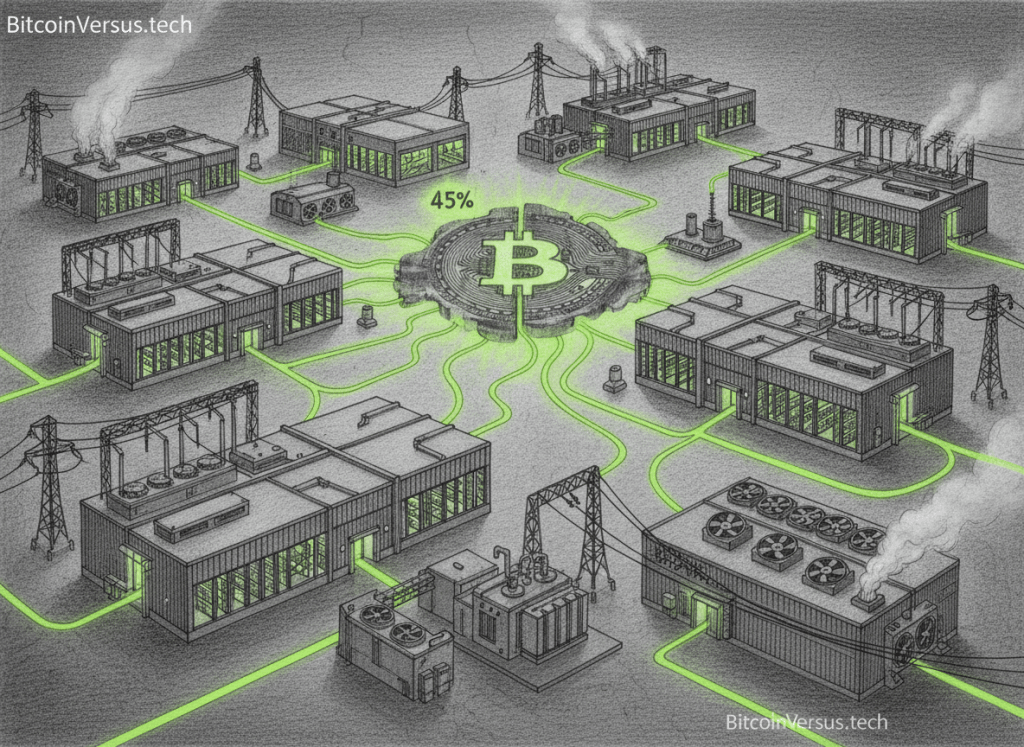
Publicly traded Bitcoin miners now represent roughly 45% of the Bitcoin network’s reported hashrate, according to the latest operating data compiled by Ziven. The figure illustrates how much industrial-scale mining capacity has become concentrated inside listed companies even as parts of the sector redirect electricity and capital toward artificial intelligence infrastructure.
Ziven’s September 24 snapshot puts the Bitcoin network at approximately 921 EH/s, with tracked public miners operating a combined 416.1 EH/s. Bitdeer leads the table at 79.9 EH/s, followed by MARA at 70.3 EH/s, CleanSpark at 38.3 EH/s, Riot Platforms at 37.2 EH/s and IREN at 36 EH/s.
The figures are particularly notable because the public-mining industry is moving in two directions at once. Some operators continue adding SHA-256 capacity, while others are retiring or repurposing mining infrastructure for AI and high-performance computing workloads.
Public miners hold a large slice of Bitcoin computing power
Hashrate measures the computational work miners contribute to Bitcoin’s proof-of-work network. A larger share of network hashrate generally gives a miner a larger statistical share of block rewards, although actual production varies with uptime, pool performance, curtailment and network difficulty.
Ziven standardizes company disclosures using operating, active, energized or self-mining hashrate where available. That distinction matters because a company’s installed fleet can be larger than the amount of hardware actually hashing at a given time.
MARA’s own second-quarter shareholder filing provides a useful cross-check. The company reported 70.3 EH/s of energized hashrate for Q2 2026 and produced 2,422 BTC during the quarter. BitcoinVersus.tech has also tracked Bitdeer’s rise to 79.9 EH/s, which currently puts it at the top of Ziven’s public-miner table.
AI is reshuffling the same power market
The concentration does not mean every public miner is expanding Bitcoin capacity. TheEnergyMag estimates that a group of public miners shed about 56 EH/s of realized hashrate during the first half of 2026 as operators redirected power toward AI retrofits. The publication also reported that directly disclosed HPC and AI revenue among comparable miners rose 52% from the first quarter.
That creates an unusual structure. Public companies can represent a large share of Bitcoin’s industrial hashrate while individual operators simultaneously reduce mining exposure. Capacity abandoned by one miner can be absorbed by another, and network difficulty continually adjusts to changes in aggregate computing power.
Mining economics still decide where the machines run
ASIC Miner Value’s current production-cost model reinforces why fleet efficiency matters. Using an 18 J/TH modern-fleet assumption and electricity at $0.06 per kWh, its September 25 model estimates an electricity cost of about $53,896 to mine one BTC. At 12 J/TH, the modeled electricity cost falls to roughly $35,930. Older 35 J/TH hardware rises above $104,000 under the same power-price assumption.
Those gaps help explain why hashrate can migrate rapidly toward companies with newer machines and lower-cost power. Operators running inefficient fleets face substantially different economics even though every miner competes for the same block subsidy and transaction fees.
For background, Wikipedia’s Bitcoin network article explains the proof-of-work system and mining process. Current operating figures are available from Ziven’s public-miner hashrate dashboard, while current hardware economics can be compared through ASIC Miner Value’s Bitcoin production-cost model.
The broader takeaway is not simply that listed miners are getting larger. It is that Bitcoin’s industrial hashrate is being redistributed among a smaller group of highly capitalized operators at the same time electricity-rich mining campuses are becoming valuable inputs for AI data centers. The next phase of the mining cycle may therefore be determined as much by access to efficient ASICs and inexpensive megawatts as by the Bitcoin price itself.
BitcoinVersus.Tech Editor’s Note:
BitcoinVersus.tech is not a financial advisor. This media platform reports on financial subjects purely for informational purposes.


Leave a Reply