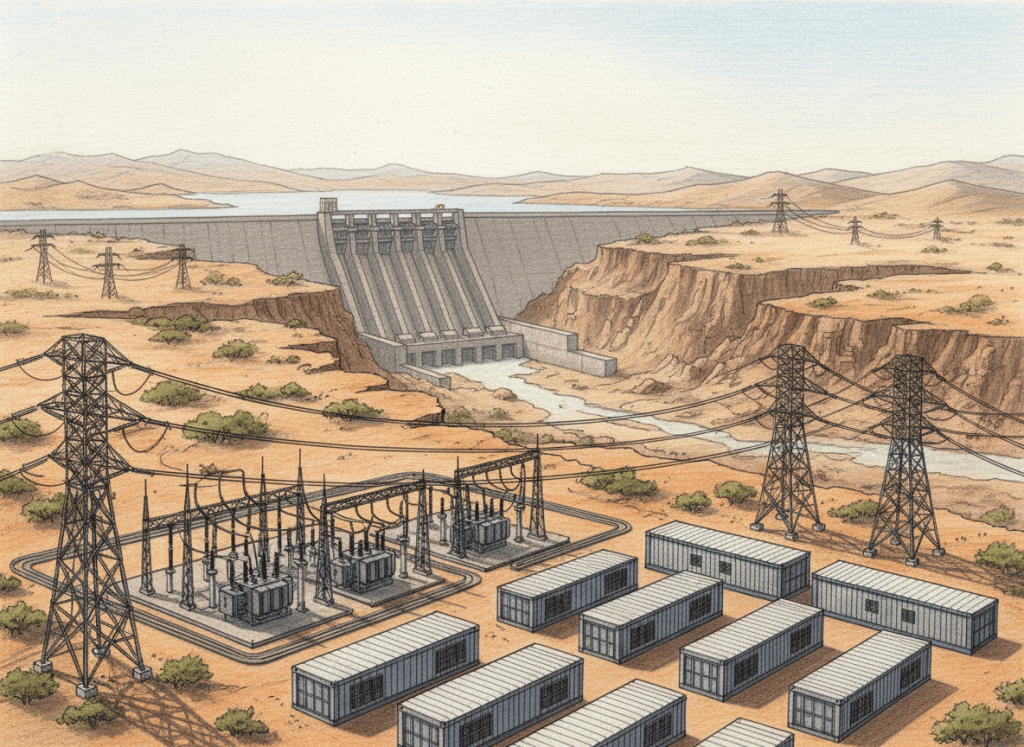
Ethiopia’s rapid rise as a global Bitcoin mining hub is facing a physical constraint that ASIC efficiency cannot solve: there is less water flowing into the country’s hydroelectric reservoirs.
Ethiopian Electric Power has reduced electricity supplied to cryptocurrency mining operators to about 23% of contracted capacity as dry conditions cut reservoir inflows. A September 20 report from Ethiopia’s Capital newspaper says the state utility may go further and terminate mining power agreements if El Niño conditions intensify.
39 mining companies have power agreements
Ethiopia currently has power-purchase agreements with 39 cryptocurrency mining companies, with 31 already operating, according to EEP figures reported by Bloomberg and Capital. The industry has become a major electricity customer after international miners moved equipment into the country to access low-cost hydropower.
EEP had been supplying miners at close to 98% of contracted capacity. As the dry season worsened, supply was reduced first to 75%, then 50%, and finally approximately 23%. Reservoir inflows have fallen by roughly 20%.
Bitcoin miners became a major power customer
The scale explains why the situation matters beyond individual mining farms. Bitcoin and cryptocurrency mining customers generated roughly 35% of Ethiopian Electric Power’s corporate revenue in the previous fiscal year. Capital reported more than 50 billion birr, or over $300 million, from the sector.
At full contracted operation, mining facilities consume close to one-third of Ethiopia’s generation capacity. That makes mining unusually important to both sides of the power market: miners need Ethiopia’s inexpensive hydroelectricity, while EEP receives hard-currency revenue that can support imported electrical equipment and grid investment.
Hydropower created the opportunity and the constraint
Ethiopia became attractive to Bitcoin miners because of abundant renewable generation and electricity pricing reported around 3.2 cents per kilowatt-hour. Operators including international hosting companies have deployed ASIC fleets around access to that energy.
But a mining fleet can only convert electricity into hashrate when the electricity is available. El Niño-linked dry conditions have reduced inflows into major reservoirs. EEP says domestic households and manufacturing remain priorities when supply becomes constrained.
Operators are already throttling mining farms
The impact is visible at the operator level. Epic Mining’s current Ethiopia farm-status notice says available electrical capacity for data-mining customers has been temporarily reduced to approximately 23% of contracted load. Its Ethiopian sites are marked as operating under energy restrictions related to the dry season.
EEP plans to continue reassessing hydrological conditions. Capital reported that the utility could reconsider its relationships with data-mining operators entirely if the drought becomes more severe.
A global Bitcoin mining infrastructure lesson
Ethiopia shows why a mining site’s nameplate megawatts are only part of its real capacity. Contracted MW, available MW and actually delivered MW can be very different numbers. Hydrology, grid priorities, curtailment rules and power-contract terms can determine effective hashrate just as much as the number and efficiency of ASICs installed in a facility.
For a global mining industry increasingly chasing inexpensive and stranded energy, Ethiopia is now a large-scale test of what happens when the energy resource itself becomes constrained.
Sources
- Capital Ethiopia: El Niño drought threatens mining power supply
- Bloomberg via Moneyweb: Ethiopia cuts Bitcoin miners’ power supply
- Epic Mining: Ethiopia farm status
- Ethiopian Electric Power: energy strategy
BitcoinVersus.Tech Editor’s Note
BitcoinVersus.Tech reports on Bitcoin, Bitcoin mining hardware, data centers, energy and emerging technology. Support independent reporting with Bitcoin: 3C9o19EH5HSiwEPyCTmEKzxhNCbo2X6TTb.
Financial disclaimer: This article is for informational and educational purposes only and is not financial, investment, legal or tax advice. Bitcoin, cryptocurrency mining and publicly traded securities can be volatile. Readers should conduct their own research before making financial decisions.
Related BitcoinVersus.tech coverage: Public miners hashrate share · Private and sovereign miners · CleanSpark mining update · Bitdeer mining update


Leave a Reply