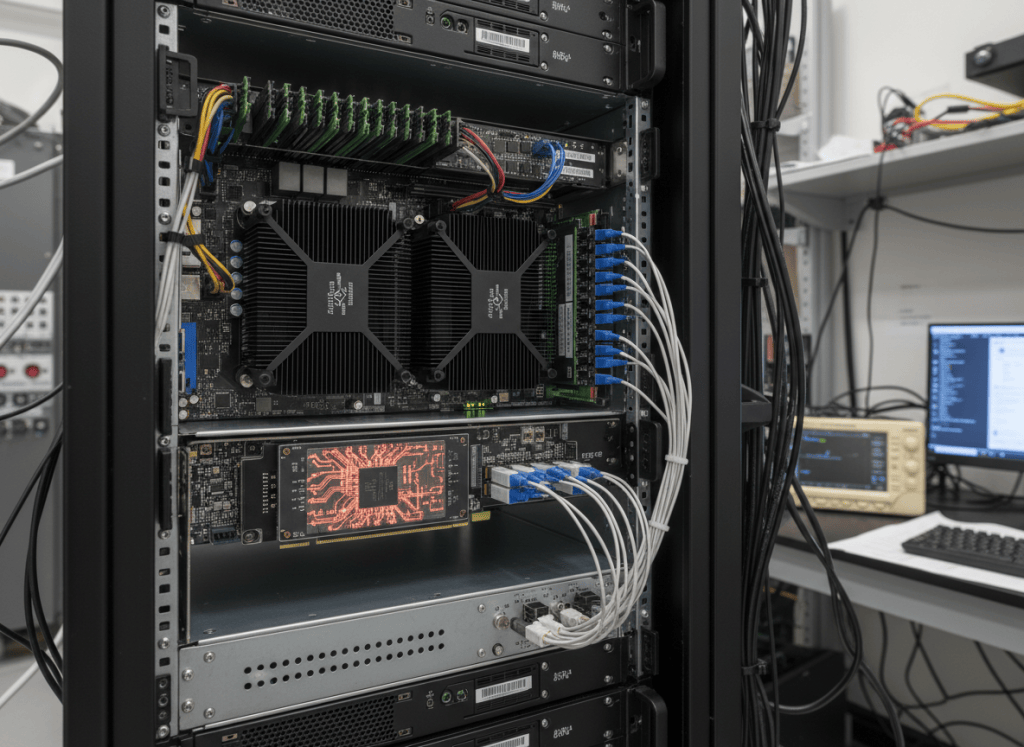
Photonic computing is moving closer to ordinary software development. Germany’s Q.ANT has released a software development kit and APIs that allow programmers to send workloads to its light-based processors using Python and C/C++.
The September 23 release matters because exotic computing hardware is only useful at scale when developers can integrate it into familiar software environments. Q.ANT is trying to make its photonic Native Processing Units behave more like accelerators that can sit beside conventional CPUs and GPUs.
Programming a Computer That Uses Light
Traditional processors represent and manipulate information electronically. Q.ANT’s approach uses optical effects to perform selected mathematical operations with photons. The company says its second-generation Native Processing Unit is already shipping in PCIe accelerator cards and complete Native Processing Servers.
The new SDK provides interfaces for Python and C/C++, two of the most common language families in scientific computing, AI and high-performance computing. That gives researchers and developers a more conventional path for sending numerical workloads to the photonic hardware.
Photonic Hardware Works Beside Existing Servers
Q.ANT is not presenting its photonic processor as a universal replacement for electronic CPUs. Instead, the accelerator targets mathematical workloads that map well onto its optical architecture, while conventional processors continue handling control logic, memory management and general software.
That hybrid model resembles the way GPUs became part of high-performance computing. Specialized hardware handles operations where it has an advantage, while the rest of the application stays on established computing infrastructure.
The Software Layer May Be the Bigger Milestone
Novel chips often face a software problem before they face a manufacturing problem. Developers already have enormous ecosystems built around x86, Arm, CUDA and established scientific-computing frameworks. Hardware that requires applications to be rewritten from scratch faces a difficult adoption path.
By exposing the NPU through familiar languages and APIs, Q.ANT is attempting to reduce that barrier. HPCwire reports that the company sees the SDK as a foundation for more complex nonlinear algorithms on future photonic systems.
Light-Based Computing Still Has to Prove Scale
Photonic processors have long promised high speed and energy efficiency for certain mathematical operations, but commercial adoption remains far smaller than electronic CPU and GPU computing. Real-world usefulness will depend on workload compatibility, accuracy, programming overhead, data movement, manufacturing cost and integration with existing servers.
Q.ANT’s SDK does not settle those questions. It does, however, give more programmers a way to test the hardware using tools they already know. That is an important step if photonic accelerators are going to move from specialized demonstrations into production computing.
BitcoinVersus.Tech Editor’s Note: We volunteer daily to ensure the credibility of the information on this platform is Verifiably True. If you would like to support to help further secure the integrity of our research initiatives, please donate here: 3C9o19EH5HSiwEPyCTmEKzxhNCbo2X6TTb
Disclaimer: BitcoinVersus.tech is not a financial advisor. This media platform reports on financial subjects purely for informational purposes.
Related BitcoinVersus.tech coverage: QBit robot SoC · Axelera Europa AI · Dnotitia vector-search ASIC · Python functions lesson


Leave a Reply