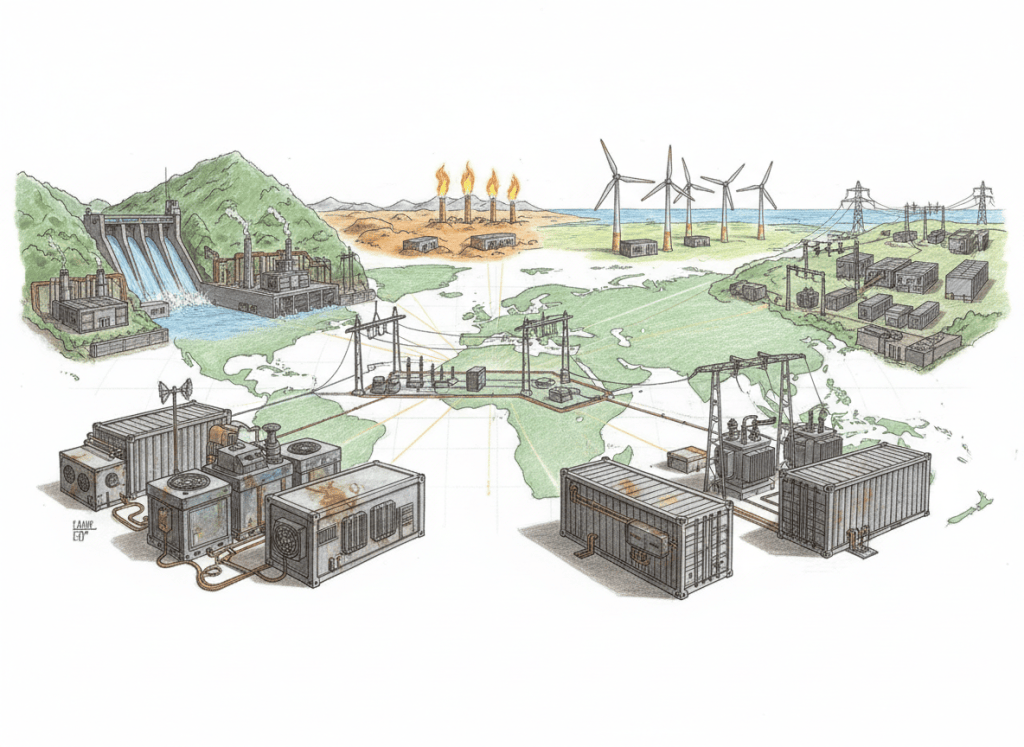
Bitcoin mining is becoming harder to understand by watching only the largest publicly traded miners. New September data shows the public-company share of global hashrate is shrinking while private and sovereign operators take a larger portion of the network.
JPMorgan analysts said this week that publicly listed miners are losing share of Bitcoin mining activity to privately owned and sovereign miners as public operators redirect power, sites and capital toward artificial intelligence infrastructure. A separate September 25 industry dataset tracking 30 public miners estimated that the group represented about 416 EH/s, or roughly 45% of global network hashrate.
Public miners no longer tell the whole network story
Ziven’s September 25 snapshot placed the Bitcoin network near 926 EH/s while its 30-company public-miner cohort accounted for 416.1 EH/s. That worked out to 44.92% of the network, down 3.09 percentage points month over month in the dataset.
The remaining hashrate is not one company. It includes private industrial miners, sovereign or state-linked projects, smaller operators, hosting customers, off-grid energy projects and miners whose fleets are not disclosed through public-company filings.
AI is pulling hashrate out of listed fleets
CoinShares’ Q2 mining report said the weighted average ex-tax cash cost to produce one Bitcoin among listed miners reached approximately $75,500 during the quarter. The report identified at least 35 EH/s scheduled to leave the listed-miner cohort as operators cancel hardware orders, retire ASIC fleets or convert facilities to AI and high-performance computing.
That does not mean the Bitcoin network loses every exahash a public company retires. ASICs can be sold, relocated or operated by another owner. Power freed by one miner can also support another mining project somewhere else. The result is a geographic and ownership redistribution that is difficult to see from public-company earnings alone.
The search has to move beyond the top 20 miners
The shift changes what mining intelligence needs to track. A useful global inventory must follow individual sites, machine models, power contracts, installed and operating megawatts, energy sources, cooling systems, hosting customers and expansion permits, including companies that never appear in a U.S. mining-stock screen.
Ethiopia illustrates the scale of the hidden layer. The country has power agreements with dozens of cryptocurrency mining companies, many privately held or based outside the United States. Paraguay, Oman, Bhutan, the Nordic region and off-grid energy projects in North America are creating similar pockets of industrial hashrate.
Mining pools reveal activity that stock tickers cannot
Pool data provides another view. Startmining’s September 26 block analysis showed Foundry USA, AntPool, F2Pool, ViaBTC and SpiderPool among the largest pools. A pool’s share does not identify who owns every ASIC behind it: thousands of machines operated by many independent companies can point hashrate at the same pool.
That distinction is increasingly important. Public-company hashrate, mining-pool hashrate and sovereign or private mining capacity measure different layers of the network. Treating any one of them as the complete mining industry can hide where new machines and megawatts are actually coming online.
What BitcoinVersus will track next
The next layer of mining coverage is therefore site-level rather than leaderboard-level: who is building, where the site is located, how many megawatts are energized, which ASIC models are installed, how many machines are online, what they mine, what the power costs, whether the operator owns or hosts the fleet, and whether the same campus is adding AI compute.
As listed miners become hybrid AI infrastructure companies, some of the most important Bitcoin mining developments may increasingly happen at private companies and energy projects that receive far less attention.
Sources
- The Block: JPMorgan mining analysis
- Ziven: public miner hashrate tracker
- CoinShares: Q2 2026 Bitcoin Mining Report
- Startmining: Bitcoin network dashboard
BitcoinVersus.Tech Editor’s Note
BitcoinVersus.Tech reports on Bitcoin, mining hardware, data centers, energy, semiconductors and emerging technology. Support independent reporting with Bitcoin: 3C9o19EH5HSiwEPyCTmEKzxhNCbo2X6TTb.
Financial disclaimer: This article is for informational and educational purposes only and is not financial, investment, legal or tax advice. Bitcoin, cryptocurrency mining and publicly traded securities can be volatile. Readers should conduct their own research before making financial decisions.
Related BitcoinVersus.tech coverage: Public miners control ~45% hashrate · CleanSpark mining update · Bitdeer mining update · Luxor mining to AI


Leave a Reply