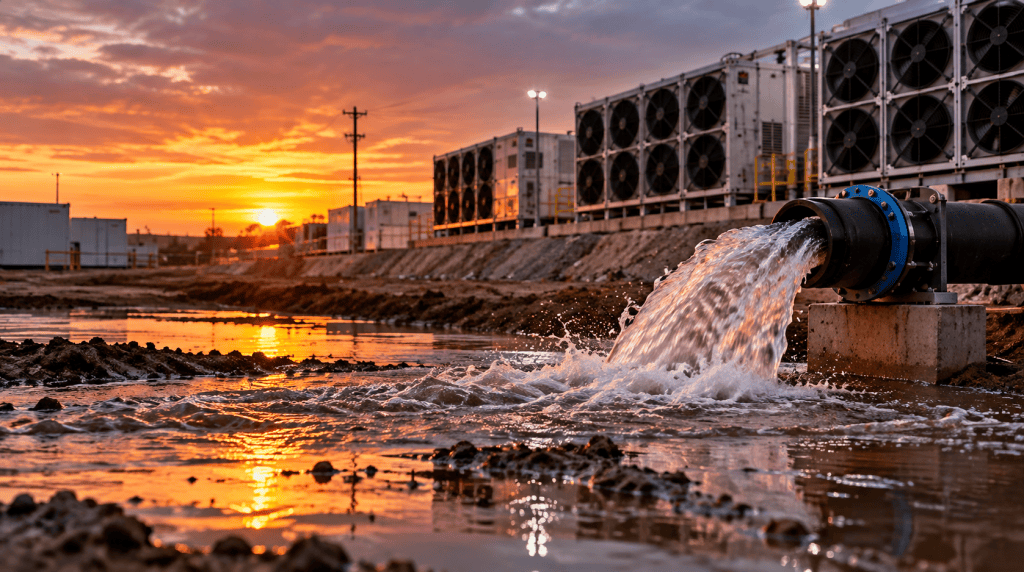
A Bitcoin mining facility in El Reno, Oklahoma, has been condemned after a failure in private water infrastructure on the property contributed to the loss of roughly 3.8 million gallons of municipal water, disrupted pressure across the city and forced local schools to close.
The facility is associated with Athlon Blockchain Technology, which describes its business around mobile data centers for AI and Bitcoin mining. The incident is significant for mining operators because it shows how support infrastructure—fire protection, water lines, electrical permits, drainage and occupancy approvals—can become just as consequential as ASIC efficiency or hashrate.
The Failure Was in Fire-Protection Infrastructure
Reporting from KOSU and Data Center Dynamics traces the water loss to a private line serving a fire hydrant at the property. That distinction matters: available reporting does not establish that the leak originated in an ASIC hydro-cooling loop.
City officials initially discussed losses of more than three million gallons; later reporting put the estimate near 3.8 million gallons. The pressure drop was severe enough to interrupt service and close schools for two days.
A Mining Site Is More Than the ASIC Fleet
Industrial Bitcoin mining is often reduced to three numbers: hashrate, megawatts and joules per terahash. In practice, the facility around the miners includes transformers, switchgear, networking, cooling equipment, pumps, fire suppression, drainage, controls and physical safety systems.
That infrastructure layer is increasingly important as mining campuses scale. BitcoinVersus.tech recently reported that Bitdeer reached 79.9 EH/s of self-mining hashrate, while BitFuFu reported 344 MW of managed power capacity. At those scales, the physical plant is inseparable from the computing hardware.
El Reno Says the Site Lacked Final Approval
According to city statements reported by KOCO, El Reno issued a stop-work order in 2023 after fire and life-safety violations and expired building and electrical permits. Officials later said they believed construction and operations continued despite the lack of a final certificate of occupancy.
After the leak, the city condemned the property and said it intended to recover costs associated with the lost water and the municipal response. Athlon had not provided a substantive public response to the local outlets cited in the reporting.
The Cooling Question Requires Careful Language
Athlon has promoted both air- and hydro-cooled mobile data-center technology. Local reporting also observed piping around the site. But those facts do not prove that mining cooling caused this particular leak. The reported failure was associated with private fire-protection water infrastructure, so treating the event as a hydro-miner cooling failure would go beyond the evidence currently available.
That technical distinction is useful as newer mining systems push deeper into liquid cooling. BitcoinVersus.tech has tracked the 8.9 J/TH Antminer S23 XP Hyd. and the broader engineering pressure to extract more hashrate from fixed electrical capacity. Liquid-cooled ASICs can change facility plumbing and heat-rejection requirements, but fire suppression remains a separate safety system.
Containerized Mining Still Needs Full Facility Engineering
Containerization can make Bitcoin mining modular, but it does not eliminate civil, electrical or safety engineering. A mining container still depends on correctly designed power distribution, grounding, networking, thermal management, fire protection and site utilities.
That is visible in projects BitcoinVersus.tech has covered recently. TerraHex is preparing a 9 MW modular mining node in Nigeria, where heat, humidity and dust affect thermal design, while Cuentas is planning modular West Texas mining infrastructure around onsite generation. Different sites have different constraints, but the engineering lesson is consistent: the ASIC is only one component of the system.
El Reno therefore offers a practical infrastructure warning for the mining industry. As operators pursue denser fleets and larger power envelopes, basic facility controls—permits, inspections, water monitoring, fire systems and maintenance—remain essential. A multimillion-gallon failure outside the hashboards can still shut the entire operation down.
BitcoinVersus.Tech Editor’s Note
Support independent technology reporting: BTC donations may be sent to 3C9o19EH5HSiwEPyCTmEKzxhNCbo2X6TTb.
Follow BitcoinVersus.tech on X/Twitter for Bitcoin mining, ASIC hardware, AI infrastructure, semiconductor and data-center reporting.
Disclaimer: BitcoinVersus.tech is not a financial advisor. This media platform reports on financial subjects purely for informational purposes.


Leave a Reply