TerraHex Digital has secured its initial fleet of Bitcoin mining ASICs for a planned 9 MW modular computing node in southern Nigeria, moving the project toward a targeted December 2026 launch.
The company has received a second ASIC shipment at its U.S. processing hub, while the first batch is being inspected, tested, conditioned and certified in Florida before shipment to Nigeria. Technical partner M3 Miner Repair is supporting the preparation process.
TerraHex says the conditioning program is designed around operating challenges that include high temperatures, humidity and seasonal Harmattan dust. Those conditions make filtration, ventilation, maintenance practices and thermal management important parts of the deployment rather than secondary facility considerations.
Containers Bring Mining and Data Center Engineering Together
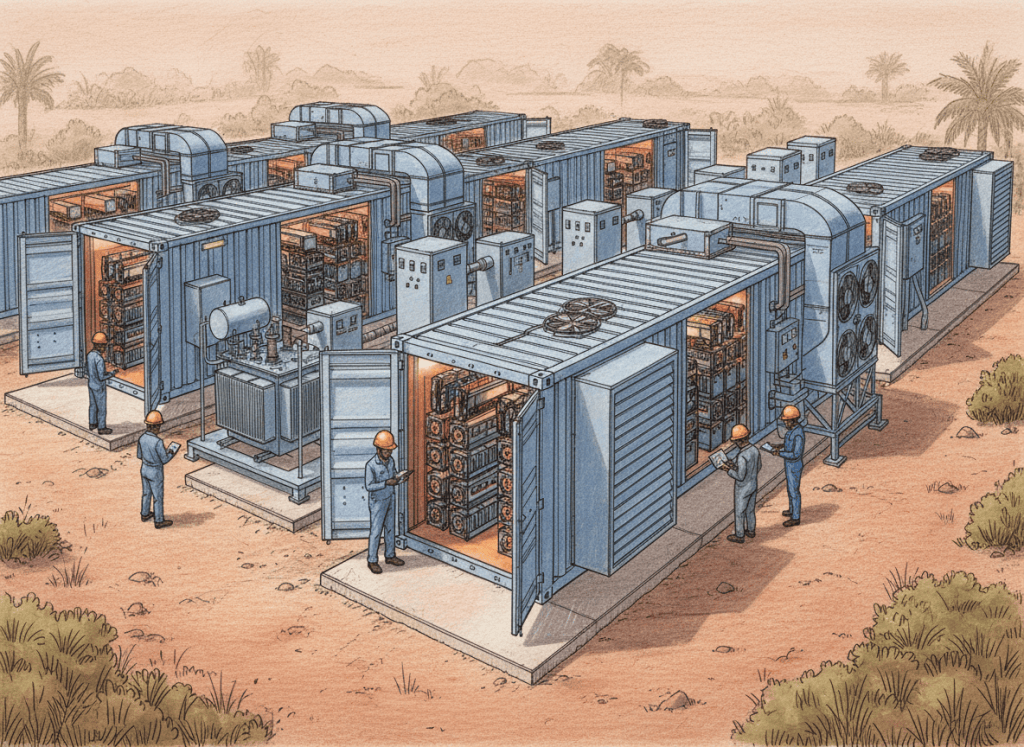
TerraHex has ordered air-cooled 40-foot mobile data-center containers from Belgian manufacturer Datacubes. Each unit can hold as many as 356 miners and supports up to 1.3 MW of electrical installation capacity. Medium-voltage and low-voltage equipment is also on order for the Nigerian deployment.
At this scale, ASIC performance depends on the infrastructure surrounding the machines. Transformers, switchgear, protection systems, conductor capacity and voltage stability determine whether power can be delivered reliably. Air-cooled containers must maintain adequate intake airflow while preventing hot exhaust from recirculating into miner inlets. Dust filtration introduces another engineering tradeoff because restrictive filters can increase pressure drop as they load with particles.
Those fundamentals matter because manufacturer hashrate and J/TH ratings do not by themselves describe facility performance. Total wall power includes conversion losses, fans, networking and other auxiliary loads, while temperature, downtime and rejected shares can reduce productive pool hashrate.
Bitcoin Mining Is the First Workload
TerraHex is building the project around underutilized energy generation. Its Power-for-Equity model pairs modular computing infrastructure with energy operators that have residual power capacity, using Bitcoin mining as the first commercial computing workload.
The company says it eventually intends to expand into AI computing and targets more than 100 MW of computing capacity in Nigeria over the following 24 months. Those figures are company plans rather than commissioned capacity. The first 9 MW node remains in deployment, with hardware preparation, container delivery, electrical installation and commissioning still required before operating performance can be measured.
The project is notable because it combines ASIC supply, pre-deployment hardware QA, modular data-center design and power infrastructure in one build. If the December launch proceeds as planned, the more meaningful operational measurements will include sustained accepted hashrate, total facility power, uptime, thermal performance and maintenance requirements under Nigerian environmental conditions.
Sources
- TerraHex Digital
- Business Post Nigeria: TerraHex Secures First Batch of Bitcoin Mining Machines for Nigeria
- TechCabal: TerraHex wants to build Bitcoin mines around Nigeria’s stranded power
BitcoinVersus.Tech Editor’s Note:
We volunteer daily to ensure the credibility of the information on this platform is Verifiably True. If you would like to support to help further secure the integrity of our research initiatives, please donate here: 3C9o19EH5HSiwEPyCTmEKzxhNCbo2X6TTb
Follow BitcoinVersus.Tech on X.
Financial Disclaimer: BitcoinVersus.Tech provides information for educational and informational purposes only. Nothing published here constitutes financial, investment, legal or tax advice. Readers should conduct independent research and consult qualified professionals before making financial decisions.


Leave a Reply