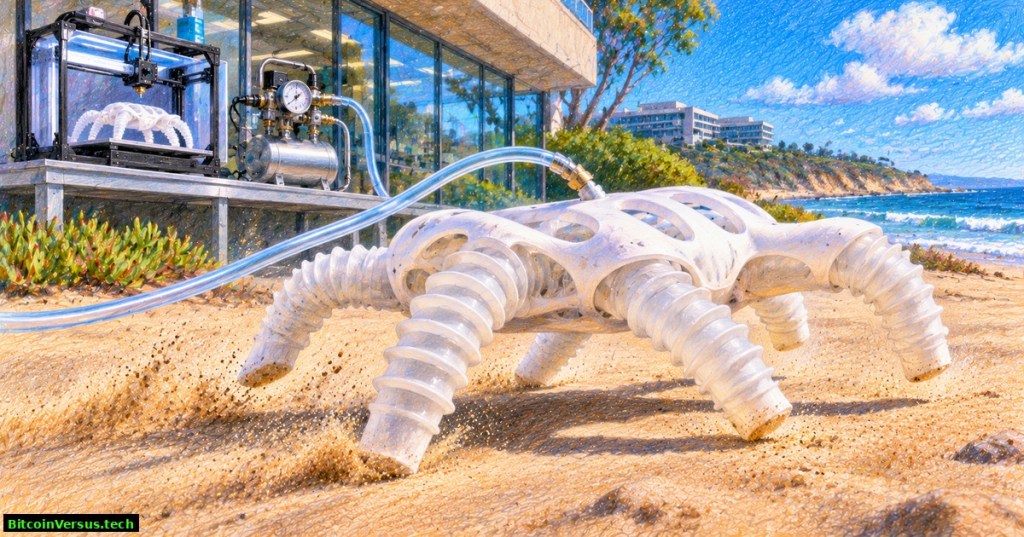
A six-legged robot made from a single soft material can sprint at 4.72 meters per second without an onboard electronic controller. Engineers at the University of California San Diego announced the result on November 18, 2026, describing what they say is the fastest robot made entirely from soft materials. Its secret is not a miniature electric motor. A cleverly arranged pneumatic circuit turns compressed air into repeating leg movements.
The researchers, led by Yichen Zhai and Michael T. Tolley, reported their findings in the November 18 issue of Science Robotics. The prototype was made in one 3D-printing process from a single flexible material, with internal channels, valves and mechanical structures printed together. It remains a laboratory experiment, not a commercially available autonomous robot.
Video distributed with UC San Diego’s November 18, 2026 research release. The university demonstrates the current six-legged, air-powered robot moving on different surfaces.
From a slow walker to a 4.72 m/s runner
The team’s earlier air-powered soft robot, developed in 2022 and described in a 2025 publication, moved at about 4 centimeters per second, equivalent to 0.04 m/s. The new system’s reported maximum is 4.72 m/s. Dividing 4.72 by 0.04 gives 118 times the earlier speed. The comparison concerns two experimental designs and their reported peak speeds, not identical trials measuring battery life, cargo capacity or continuous operation.
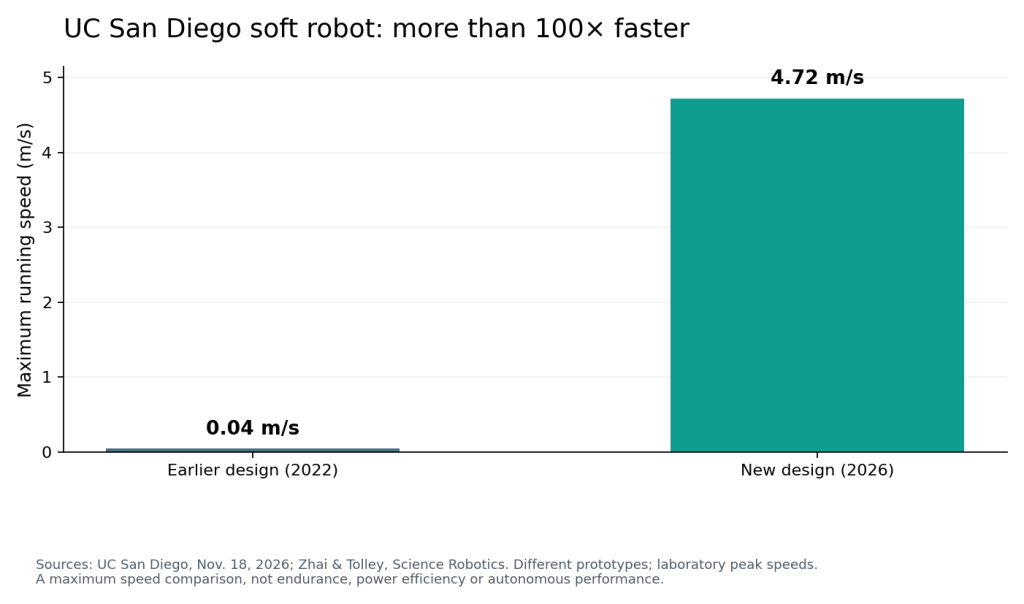
The speed improvement comes from accepting higher air pressures and volumes, then making better use of the pressure instead of venting valuable energy after each cycle. The team drew inspiration from compound steam engines, which expand working fluid through more than one stage.
How it moves without a computer
Inside the robot, compressed air passes through an oscillator containing chambers, valves and tubes. Small high-pressure chambers drive the valves; larger low-pressure chambers subsequently drive the legs. Alternating air flows generate a repeated gait. The mechanism effectively performs the timing function that a microcontroller and electromechanical actuators would ordinarily provide.
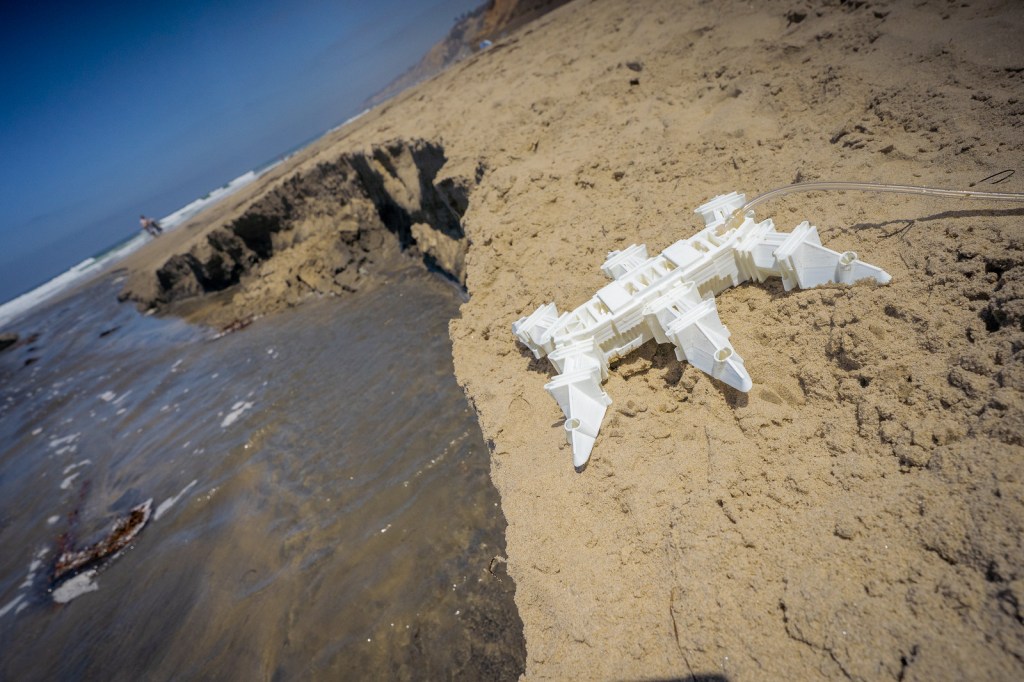
The university reports successful movement across concrete, gravel, grass, mulch and sand. The robot also descended stairs and demonstrated motion in and under water. Those experiments establish versatility in selected conditions, but no published result establishes unattended navigation through a disaster zone or prolonged operation without a tether.
UC San Diego Jacobs School of Engineering archival video about its earlier electronics-free, 3D-printed walking robot. It illustrates the research lineage rather than the new 2026 speed benchmark.
A major limitation: it still needs a hose
The phrase “no electronics” is accurate for the robot’s onboard controls, not for an entire operating setup. The 2026 design is powered by an external compressed-air source, typically connected through a hose. Supplying and storing sufficient air remains an engineering hurdle. The researchers want to reduce air consumption and investigate a portable cartridge, while improving steering and manipulation capabilities.
Comparable robotics research has taken different routes. MIT’s tiny flying robot uses onboard electronics but still requires external power, while Boston Dynamics tested motor control with a wheeled Atlas setup. Neither is directly comparable to the air-powered soft hexapod.
Manufacturing is another distinction. UC San Diego combines pneumatic actuators and timing valves inside a single print. Related advances in faster 3D printing of complex structures and underwater robot designs show how materials and mechanisms can sometimes simplify tasks usually assigned to electronic control systems.
What the research could lead to
The absence of onboard electronics could prove useful where radiation, strong magnetic fields, contamination or harsh environmental conditions complicate conventional machines. Potential applications include specialized reconnaissance and scientific exploration. Those uses remain proposed, with substantial work needed on air supply, maneuverability, payload, durability and repeatability.
UC San Diego has also released experimental measurements and downloadable CAD files through Dryad. That makes the claimed mechanism and speed easier for other researchers to inspect and reproduce. The immediate achievement is a rapid air-powered gait in a fully soft printed machine, rather than a new independent field robot.
Primary research and original media
- UC San Diego, November 18, 2026: official research announcement and photo gallery
- Yichen Zhai and Michael T. Tolley, Printing powerful soft robots on a desktop, Science Robotics (2026), DOI 10.1126/scirobotics.aei1264
- UC San Diego research data and CAD designs, Dryad, October 30, 2026
- UC San Diego Jacobs School of Engineering: original 2026 photo gallery
- UC San Diego, earlier electronics-free soft robotics research
Editor’s Note: We volunteer daily to ensure the credibility of the information on our platform is Verifiably True. If you would like to support our work and the integrity of our research initiatives, scan the QR code below to donate 5,000 sats.

For mobile scanning, open the article on another display and scan the QR code with a Bitcoin wallet. Verify receiving address 3C9o19EH5HSiwEPyCTmEKzxhNCbo2X6TTb before sending.
BitcoinVersus.Tech publishes technology, science and engineering journalism for informational purposes and does not provide financial, investment, legal, medical or professional engineering advice.


Leave a Reply