Cornell University researchers have built a thermal interface from thousands of upright polymer fibers, producing a laboratory result with implications for electronic cooling. In a simulated chip-to-heat-sink experiment at roughly 1.2 watts of heating, their epoxy-based fiber assembly held the heated surface 17°C cooler than a commercial ceramic-filled silicone pad. The finding, announced November 18, 2026, is a laboratory demonstration rather than a shipping processor cooler.
Cover photograph: an authentic scanning-electron micrograph of melt-electrospun polymer fibers by Daltster / Wikimedia Commons, CC BY-SA 3.0. Used unmodified under the original open license. The fibers photographed are not the Zylon samples studied by Cornell; the image is representative of polymer microstructures.
How a polymer forest carries heat
A thermal interface material fills microscopic gaps between a hot chip package and its heat spreader. Air trapped in those gaps conducts heat poorly. Metals can transfer heat effectively but can introduce electrical-conduction risks, while many soft insulating polymers sacrifice thermal conductivity. Cornell’s design aims to combine directional heat transfer with electrical insulation and a matrix chosen for mechanical fit.
Doctoral researcher Gangchen Ren and colleagues packed Zylon polymer fibers into a mold, added a surrounding polymer, and rotated the hardened assembly so the fibers stood perpendicular to the heated surface. The densely packed fibers act as parallel paths for energy to move through the interface thickness. Orientation matters: thermal conductivity along an aligned fiber need not equal conductivity across a random polymer network.
The researchers produced one version with an epoxy matrix and another with polydimethylsiloxane, or PDMS, a softer silicone-like material. Softer pads can better follow uneven surfaces, potentially lowering contact resistance, although sample-level conductivity and actual contact performance are separate measurements. Similar distinctions appear in semiconductor materials engineering, where mechanical, thermal, and manufacturing properties must be evaluated together.
What the measurements actually show
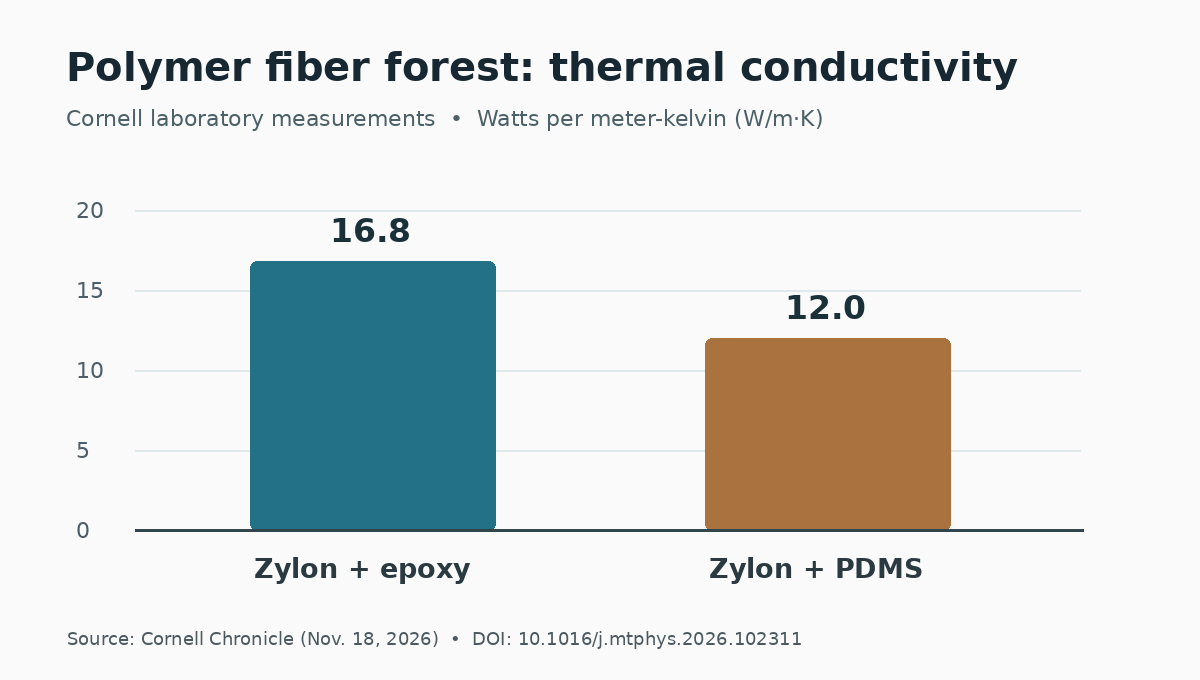
The Cornell team reported thermal conductivity of 16.8 W/(m·K) for Zylon with epoxy and 12.0 W/(m·K) for Zylon with PDMS. The epoxy sample’s conductivity was 40% higher in that direct comparison: (16.8 − 12.0) ÷ 12.0 = 0.40. Both values are measurements of laboratory material samples; the comparison does not establish a 40% improvement in server cooling efficiency.
For the separate simulated-chip test, the epoxy-based design lowered the heated-surface temperature by 17°C relative to the commercial pad under approximately 1.2 W input. Temperature difference is not a measure of energy saved, and the test conditions cannot be transferred directly to a 300 W processor, a kilowatt-class accelerator, or a mining hashboard. The peer-reviewed article, “Polymer Fiber Forest: A Scalable and Tunable Platform for Advanced Thermal Interface Materials,” provides the technical research record.
What engineers must validate next
Commercial relevance depends on more than peak conductivity. Repeated thermal cycling, compressive force, thickness uniformity, fiber-to-matrix adhesion, contamination, cost, and manufacturability could change performance after installation. A useful qualification program would compare equal-thickness interfaces at matching contact pressure and report thermal resistance in K/W, not merely bulk conductivity in W/(m·K). Thermal-cycling research illustrates why an impressive initial result does not automatically establish long-term reliability.
For data-center operators and Bitcoin miners, improved interfaces could eventually reduce local hot spots or cooling demands, but Cornell reported no ASIC hash rate, J/TH figure, rack PUE, or system-level electricity savings. A cooler chip need not compute with fewer joules unless operation, leakage, throttling, or cooling equipment changes. Related questions arise in high-performance computing infrastructure and research on computing efficiency limits.
The credible near-term conclusion is narrower and more useful: Cornell demonstrated an architecture that moves heat through electrically insulating fibers and allows engineers to trade matrix stiffness against material conductivity. Whether it improves operating cost or hardware lifetime at industrial power density remains an open engineering question.
Primary sources: Cornell Chronicle, November 18, 2026; Materials Today Physics, DOI 10.1016/j.mtphys.2026.102311.
We volunteer daily to ensure the credibility of the information on this platform is Verifiably True. If you would like to support to help further secure the integrity of our research initiative, please scan the QR code below.



Leave a Reply