Industrial electricity procurement
General Motors announced on November 12, 2026, a renewable electricity arrangement covering Branch Solar and Lake Iris Solar in Michigan. NorthStar Clean Energy developed both projects, with GM as the principal customer through a virtual power purchase agreement. GM puts combined project investment at about $550 million and combined capacity at 300 MW. The automaker says 92% of that capacity is allocated to its arrangement.
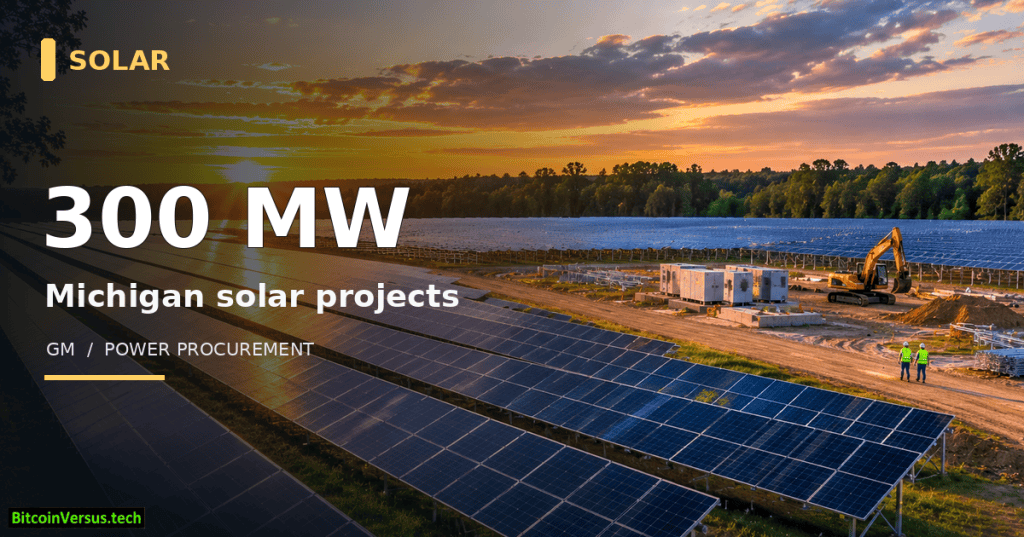
Featured cover: conceptual editorial illustration, not a photograph of the named project. Documentary and contextual images are identified in their captions.

A contract is not a dedicated power line
A virtual power purchase agreement is primarily a financial and environmental-attribute arrangement. An industrial customer can contract against a renewable generator’s electricity sales without receiving every electron from the installation directly through a dedicated line. Physical electricity continues to flow through the interconnected grid according to demand and network conditions. Contract settlement and renewable energy credits can help manage market exposure and account for renewable procurement, but annual matching differs from round-the-clock carbon-free supply.
Analyzing the projected energy
GM forecasts about 539,000 MWh of combined annual production. Dividing that estimate by 300 MW multiplied by 8,760 hours produces an implied capacity factor of approximately 20.5%. The same forecast equates to an average electrical output of about 61.5 MW across a year. Applying the 92% allocation mechanically yields 276 MW of capacity and roughly 496,000 MWh annually, assuming a proportional energy allocation. Those derived quantities are not separately reported measurements.
Why manufacturing loads matter
Automotive plants consume electricity across welding, robotics, machining, ventilation, lighting, conveyors and other processes. Production schedules and local grid conditions may create electricity demand when solar output is limited. Storage, flexible operations or other grid resources can help address mismatches between renewable generation and industrial demand. Contracted solar capacity is therefore only one component of a factory’s broader energy procurement and operational reliability strategy.
Capital costs and the next evidence
The stated combined investment equates to approximately $1.83 million per MW of announced capacity, without adjusting for financing, construction timing or the scope of costs. The developer’s operating data would allow a stronger assessment of annual output, degradation and availability. GM’s announcement associates the projects with Michigan industrial electricity use, but does not demonstrate that all manufacturing loads are supplied by solar power at every hour. The key distinction is between contracted annual energy, grid-delivered power and the physical reliability requirements of industrial facilities.
The investment announcement also illustrates how corporate electricity buyers can influence infrastructure financing. Long-term purchase commitments may provide a project developer with greater certainty about revenue, depending on the terms of the contract. The quoted investment amount should not be interpreted as a direct capital expenditure by GM without additional documentation. Actual electricity settlement prices, contracted volumes and the division of financial risk between the developer and customer would be necessary to calculate the arrangement’s economic value.
Sources and further reading
Fervo’s geothermal transmission rights | China’s 60 MW liquid-air battery | U.S. electricity generation mix | Utah’s 600 MWh battery
We volunteer daily to ensure the credibility of the information on this platform is Verifiably True. If you would like to support to help further secure the integrity of our research initiative, please scan the QR code below.

For mobile scanning, open the article on another display and scan the QR code with a Bitcoin wallet. The voluntary donation amount is 5,000 sats. Verify the receiving address 3C9o19EH5HSiwEPyCTmEKzxhNCbo2X6TTb before sending.
BitcoinVersus.tech is not a financial advisor. This media platform reports on financial subjects purely for informational purposes.


Leave a Reply