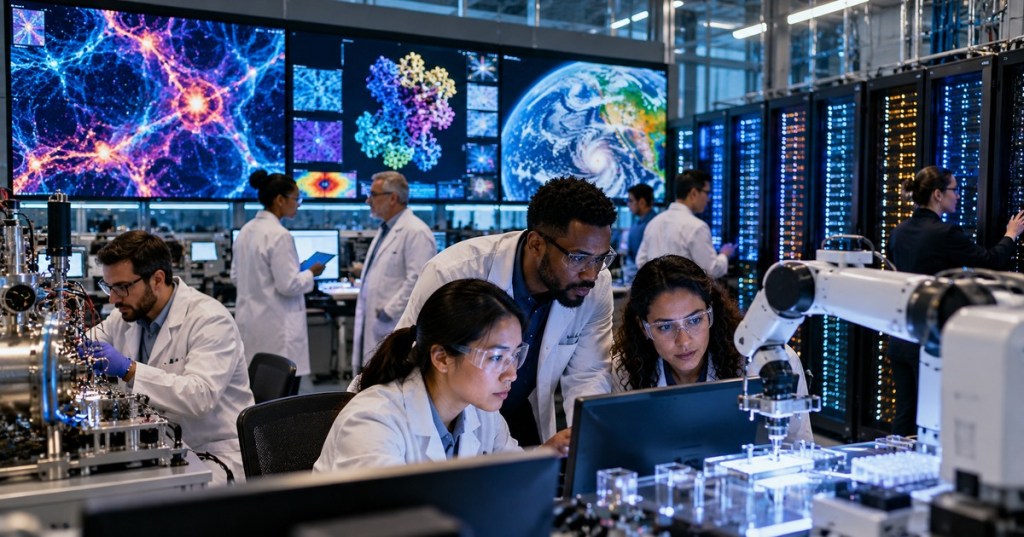
Eleven technology companies have pledged $2.4 billion in AI compute, models, and research tools for the U.S. Genesis Mission, with NVIDIA alone committing $1 billion. The goal is straightforward: give federal scientists access to the same class of computing infrastructure now driving the commercial AI boom.
The White House says the new industry commitments will support more than 15 federal agencies working on national science and technology challenges. NVIDIA accounts for $1 billion, AMD $500 million, OpenAI $200 million, Anthropic and Google $150 million each, AMP and Emerald AI $100 million each, and AWS, Armada, Crusoe, and Micron $50 million each.
The announcement came during the White House’s Science: A New Golden Age Summit broadcast on X. The important detail is that this is not simply another corporate investment round. Much of the value arrives as compute credits, AI models, software, and access to infrastructure that researchers can use directly.
NVIDIA and AMD are supplying the biggest shares
NVIDIA’s $1 billion pledge is the largest single contribution, followed by AMD at $500 million. That pairing reflects the same infrastructure competition BitcoinVersus previously examined in NVIDIA vs. AMD: Battle for AI Infrastructure Leadership. The difference here is that the contest is moving into public research, where the limiting resource is often not ideas but access to expensive accelerators, storage, networking, and software stacks.
AI research infrastructure has become enormously capital intensive. That trend was already visible when BlackRock and Microsoft launched a $30 billion AI infrastructure fund. Genesis applies the same basic reality to science: modern research increasingly depends on access to large-scale computing.
The money is being paired with real research projects
The compute pledges are landing alongside a new round of Department of Energy projects. Nextgov reports that DOE awarded $159 million to 12 Phase II Genesis Mission projects and added six Phase I projects, bringing the first-year portfolio to 297 teams across all 50 states.
Those projects span areas including fusion, advanced materials, microelectronics, biotechnology, energy systems, and quantum computing. The broader idea is to connect scientific instruments, national-lab supercomputers, AI models, and automated experiments so that researchers can move from hypothesis to simulation to physical testing with fewer manual handoffs.
That convergence is already showing up elsewhere. BitcoinVersus recently covered how IonQ connected a quantum computer to an NVIDIA AI supercomputer, an example of the same broader shift toward mixed computing systems rather than one machine doing everything.
What scientists actually gain
For a researcher, “compute credits” can mean access to GPU clusters that would otherwise be too expensive or too heavily booked. AI model access can mean using specialized systems to search scientific literature, generate candidate molecules, analyze microscope or telescope data, rank experiments, or help control automated laboratory equipment.
- More compute: larger simulations, model training runs, and data analysis jobs.
- Better tools: commercial and scientific AI models without every lab building its own stack from scratch.
- Faster experiment loops: tighter links between simulation, data analysis, robotics, and physical instruments.
- Shared infrastructure: researchers at agencies and universities can use systems that would be difficult to finance independently.
The real test is utilization
The headline number is large, but credits are not the same as cash already spent. Their value depends on whether scientists can actually schedule the hardware, move data into the systems, integrate instruments, and use the models productively. Expensive compute that sits behind technical, security, or procurement bottlenecks does not accelerate discovery.
That makes utilization the next metric to watch. If the Genesis Mission turns shared AI infrastructure into shorter experiment cycles, more validated discoveries, and working scientific tools, the $2.4 billion pledge could matter far beyond the headline. If researchers cannot get practical access, it becomes another impressive pool of nominal capacity.
Editor’s Note: Corporate commitments described here include compute credits, AI tools, models, and related resources. They should not be interpreted as $2.4 billion in cash transferred to the federal government.
Support independent technology reporting: Bitcoin donations help fund BitcoinVersus.Tech research and publishing.
Disclaimer: BitcoinVersus.Tech provides technology news and analysis for informational purposes only.


Leave a Reply