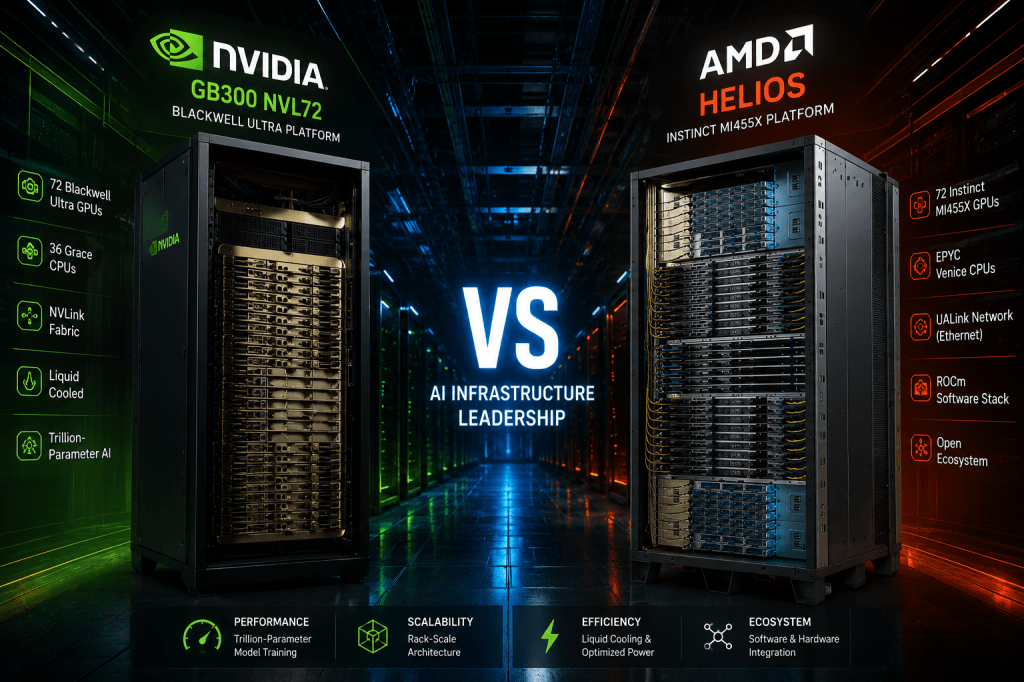
The race to build the world’s most powerful AI infrastructure has shifted beyond individual GPUs to complete rack-scale systems that integrate processors, networking, memory, and cooling into a single high-performance platform.
Rather than selling standalone accelerators, companies are now engineering entire AI racks capable of training trillion-parameter models and supporting the next generation of reasoning models and autonomous AI agents. This systems-level approach reduces latency, improves scalability, and maximizes performance per watt inside modern AI factories.
Today, three rack-scale platforms dominate the conversation. NVIDIA’s GB300 NVL72 remains the current production leader with 72 Blackwell Ultra GPUs, 36 Grace CPUs, liquid cooling, and NVLink connectivity linking every GPU into a unified computing fabric.
AMD Helios is the strongest challenger, combining 72 Instinct MI455X GPUs with EPYC Venice processors, UALink networking over Ethernet, and the ROCm software ecosystem.
Looking ahead, NVIDIA Vera Rubin NVL72 represents the company’s next-generation flagship, delivering higher memory bandwidth, improved reasoning performance, and greater token generation efficiency for advanced AI workloads.
Microsoft, Oracle, Meta, OpenAI, Google Cloud, and other hyperscale providers have announced deployments or partnerships around these next-generation platforms as the competition for AI infrastructure accelerates.
BitcoinVersus.Tech Editor’s Note:
We volunteer daily to ensure the credibility of the information on this platform is Verifiably True. If you would like to support to help further secure the integrity of our research initiatives, please donate here: 3C9o19EH5HSiwEPyCTmEKzxhNCbo2X6TTb
BitcoinVersus.tech is not a financial advisor. This media platform reports on financial subjects purely for informational purposes.


Leave a Reply