Load management has become one of the NBA’s most debated strategies as veteran stars and injury-prone players try to maximize postseason availability.
Instead of reacting to injuries after they happen, one alternative approach is to proactively rotate availability throughout the regular season. The goal is simple: reduce cumulative wear and tear while maintaining enough talent on the floor to remain competitive over 82 games.
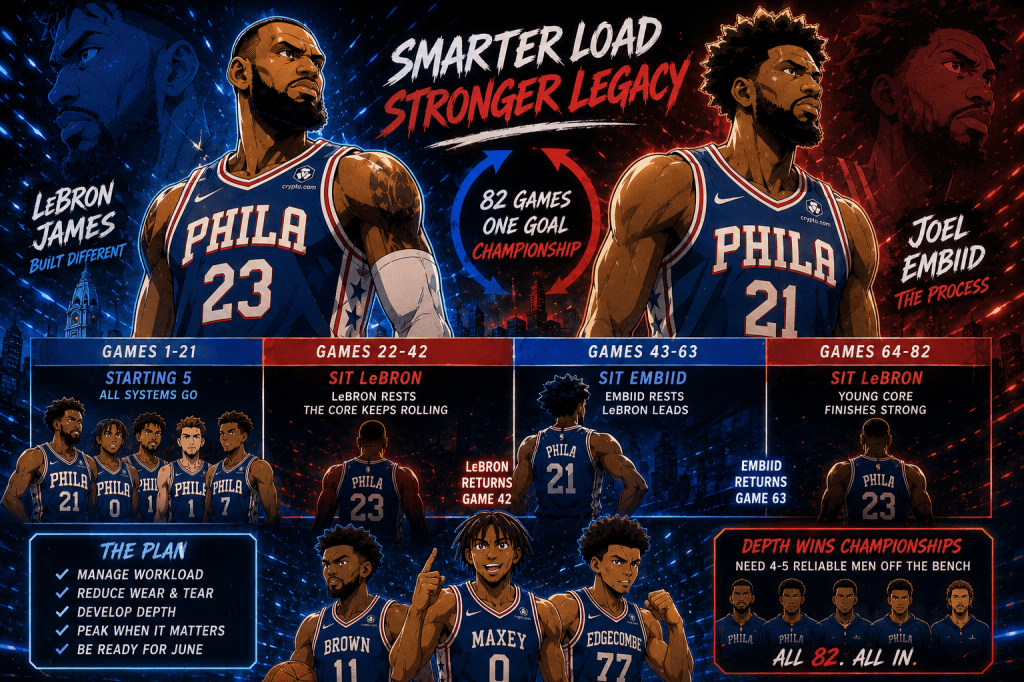
One hypothetical strategy would begin with the full starting lineup playing together for the first 21 games to establish chemistry. During the following 21 games, LeBron James would rest while the rest of the roster continues to play.
LeBron would then return around Game 42, while Joel Embiid would rest for the next 42-game stretch before returning around Game 63.
After Embiid’s return, LeBron would be shut down for the remainder of the regular season, allowing younger players such as Jaylen Brown, Tyrese Maxey, and VJ Edgecombe to carry more of the workload while the bench absorbs additional minutes.
This approach is designed around workload distribution rather than maximizing games played by every star simultaneously.
By intentionally reducing the number of high-impact minutes for aging or injury-sensitive players, the coaching staff could theoretically lower accumulated fatigue while developing bench depth. A deeper rotation could also prepare reserve players for larger postseason roles.
There are important limitations. Sports medicine cannot guarantee injury prevention, and no scheduling strategy can realistically promise a “100% injury prevention” outcome.
Injuries result from many factors including contact, biomechanics, conditioning, recovery, travel, and simple randomness. While reducing workload may decrease some injury risk, it cannot eliminate it entirely.
The biggest question would be competitive success.
Teams would need enough depth to survive extended absences from elite players without falling too far in the standings. If supported by strong bench production and careful minute restrictions, a structured rotation could potentially improve postseason freshness, but it would also require significant roster planning and player buy-in.
Ultimately, the effectiveness of such a system could only be evaluated through real-world implementation rather than theory alone.


Leave a Reply