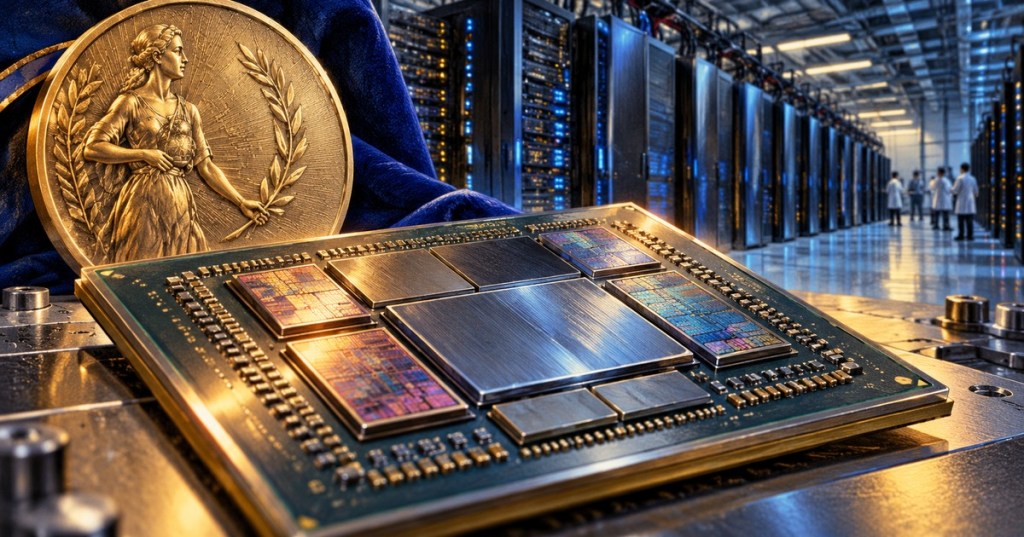
AMD CEO Lisa Su has received the National Medal of Science, with the White House specifically citing her leadership in processor architecture, chiplet-based integration and the computing technology behind the world’s first exascale supercomputer.
AMD Chair and CEO Dr. Lisa Su received the National Medal of Science on October 8, 2026, putting one of the semiconductor industry’s most consequential engineering leaders in a group of honorees that also included NVIDIA CEO Jensen Huang, Google co-founder Sergey Brin and Elon Musk. Michael Dell and Microsoft CEO Satya Nadella received the National Medal of Technology and Innovation at the same ceremony.
The important part for the semiconductor story is not simply that Su received a major national award. It is why she received it. The White House citation points directly to her lifetime of leadership in semiconductor engineering and high-performance computing, including advances in processor architecture and “chiplet-based integration,” and connects that work to the system that broke the exascale barrier.
Lisa Su reflected on receiving the National Medal of Science and on the path that brought her family and career to the United States.
The award is unusually specific about the engineering
Technology awards can sometimes be written in broad language about innovation or leadership. Su’s citation is much more technical. It identifies processor architecture, chiplet integration, high-performance computing and exascale performance as the core of the recognition. Those are not separate trends. They form a chain that explains how modern processors have continued scaling even as simply making one enormous monolithic die has become increasingly difficult and expensive.
BitcoinVersus.Tech’s older guide to x86, x64 and RISC CPU architectures provides the foundation: an instruction-set architecture defines the machine-language contract software targets, while the physical processor underneath can evolve dramatically from generation to generation. Chiplets extend that design freedom. Instead of requiring every function to live on one giant piece of silicon, designers can partition compute, I/O, cache and other functions across multiple dies and connect them inside one package.
That modular approach has become so important that the industry is now trying to standardize how dies communicate. BitcoinVersus.Tech recently covered AMD’s use of UCIe links in Versal RF for open chiplet architecture. UCIe is a different product context from the EPYC processors that helped establish AMD’s chiplet strategy, but the direction is related: packaging is increasingly becoming part of computer architecture rather than merely the final mechanical step after a chip is designed.
Frontier turned that architecture into an exascale machine
The exascale reference in Su’s medal citation points to Frontier at Oak Ridge National Laboratory. The Oak Ridge Leadership Computing Facility describes Frontier as the first exascale computing system. Its nodes combine optimized AMD EPYC processors with AMD Instinct MI250X accelerators inside an HPE Cray EX system, tying CPU architecture, GPU acceleration, packaging, memory and high-speed interconnects into one massive scientific instrument.
Exascale means a system can execute at least one quintillion floating-point operations per second on a benchmark used to measure supercomputing performance. The milestone matters because the jump is not achieved by adding one faster processor. It requires improvements across silicon efficiency, parallelism, memory movement, networking, software and power delivery. A processor that is impressive in isolation still has to operate as one element in a machine made of thousands of nodes.
The October 8 ceremony included Lisa Su among the National Medal of Science recipients.
Chiplets became a competitive weapon
AMD’s modern rise is often summarized as a CPU comeback, but that description misses the systems-engineering change underneath it. Chiplets allowed AMD to mix manufacturing choices, improve usable silicon yield and scale core counts without depending on a single giant die for every function. The technique does not eliminate difficult engineering. In many ways it moves more of the difficulty into packaging, interconnect design, latency management, thermal behavior and power delivery. But it gives architects another dimension in which to optimize a processor.
That history also helps explain why the company’s current competition with NVIDIA is bigger than a benchmark chart. In our look at AMD versus NVIDIA in AI infrastructure, the contest already extended across accelerators, CPUs, software and complete data-center platforms. The chip itself remains critical, but the commercial unit of competition is increasingly the rack, cluster and software stack.
The same shift can be seen in AMD’s Helios platform. HPE’s $1.2 billion Vultr order, covered in our report on AMD Helios AI racks, illustrates how processors are now sold as parts of much larger systems that have to solve networking, cooling and power problems at rack scale. That is one reason a medal citation focused on architecture and integration is especially relevant in 2026: the industry is moving toward more integration, not less.
The CPU side is still moving just as fast
AI has put GPUs and accelerators at the center of the semiconductor conversation, but general-purpose CPUs remain essential to data-center design. BitcoinVersus.Tech recently examined HPE’s next ProLiant generation built around 256-core AMD EPYC Venice and PCIe 6. Higher core counts, faster I/O and more capable host processors matter because accelerators still depend on the rest of the server to feed, schedule and move data efficiently.
That is also why it would be inaccurate to describe Su’s award as recognition for a single invention. Modern semiconductor progress is cumulative and collaborative. Processor architects, circuit designers, packaging engineers, foundry teams, software developers, system builders and researchers all contribute to the final machine. The medal instead recognizes a career of technical leadership through several generations of those changes.
A career recognition that lands during an AI infrastructure race
AMD’s own announcement of the award notes that Su is an electrical engineer with bachelor’s, master’s and doctoral degrees from MIT, has published more than 40 technical articles and is an IEEE Fellow. She joined AMD in 2012 and became CEO in 2014, years before the current AI infrastructure boom made accelerator roadmaps and data-center power constraints mainstream business topics.
That timing gives the award a useful perspective. Today, semiconductor companies are racing to build entire AI platforms, but the enabling technologies were developed over many product cycles. The current market for enormous accelerator clusters depends on ideas that matured earlier: modular processors, advanced packaging, coherent high-speed links, dense memory systems, efficient CPUs and software capable of orchestrating parallel hardware.
For BitcoinVersus.Tech, this is where older archive material becomes especially valuable. A 2025 architecture explainer, a 2026 chiplet-interface story and today’s AI-rack coverage are not disconnected posts. They describe different layers of the same computing transition. Su’s National Medal of Science gives us a useful point to connect those layers.
What to watch next
The next phase will test whether AMD can carry the architectural strengths that helped revive its CPU business into a broader AI systems business. That means continuing to scale EPYC CPUs, Instinct accelerators, memory bandwidth, rack-level integration and software while competing against NVIDIA’s tightly integrated ecosystem and a growing field of custom accelerators.
For engineers, the deeper lesson is that packaging is no longer peripheral. Chiplets, die-to-die links, advanced interposers and heterogeneous integration increasingly determine what can be built within practical limits of yield, power, latency and cost. The National Medal of Science awarded to Lisa Su is therefore more than a career marker. It is recognition of an architectural transition that is still reshaping CPUs, supercomputers and AI data centers right now.


Leave a Reply