
The world’s fastest computers are now firmly in the exascale era. BitcoinVersus.Tech ranked the current top seven using the June 2026 TOP500 results and the measured High Performance Linpack, or HPL, Rmax score—not theoretical peak performance.
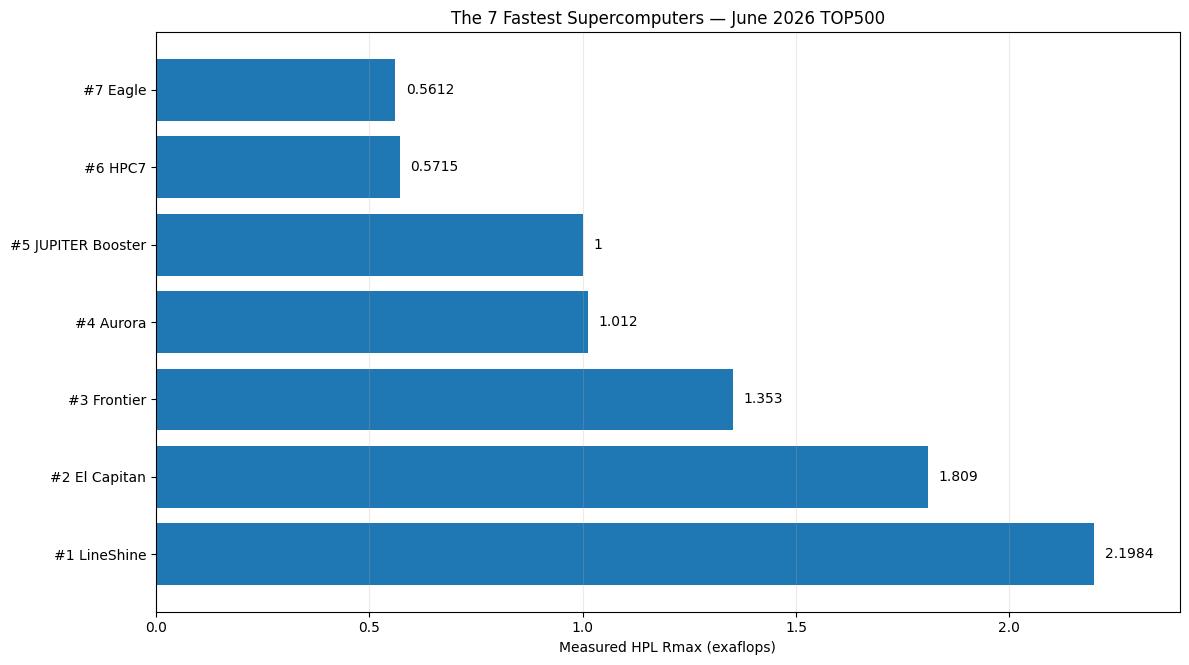
The comparison uses sustained HPL Rmax. One exaflop equals one quintillion floating-point operations per second.
#7 — Eagle
561.2 petaflops. Microsoft Azure’s Eagle is unusual because it is cloud infrastructure rather than a traditional national-lab machine. The NDv5 system combines Intel Xeon Platinum processors with NVIDIA H100 GPUs and NVIDIA InfiniBand. The same H100 generation also appears throughout our Top 7 AI Accelerators ranking.
Microsoft Azure and NVIDIA discuss the H100 cloud infrastructure family that underpins Eagle’s NDv5 architecture.
#6 — HPC7
571.5 petaflops. Eni’s new HPC7 is the highest-ranked industrial supercomputer on the list. Installed at Eni’s Green Data Center in Italy, it uses AMD Instinct MI300A accelerated processors, HPE Cray infrastructure and direct liquid cooling. Eni says HPC7 and HPC6 together exceed one exaflop of sustained computing capacity.
A video made in collaboration with Eni tours the company’s Green Data Center and HPC6, the immediate predecessor infrastructure that HPC7 now expands at the same supercomputing campus.
#5 — JUPITER Booster
1.000 exaflop. Germany’s JUPITER Booster is Europe’s first full exascale-class system. Its accelerator module uses NVIDIA GH200 Grace Hopper Superchips inside Eviden BullSequana XH3000 infrastructure. BitcoinVersus.Tech previously covered the Rhea1 processors entering JUPITER’s broader architecture.
Forschungszentrum Jülich breaks down JUPITER’s architecture and its path to exascale computing.
#4 — Aurora
1.012 exaflops. Aurora at Argonne National Laboratory combines Intel Xeon CPU Max processors with Intel Data Center GPU Max accelerators. Its 9.26 million cores support simulation, AI and data-analysis workloads ranging from fusion energy to materials research.
Argonne National Laboratory explains how Aurora combines exascale simulation with AI and large-scale scientific data analysis.
#3 — Frontier
1.353 exaflops. Oak Ridge National Laboratory’s Frontier was the first officially ranked exascale system. It pairs AMD EPYC CPUs with AMD Instinct MI250X accelerators over HPE’s Slingshot interconnect. Its role in the exascale era also connects directly with our coverage of AMD CEO Lisa Su’s work in chiplets and exascale computing.
Oak Ridge National Laboratory introduces Frontier and the science enabled by the first officially ranked exascale supercomputer.
#2 — El Capitan
1.809 exaflops. Lawrence Livermore National Laboratory’s El Capitan uses AMD 4th-generation EPYC CPUs and Instinct MI300A accelerators in an HPE Cray EX255a system. It remains one of the most powerful computers ever built and is dedicated primarily to U.S. national-security simulation work.
HPE and Lawrence Livermore explain the architecture and scientific role of El Capitan.
#1 — LineShine
2.1984 exaflops. China’s LineShine debuted at No. 1 in June 2026 and became the first TOP500 system to sustain more than two exaflops on HPL. Unlike most of its closest rivals, it is CPU-only: roughly 13.8 million cores built around custom 304-core LX2 processors and the proprietary LingQi interconnect. Nature described the system as a major shift toward architectures that blend conventional scientific computing with AI-oriented acceleration.
An English explainer examines LineShine’s CPU-only exascale architecture and its move to the top of the global ranking.
What this ranking really measures
TOP500 measures double-precision Linpack performance, so this is a ranking of sustained scientific-computing throughput—not necessarily AI training speed. That distinction matters: Eagle, JUPITER and several other systems are heavily GPU-accelerated, while LineShine reaches No. 1 using a very different CPU-centered architecture.
Bottom line: the supercomputer race is no longer built around one chip strategy. The current top seven includes AMD, Intel and NVIDIA accelerators, custom Chinese CPUs, cloud infrastructure, national laboratories and industrial computing. What they share is a system-level obsession with memory bandwidth, interconnects, cooling and power efficiency.
BitcoinVersus.Tech Editor’s Note:
We volunteer daily to ensure the credibility of the information on this platform is Verifiably True. If you would like to support to help further secure the integrity of our research initiatives, please donate using the QR code provided

For best QR-code scanning results, please scan this donation code from a desktop or larger screen. Mobile screens may prevent camera recognition.


Leave a Reply