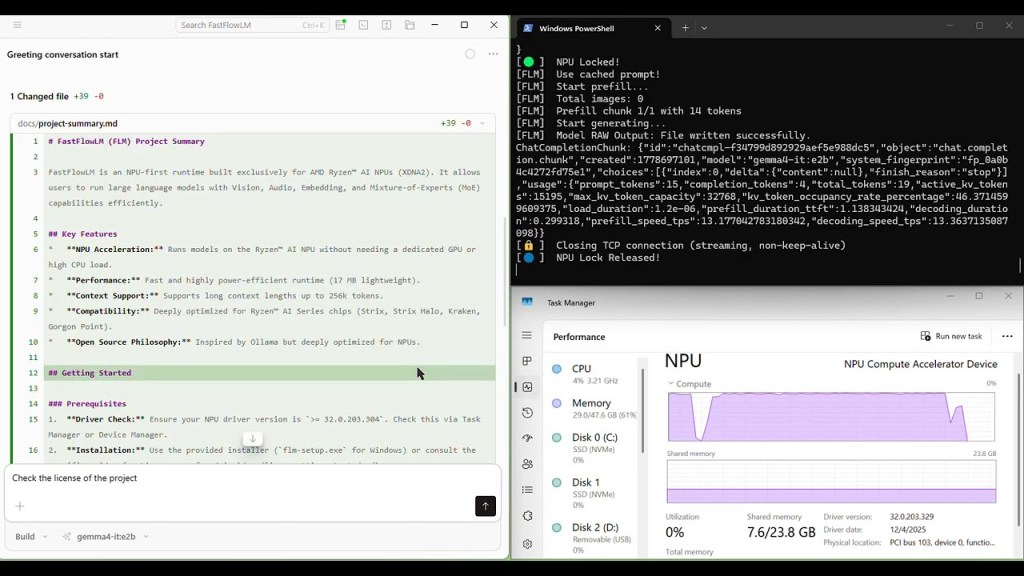
AMD is widening the hardware options for people who run artificial intelligence models on their own computers. FastFlowLM version 1.0.13, released November 13, adds an early-access integrated graphics processor (iGPU) execution path alongside its existing neural processing unit (NPU) support. AMD described the software update in a November 19 engineering article. The change lets compatible Ryzen AI systems expose both accelerator types through a common local interface.
Background: FastFlowLM’s earlier Linux NPU demonstration illustrates the existing execution path, not the new Windows GPU backend.
One interface, different execution engines
A GPU and an NPU perform mathematical operations using different hardware designs. A GPU offers flexible parallel execution for a wide range of workloads, whereas an NPU specializes in neural-network computation. Model operators must be supported by the software and hardware combination before either device can execute them efficiently.
FastFlow separates hardware execution from application-facing services. Developers can retain their existing local chat interface while selecting a compatible model variant for the accelerator. AMD’s new backend relies on HIP EP, an execution provider for ONNX Runtime. Its compilation and kernel layers translate model operations into work suitable for AMD graphics hardware. The FastFlowLM repository provides the implementation and installation resources.
What AMD measured
AMD reports that its November 10 HIP EP build reduced the time needed to begin returning generated text by 43% relative to llama.cpp using Vulkan, while generation throughput improved by 7%. The comparison used a 16K-token context on a Ryzen AI Max system. Normalizing the baseline to one gives relative latency of 0.57 and relative throughput of 1.07. The results concern HIP EP, not a complete independent benchmark of FastFlowLM.
Prompt processing and text generation stress hardware differently. A faster initial response can improve an interactive assistant even when the subsequent generation rate changes only modestly. Neither figure establishes a power-efficiency advantage. Measuring energy per token would require recording energy consumption across comparable requests, with consistent model weights, quantization, output lengths and system boundaries.
Background: FastFlowLM demonstrates long-context processing on an NPU in an earlier experiment. It is not evidence for the GPU performance figures.
Where the new backend fits
The GPU path initially targets supported Windows 11 systems. AMD notes that a compatible NPU must still be present in the computer even when the GPU performs inference. Consequently, the announcement should not be interpreted as universal support for older Radeon graphics cards or every AMD-powered computer. Model availability, drivers and memory capacity remain deployment constraints.
Local applications also compete for system resources. Integrated graphics share memory resources with other components, so model size, attention-cache growth and concurrent workloads can affect responsiveness. Our coverage of GPU memory monitoring, LocalAI, llama.cpp and Google’s XLA Serving Engine explores related layers of the inference stack.
The value of FastFlow’s expanded device support is architectural rather than a promise of universal speed. A shared application interface allows developers to evaluate alternative accelerators without rebuilding the surrounding application. The early-access release creates an opportunity to compare responsiveness, memory pressure and energy consumption on actual laptops. Independent testing remains necessary before drawing broader conclusions about which device is most efficient.
Featured media: FastFlowLM’s May 2026 NPU demonstration; an earlier example, not a GPU benchmark. Video source links are supplied for direct viewing.
We volunteer daily to ensure the credibility of the information on this platform is Verifiably True. If you would like to support to help further secure the integrity of our research initiative, please scan the QR code below.



Leave a Reply