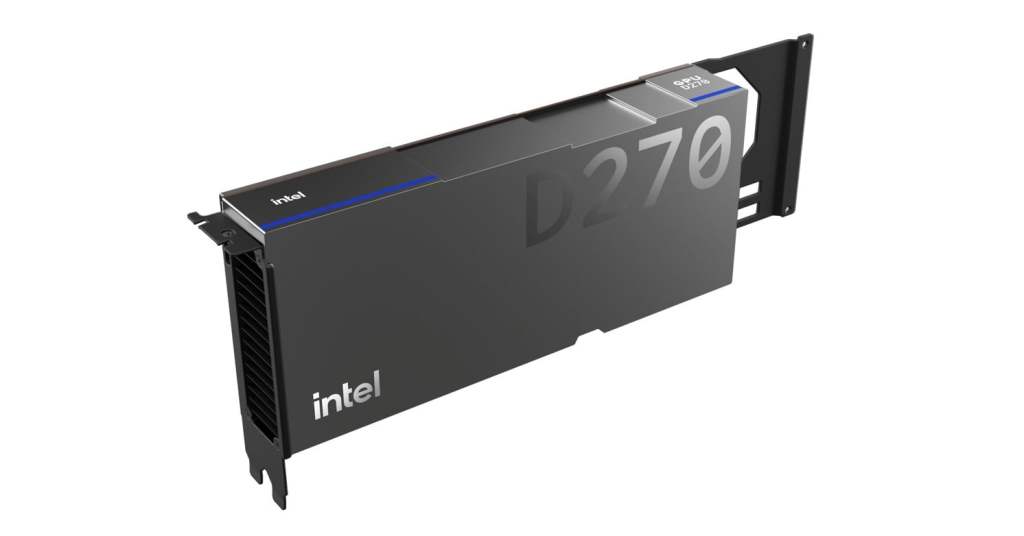
Intel’s 160 GB D270 server accelerator is entering the high-performance computing conversation with a set of workload-specific performance claims. On November 16, during SC26 in Chicago, Intel published financial-modeling and AI inference comparisons against NVIDIA’s RTX PRO 6000 Blackwell Server Edition. The new results extend our October coverage of Crescent Island’s memory architecture with application-level tests rather than another product announcement.
Cover image: Intel D270 product rendering, via StorageReview. It is not a photograph of the benchmark system.
Where Intel claims a performance advantage
| FP64 financial workload | Intel D270 | NVIDIA baseline |
|---|---|---|
| European Monte Carlo | 5.9× | 1.0× |
| European Black-Scholes | 5.6× | 1.0× |
| Binomial pricing | 4.6× | 1.0× |
| American Monte Carlo | 1.92× | 1.0× |
The largest reported advantage comes from European Monte Carlo option pricing, which repeatedly evaluates randomized scenarios. The remaining results demonstrate that gains vary by algorithm. Intel’s November 17 correction identifies the fourth workload as American Monte Carlo, rather than American Black-Scholes. The corrected appendix specifies one active accelerator per comparison, although the host processors, memory configurations and software stacks differ.
Double-precision floating point, or FP64, reduces rounding error compared with lower-precision formats. It matters in calculations where numerical error can accumulate. Intel’s Xe3P architecture includes native full-rate FP64 execution, while lower-precision operations support neural-network inference. A large memory allocation alone does not explain the financial results; arithmetic throughput, kernel implementation and data reuse also matter.
Company context: Intel CEO Lip-Bu Tan on Saving Intel and Catching TSMC. Gavin Baker interviews Tan at the TomorrowX Summit, uploaded November 21, 2026 by iConnections. The English-language conversation covers Intel’s broader strategy; it is not independent validation of the D270 benchmarks.
Memory capacity versus bandwidth
The D270’s standard 160 GB of LPDDR5X exceeds the NVIDIA card’s 96 GB of GDDR7 by 64 GB, or 66.7%. However, Intel specifies 1.5 TB/s of memory bandwidth compared with NVIDIA’s 1.6 TB/s. Intel therefore offers greater capacity but 6.25% less peak bandwidth. A model that fits entirely on the larger card may avoid transfers or partitioning; a workload that already fits on both cards can instead be constrained by bandwidth or arithmetic execution.
For example, 60 billion parameters at an idealized two bytes each require 120 GB before accounting for runtime allocations, attention caches and other overhead. Such a model exceeds 96 GB of nominal memory but may fit within 160 GB. Actual model placement depends on precision, implementation and available memory.
Power ratings are not energy measurements
Intel specifies a 350 W air-cooled PCIe card; NVIDIA lists a maximum of 600 W for the comparison GPU. Eight cards at their respective ratings imply 2.8 kW versus 4.8 kW of GPU-only capacity, excluding servers, networking and cooling. That 2 kW difference is a planning calculation, not a measured saving. Establishing joules per completed workload requires time-integrated power readings under matched conditions.
AI inference and the limits of comparison
Intel separately reports 29% lower latency on Drex 2.0 and 1.12× output-token throughput on Qwen3-30B-A3B FP8. Its NVIDIA inference environment used an Amazon EC2 virtual machine, while the D270 ran on a different host and software stack. Independent reproduction on production hardware is needed. Other Blackwell products, including the B300, have different memory and compute specifications.
Related coverage: B300 deployments, GPU memory monitoring and AMD’s alternative inference execution paths. The D270’s potential is strongest where precision and memory residency determine application performance, rather than where a single benchmark is assumed to represent every GPU workload.
We volunteer daily to ensure the credibility of the information on this platform is Verifiably True. If you would like to support to help further secure the integrity of our research initiative, please scan the QR code below.



Leave a Reply