
Qualcomm published a deeper look at its Dragonwing IQ-2390 and Q-2390 processors on November 19, explaining how a compact computing platform can combine application software, local AI inference and real-time control. The two chips were originally announced on September 1, 2026. Their architectural significance lies in integrating capabilities normally distributed across several components in industrial and commercial equipment.
A factory controller, for example, may need to display operating conditions, analyze camera images, communicate with equipment and respond predictably to a sensor. These tasks place different demands on computing hardware. Combining them on one platform can simplify board design, although engineers must still verify timing, reliability and isolation. Featured product artwork is credited to Qualcomm Technologies.
An Arm CPU alongside a RISC-V controller
The industrial IQ-2390 specifications identify one Cortex-A78 core and three Cortex-A55 cores, with CPU frequency reaching 1.9 GHz. A separate RISC-V microcontroller serves real-time workloads. Graphics processing uses the Adreno 704, while Qualcomm Hexagon hardware provides dedicated inference capability rated at 1.1 TOPS.
The combination illustrates heterogeneous computing: rather than asking a general-purpose CPU to handle every operation, dedicated engines perform particular classes of work. Linux can host an operator interface and application logic while a real-time operating system manages time-critical functions on the microcontroller. Support for multiple operating systems does not, by itself, demonstrate that any particular application meets a hard deadline.
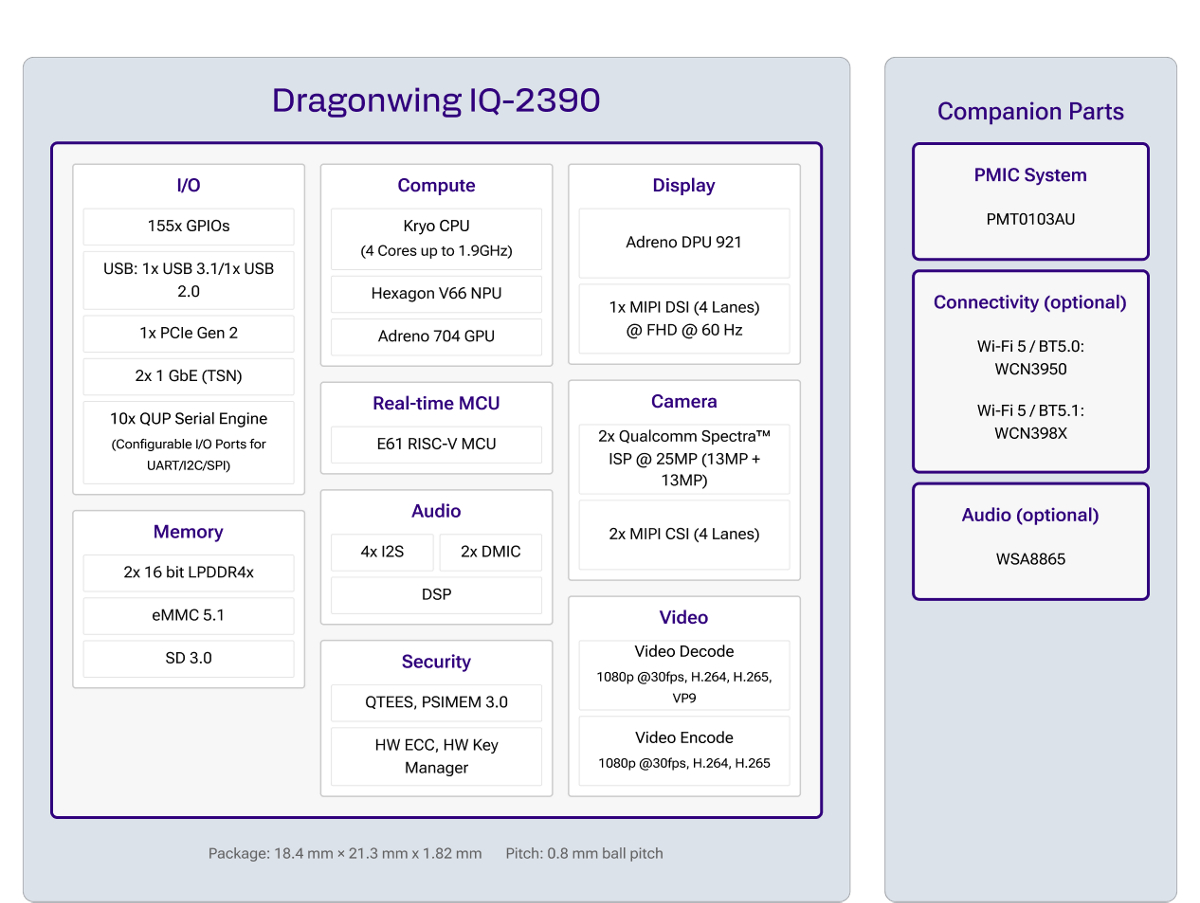
Networking and industrial reliability
The industrial processor has two gigabit Ethernet interfaces supporting Time-Sensitive Networking (TSN). Conventional Ethernet traffic may experience variable delay when links become congested. TSN incorporates mechanisms that help engineers manage timing and traffic priority across compatible equipment. Predictable delivery requires configuration and validation across the entire network, not merely a capable processor.
Qualcomm specifies an operating range from −30°C to 115°C for the IQ-2390, error-correcting memory protection and a ten-year product longevity commitment. Component availability matters for industrial equipment because replacing a processor can require board revisions, software changes and renewed product qualification. A longevity commitment does not guarantee that every finished device will operate continuously for a decade.
A related chip for commercial devices
The November architecture update describes the Q-2390 as a commercial alternative, with optional cellular connectivity on the Q-2390M variant and features suited to kiosks, access panels and appliances. Qualcomm claims roughly 25% higher CPU performance in DMIPS and 10% higher GPU performance compared with the Q-2290. Those vendor comparisons do not establish equivalent improvements for every application.
Related BitcoinVersus.Tech reporting explores custom RISC-V instructions, Arm vector processing, radiation-tolerant programmable processors and Ambarella edge inference.
The September announcement, also covered by Computer Weekly, anticipated evaluation kits in early 2027. Independent workload latency, system power, thermal behavior and production availability remain important questions for engineers selecting either platform. Peak inference capacity is not a measured system-level energy-efficiency result.
We volunteer daily to ensure the credibility of the information on this platform is Verifiably True. If you would like to support to help further secure the integrity of our research initiative, please scan the QR code below.



Leave a Reply