Efinix introduced its Sapphire RV64 processor design on September 28, 2026, expanding the computing capabilities available inside field-programmable gate arrays (FPGAs). The new system-on-chip is a configurable 64-bit RISC-V soft core rather than a separately manufactured CPU package. Engineers can implement the processor using programmable logic and place application-specific circuitry alongside it on the same FPGA.
The launch announcement targets applications that need greater memory capacity and software flexibility than earlier 32-bit embedded designs. Machine vision, communications and local AI are among the relevant markets. Featured conceptual artwork is credited to Efinix via EDN.
A processor that occupies programmable logic
A conventional CPU has a fixed physical implementation. An FPGA contains configurable logic, memory blocks and routing resources. A hardware designer can synthesize a soft processor into those resources, then change its configuration during development by generating a new bitstream. Adding processor features consumes resources that could otherwise implement accelerators, interfaces or signal-processing circuits.
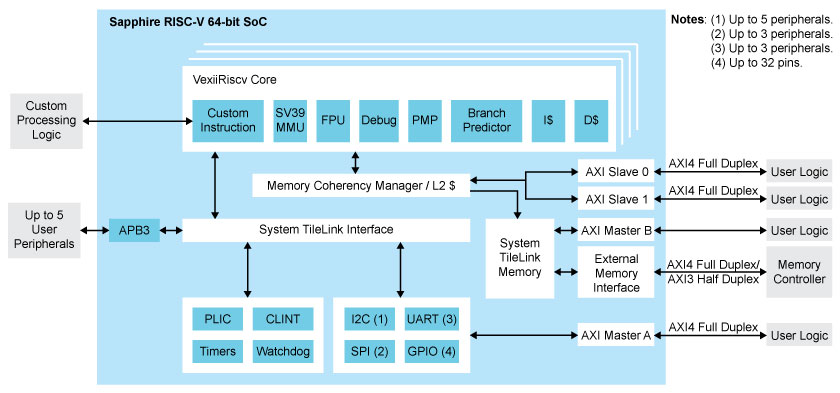
Efinix lists between one and four VexiiRiscv cores, a seven-stage execution pipeline and configurable clock rates from 20 to 400 MHz on its product page. Maximum achievable frequency depends on the chosen FPGA, timing constraints and the complete logic design. A four-core configuration is not guaranteed to deliver four times the application throughput of one core.
Memory capacity and Linux support
The memory subsystem supports configurations with up to 512 KB of internal RAM and external memory modules as large as 8 GB. An optional Sv39 memory management unit provides virtual-address translation for Linux configurations. A 64-bit instruction set does not automatically supply a full 64-bit physical address space; the implemented address translation and memory controller define practical limits.
An industrial imaging system illustrates the value of a larger memory footprint. Programmable logic could handle incoming camera pixels while the CPU manages configuration, communicates with other machines and supervises application software. External memory can hold image buffers and model parameters, but bandwidth, access latency and contention between processing engines still affect performance.
Custom hardware without a new semiconductor tape-out
The Sapphire design supports optional custom instructions, enabling developers to connect selected operations to dedicated FPGA logic. A specialized filter or data transformation could reduce the number of general-purpose instructions executed. The hardware and compiler interface must still be validated for correctness, timing and numerical precision.
Related BitcoinVersus.Tech reporting covers Andes custom RISC-V instructions, Qualcomm heterogeneous industrial processors, Synaptics memory-integrated microcontrollers and Tendrils parallel processor research.
Independent coverage from EDN highlights the expanded memory and debugging capabilities. Neither the launch nor the reporting establishes a universal performance or energy advantage over fixed-function processors. Engineers must compare resource occupancy, achievable clock speed, workload latency and board-level power for their specific implementation. The main advance is flexibility: a richer embedded processor can coexist with reconfigurable application hardware.
We volunteer daily to ensure the credibility of the information on this platform is Verifiably True. If you would like to support to help further secure the integrity of our research initiative, please scan the QR code below.



Leave a Reply