
Cambridge-based Tendrils Compute announced a $30 million funding round on November 10, 2026, to develop a general-purpose processor designed around thousands of parallel cores. The company is pursuing an alternative to conventional instruction execution: a mathematical model called interaction nets. Its ambition is to make parallel computing accessible across more workloads than those traditionally assigned to graphics processors.
The company announcement identifies Benchmark as the lead investor, alongside the United Kingdom’s Sovereign AI Fund and several other venture firms. The funding supports processor development and an accompanying experimental programming language. It does not establish that a commercial chip exists. Featured logo: Tendrils, via Tech.eu.
Computing with graphs instead of instruction streams
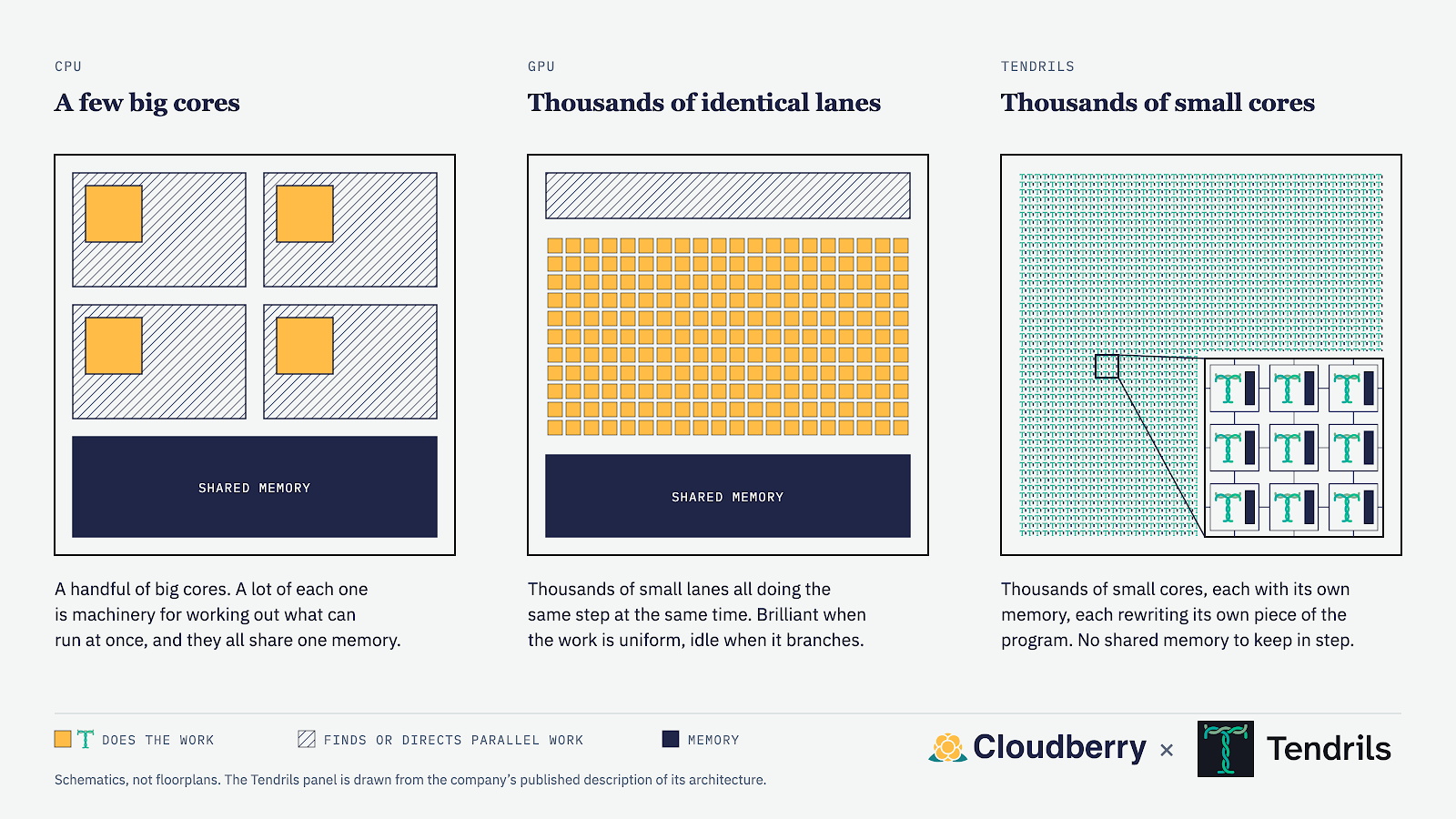
Conventional CPUs use techniques such as instruction pipelining, speculative execution and multiple cores to expose parallel work while preserving the behavior expected by existing software. Coordinating access to shared data can require cache coherence messages and synchronization. GPUs provide extensive parallel execution but can lose utilization when execution paths diverge or memory access becomes irregular. Neither architecture is inherently unsuitable for all graph workloads.
Interaction nets represent a computation as interconnected nodes. When a pair of nodes meets the conditions of a rewrite rule, it can be replaced with a different arrangement. Independent pairs can be rewritten concurrently. The formal model’s locality and confluence make it attractive for parallel execution; however, a physical machine still needs to route messages, allocate memory and manage finite resources.
Vine connects the software and hardware
The open-source Vine programming language compiles source code to an intermediate language called Ivy, which executes on the Interaction Virtual Machine. Its existing software implementation lets researchers explore the computation model before dedicated hardware becomes available. The startup plans to develop its processor and compiler ecosystem together, rather than treating compatibility with existing executable binaries as the starting requirement.
A useful example is the longest common subsequence problem, which finds ordered elements shared by two sequences. Independent portions of a computation can be evaluated concurrently when their dependencies permit. The company’s technical explanation explores the parallelism exposed by that workload. Available independent tasks are not equivalent to sustained physical core utilization or a measured speedup.
What would establish a competitive processor?
The UK Sovereign AI Fund describes the project as an investment in making general-purpose parallel computation more practical. Independent reporting by Tech.eu notes that the startup has not disclosed hardware benchmarks. Without fabricated silicon results, efficiency, clock frequency, memory bandwidth and real application performance remain unknown.
Related BitcoinVersus.Tech reporting includes Frostbite’s separate graph-oriented CPU design, AMD’s high-core-count EPYC Embedded processors, custom RISC-V instructions and memory-integrated AI microcontrollers. These projects pursue different approaches to computation and data movement.
Tendrils is betting that redesigning the execution model can be more valuable than adding another layer of scheduling hardware. The decisive evidence will be reproducible application benchmarks that measure execution time, energy consumption and memory requirements against appropriately configured conventional systems.
We volunteer daily to ensure the credibility of the information on this platform is Verifiably True. If you would like to support to help further secure the integrity of our research initiative, please scan the QR code below.



Leave a Reply