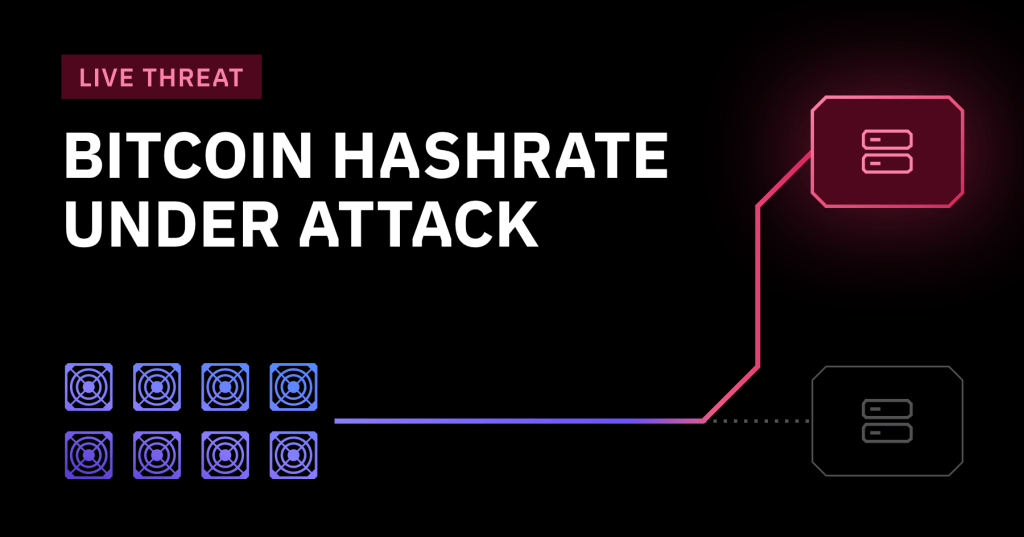
Bitcoin mining pool operator Braiins issued a security advisory on November 25, 2026, reporting coordinated incidents that redirected computing work from mining sites using unencrypted Stratum V1 connections. Four incidents on November 20 affected approximately 1,050 to 1,600 sites per episode, with reported diverted capacity ranging from 0.6 to 1.9 exahashes per second. Unchained also reported the warning. The figures describe separate episodes, not a cumulative count of unique victims.
When a healthy ASIC is not earning revenue
A mining machine performs SHA-256 calculations on work supplied by a pool. The pool measures contributed work through accepted shares, which represent probabilistic evidence of computational effort. Its accounting system attributes that work to a particular worker or account. Local hashrate and pool-credited hashrate therefore measure different parts of an operational process.
An ASIC can remain electrically healthy while its owner receives no credit for the work. A monitoring system that checks only fan speed, temperature and chip performance cannot establish whether accepted shares are reaching the intended pool account. Pool-side telemetry provides a separate and necessary observation.
Braiins attributed the November incidents to manipulation of internet routing and impersonation of a mining pool, rather than compromise of the ASICs or the pool’s servers. The company did not report theft of existing pool account balances. Its incident data establishes a risk to new mining earnings, not the precise amount of money lost by every affected operator.
How much computing power is 1.9 EH/s?
One exahash per second equals one million terahashes per second. The reported upper figure of 1.9 EH/s is equivalent to the rated aggregate output of 9,500 hypothetical 200 TH/s ASICs. Actual machines may have different specifications and operating conditions. The comparison does not establish how many devices were involved.
For a facility, the financial consequence depends on the duration of redirected work, pool payout policy, electricity cost and actual share acceptance. A temporary drop in credited output cannot be converted into a definitive revenue-loss figure without those measurements.
Encryption needs authentication
The Stratum V2 project develops an open mining protocol supporting authenticated, encrypted communication. Authentication allows a miner to distinguish the intended service from an impersonator. Encryption alone is insufficient if the client accepts an untrusted identity.
Braiins recommends Stratum V2 or certificate-verifying TLS for compatible legacy devices. Its new translation proxy offers another route for older machines, provided the local network is secured. Operators should review every configured fallback, test certificate validation and compare miner telemetry with pool-side accounting. Authenticated transport cannot eliminate internet outages or prevent deliberate interruption of connectivity, but it can prevent an unauthenticated server from silently receiving the miner’s work.
Related BitcoinVersus.Tech reporting: Braiins OS 26.11, Foundry’s Stratum V2 testing, MARA’s first Stratum V2 block, and DATUM’s miner-selected block templates. Transport security and control over transaction selection are separate features; adopting encrypted connections does not automatically decentralize block construction.
Featured artwork: Braiins security advisory, November 25, 2026.
We volunteer daily to ensure the credibility of the information on this platform is Verifiably True. If you would like to support to help further secure the integrity of our research initiative, please scan the QR code below.



Leave a Reply