A Bitcoin miner tuned during a cool morning may behave differently when its coolant warms later in the day. Braiins OS 26.11, announced November 25, 2026, makes continuous chip-level optimization a standard performance option. The firmware also adds support for two hydro-cooled Antminers, individual chip throttling on selected models and encrypted Stratum V1 connections. The release targets operating stability rather than announcing a new ASIC efficiency record.
From fixed profiles to adaptive firmware
The Continuous Tuner documentation contrasts conventional autotuning, which establishes chip frequencies and voltages during an initial optimization period, with an ongoing adjustment process. As silicon warms, its electrical behavior changes. Settings chosen under one thermal condition may no longer offer the same balance of power, accepted hashes and stability at another.
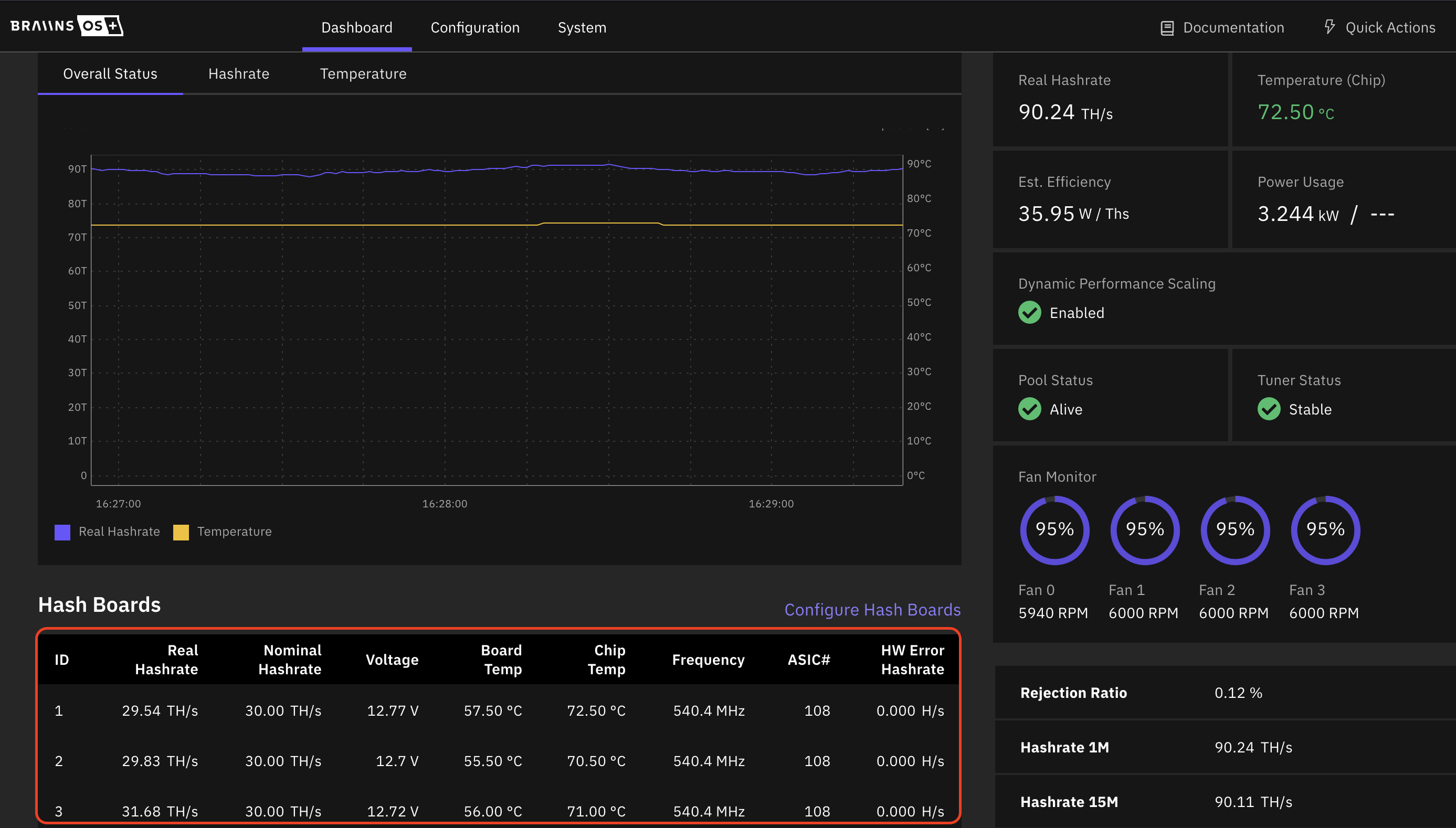
The adaptive mode estimates available thermal capacity and revisits operating parameters approximately every five minutes. Under version 26.11, the continuous tuner replaces conventional Dynamic Performance Scaling (DPS) rather than operating alongside its discrete power steps. Temperature safeguards override the requested performance target.
Protect the chip without losing the board
According to the November 25 changelog, the Antminer S23 Hyd. and S21j XP Hyd. operate exclusively with continuous tuning under Braiins OS. New hydro installations default to the mode. An optional chip-specific thermal response on selected devices lowers the clock of an overheating chip instead of immediately stopping its entire hashboard. Hydro models also gain protection against starting or resuming with inlet water above 55°C or missing inlet temperature readings. Operators must still follow equipment specifications and facility cooling procedures.
See our earlier lesson on hashboard thermal sensors and reporting on LuxOS recovery power for related approaches to reliability.
Efficiency requires an energy measurement
Consider a hypothetical ASIC delivering 200 TH/s at 3,000 watts: dividing watts by terahashes per second gives 15 J/TH. If a second operating point delivers 190 TH/s at 2,660 watts, efficiency becomes 14 J/TH. Energy per hash improves by about 6.7%, while hashrate falls 5%. Neither operating point represents measured Braiins OS 26.11 performance. Fleet operators should compare cumulative energy and accepted pool work over comparable periods, including downtime, rather than selecting the highest dashboard hashrate.
Secure pool connections and fleet controls
Version 26.11 adds TLS encryption for supported Stratum V1 pool connections, reducing exposure of mining traffic to passive observers when certificate validation is correctly implemented. It does not turn Stratum V1 into Stratum V2. The public API now supports tuner selection; the Toolbox documentation warns that switching tuner type restarts the firmware. Related coverage: MARA’s Stratum V2 milestone and Braiins OS 26.10 restart improvements.
A staged deployment with measured wall power, pool-accepted hashrate, temperature history and error rates can reveal whether the new mode helps a particular fleet. Firmware can change how existing silicon operates; it cannot guarantee identical gains across machines or substitute for proper cooling and electrical infrastructure.
We volunteer daily to ensure the credibility of the information on this platform is Verifiably True. If you would like to support to help further secure the integrity of our research initiative, please scan the QR code below.



Leave a Reply