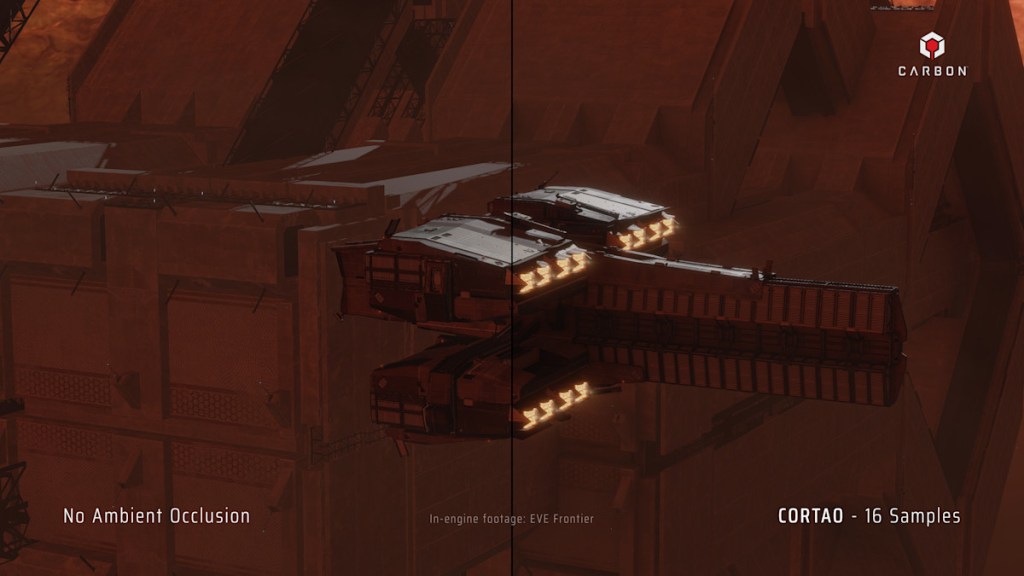
A spacecraft floating near an enormous industrial structure can look disconnected from its surroundings when a game engine fails to account for the light blocked by nearby surfaces. On November 12, 2026, Fenris Creations announced CORTAO, an open-source graphics technique developed by rendering engineer Daniel Isheden and tested inside the space survival game EVE Frontier. The Carbon Engine implementation is available under the MIT license.
Official Fenris Creations showcase: CORTAO in EVE Frontier, demonstrating the rendering effect inside the engine. Watch directly on YouTube. Featured image: the studio’s November 12 in-engine comparison of disabled ambient occlusion and CORTAO at 16 samples.
Why corners and contact points need shading
Imagine a white sphere resting on a white floor under an overcast sky. Even without a sharp shadow from the sun, the contact region appears darker because the sphere and floor obstruct parts of the surrounding light field. Ambient occlusion approximates that visibility. It does not independently calculate every light source, colored reflection or indirect bounce.
A common real-time approach uses information already generated during rendering, including the depth buffer. Each depth value represents the distance of a visible surface along a viewing direction. Screen-space ambient occlusion algorithms inspect neighboring samples to estimate how much of the environment a point can see. Geometry hidden behind the nearest visible surface is unavailable, creating a fundamental approximation.
Tracing rays against a simplified local environment
CORTAO stands for Circular Occluder Ray-Traced Ambient Occlusion. Rather than estimating obstruction solely through angular horizons, the method builds a simplified representation of nearby surfaces using circular elements. It then tests rays against those elements. The Carbon implementation documentation describes configurations capable of tracing up to 32 rays per pixel, as well as an optional directional output called a bent normal. That direction approximates where unblocked ambient illumination predominantly arrives.
The published shader pipeline prepares depth and normal information, performs the occlusion calculation, and can filter the resulting image before subsequent temporal processing. The implementation is written in HLSL and targets Shader Model 6.7 by default, with documented compromises for earlier versions. Its adjustable screen-space radius helps accommodate scenes containing objects at vastly different distances.
Original developer discussion on r/GraphicsProgramming, November 12: the author introduces the technique and discusses comparisons with other methods. Read the discussion.
The frame-time budget matters more than a marketing label
A game targeting 60 frames per second has about 16.67 milliseconds to produce each frame; at 120 frames per second, that interval falls to approximately 8.33 milliseconds. A hypothetical one-millisecond graphics pass would therefore consume about 6% or 12% of those respective budgets, assuming serial execution. Actual GPU scheduling and overlapping work can change the relationship. Those calculations illustrate the engineering constraint, not measured CORTAO performance.
The developers report that their comparisons with ground-truth ambient occlusion show stronger results in scenes with complicated depth discontinuities. Such tests establish behavior for the documented configurations, not a universal frame-rate increase. Screen-space methods still cannot recover every obstruction outside the camera’s visible data. Independent comparisons across hardware, resolutions and moving scenes would help establish broader performance.
Why releasing the code matters
The general reference implementation and Carbon-specific code give developers a starting point for experimentation outside EVE Frontier. The MIT license covers the software, not the studio’s game assets or trademarks. Related coverage includes Blender’s graphics development, Phasmophobia’s lighting overhaul, Mesa’s open graphics drivers and Godot engine development. The opportunity is reusable rendering research, not a guarantee that every engine will gain performance without integration work.
We volunteer daily to ensure the credibility of the information on this platform is Verifiably True. If you would like to support to help further secure the integrity of our research initiative, please scan the QR code below.



Leave a Reply