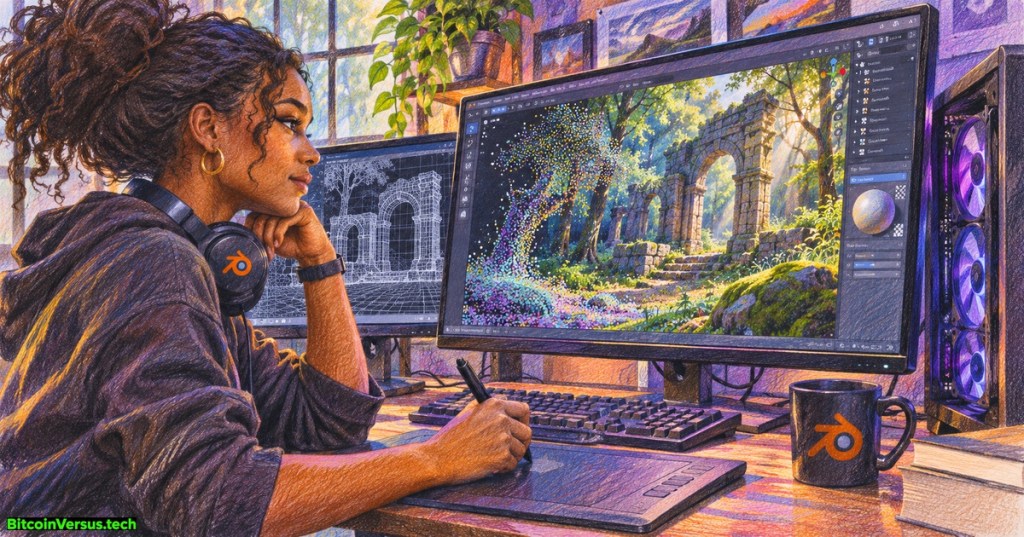
Blender’s free, open-source 3D creation suite reached version 5.3 on November 10, 2026, bringing two important changes for game developers and visual-effects artists: a modern graphics interface as the default on supported Windows and Linux platforms, and built-in support for importing and rendering three-dimensional Gaussian splats. Together, the updates give creators additional ways to work with real-world environments and GPU-accelerated scenes without purchasing proprietary modeling software.
Reconstructing environments without conventional meshes
Traditional game assets generally represent surfaces using vertices, edges and polygons. Gaussian splatting takes a different approach: numerous soft, partially transparent primitives with individual dimensions, orientations and appearance parameters combine to reproduce a scene. A separate reconstruction process can estimate those parameters from photographs taken at different viewpoints.
According to Blender’s rendering documentation, version 5.3 can load PLY and SPZ splat data into point clouds, manipulate the data through Geometry Nodes and display it with Workbench, EEVEE and Cycles. The pipeline also supports importing splats through certain glTF and USD workflows. A conventional polygonal object and a splat-based environment can therefore coexist within a Blender project.
For an independent game studio, a photographed courtyard, rocky landscape or industrial interior could become a visual reference or background asset. However, importing a reconstruction does not automatically create a playable level. Collision geometry, navigation meshes, optimization and engine-specific support remain separate development tasks. Blender’s release notes also identify incomplete transform handling, imperfect rendering in some transparency conditions and a lack of native PLY/SPZ splat export.
Vulkan moves from optional to default
Blender’s graphics release notes identify Vulkan as the default graphics backend on Linux and non-ARM Windows systems, with a minimum Vulkan version of 1.1. Vulkan gives developers more explicit control over graphics resources and command submission than traditional OpenGL. Such control can reduce driver overhead, but performance depends on scene complexity, hardware, drivers and implementation quality.
Blender’s own benchmark table illustrates the variation. On a Ryzen 7950X workstation equipped with an NVIDIA RTX 6000 Ada, the autumn scene ran at 192.686 frames per second using OpenGL in version 5.3 and 282.065 frames per second with Vulkan, approximately 46.4% higher. Meanwhile, the barbershop scene increased from 42.217 to 45.641 frames per second, roughly 8.1%. Each reported result averages three runs. Neither example establishes an equivalent improvement on other GPUs or operating systems.
Why open-source graphics infrastructure matters
The release also introduces lighting controls in EEVEE that allow artists to specify how materials respond to individual lights, including stylized shading effects. Blender’s new project system optionally provides context beyond an individual blend file, another useful step for teams managing multiple scenes and assets.
Open development is particularly valuable when graphics applications, drivers and game engines must cooperate. Previous BitcoinVersus.Tech reporting examined the principles of open-source software, Crown Engine’s game programming tools, AI-assisted game development and desktop processor benchmarks. Blender’s update extends the same ecosystem at the asset-creation layer.
Artists can download the release through Blender’s official release page. Production teams should evaluate GPU compatibility, add-on behavior and asset portability on copies of existing projects before migrating. The long-term opportunity is not merely faster previews; it is a more accessible pipeline connecting captured environments, traditional modeling and interactive graphics.
Cover: original colored-pencil editorial illustration; not an actual software screenshot.
We volunteer daily to ensure the credibility of the information on this platform is Verifiably True. If you would like to support to help further secure the integrity of our research initiative, please scan the QR code below.



Leave a Reply