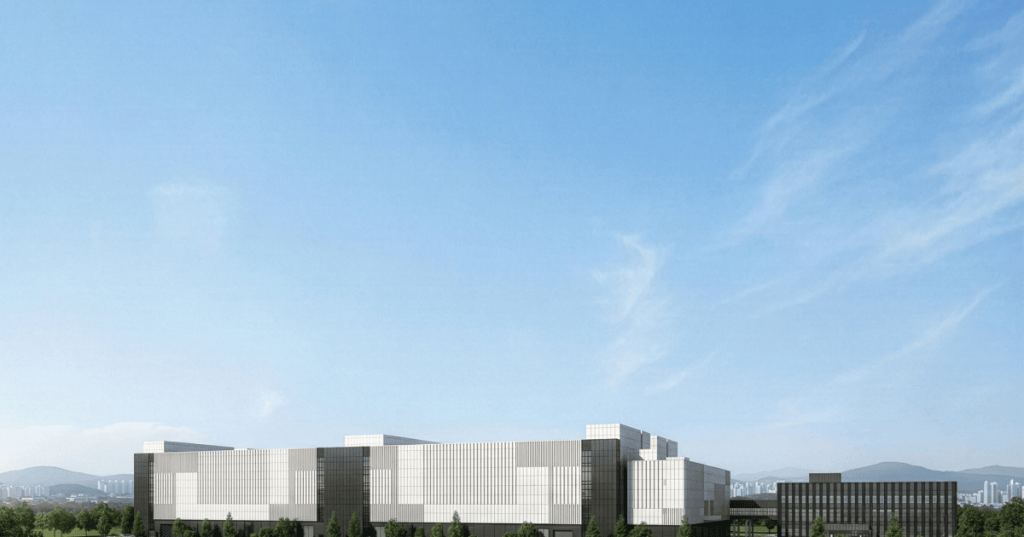
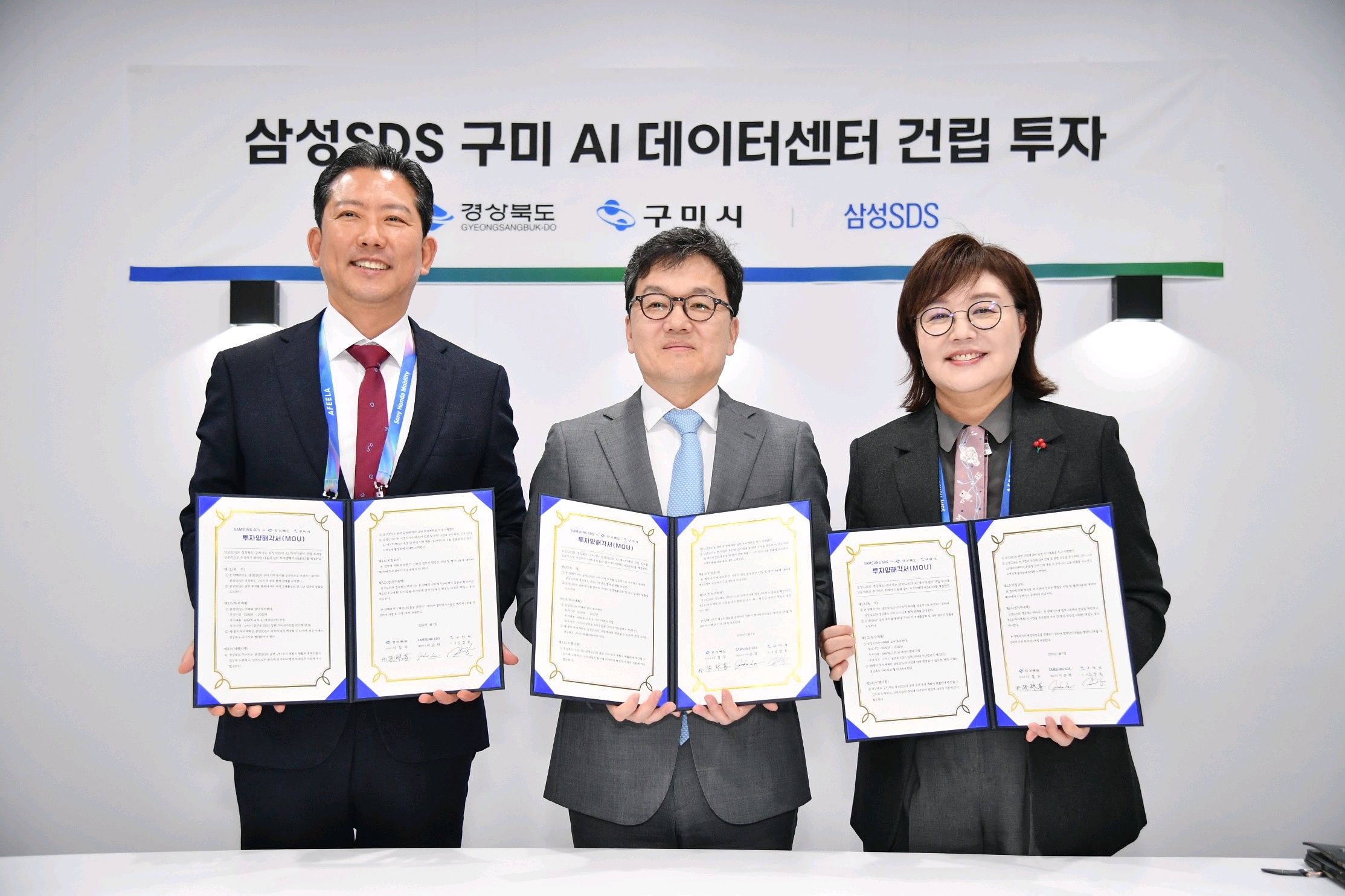
Samsung SDS is converting a former electronics manufacturing site in South Korea into computing infrastructure for artificial intelligence. On November 2, 2026, the company held a groundbreaking ceremony for its Gumi AI Data Center, according to its November 4 announcement. The project begins with a planned electrical capacity of 60 MW and provision for expansion to 120 MW. Construction commenced following municipal approval in late August, with completion targeted for the end of 2028.
The facility occupies roughly 46,000 square meters in Gumi’s Gongdan-dong industrial district. Samsung’s earlier January investment announcement identified the property as the former Samsung Electronics Gumi Plant 1 and specified a March 2029 operational target. Construction completion and commencement of customer services are separate milestones. Featured image: Samsung SDS architectural visualization of the planned facility, not a photograph of a completed building.
Local news coverage of the November 2 groundbreaking ceremony.
The electrical scale of an AI campus
A continuous 60 MW electrical load corresponds to 525,600 MWh of annual electricity consumption, using 8,760 hours in a non-leap year. At 120 MW, the equivalent figure becomes 1,051,200 MWh, or 1.0512 TWh. These calculations represent full utilization of the stated power ratings, not actual demand forecasts. Samsung SDS has not specified whether the figures represent critical IT load or total facility electrical capacity, a distinction essential to estimating usable computing power.
The January board-approved construction budget was KRW 427.3 billion for the building and facilities. Dividing that figure by the initial 60 MW yields approximately KRW 7.12 billion per MW of stated capacity. The quotient is not a comprehensive cost per MW of installed GPU infrastructure. Future expansion, customer equipment and other capital expenditures may require separate investment.
Why the cooling architecture matters
The design separates relatively conventional network and storage equipment from high-density accelerator servers using a combination of air and liquid cooling. Liquid coolant transports heat from densely packed components to heat exchangers, where it must ultimately be rejected to the surrounding environment. Pumping power, water chemistry, pressure management and leak detection become important operational considerations. Air-cooled equipment still needs carefully controlled airflow to prevent exhaust recirculation.
Different rack power densities also complicate distribution planning. Engineers must coordinate upstream capacity, protective devices, busways, power supplies and cooling availability. Redundant infrastructure consumes space and capital but permits maintenance and can reduce the consequences of equipment failures. Samsung has not published a Gumi-specific power usage effectiveness target or detailed rack power specification.
YTN’s January report covers the earlier Gumi site selection and regional infrastructure considerations.
Manufacturing AI and infrastructure economics
Samsung SDS intends to sell computing services from its own accelerator infrastructure and offer colocation for customers bringing their own hardware. The project forms one part of a broader KRW 60 trillion regional investment plan spanning several industries; that larger figure is not the Gumi construction budget. The company’s third-quarter results reported growing demand for cloud and GPU services.
The Gumi development joins projects such as Qatar’s 20 MW Syntys facility, EdgeCore’s Reno campus and Applied Digital’s first 25 MW ready-for-service hall. The manufacturing applications also complement developments in robotic machine vision. However, Gumi remains under construction. Utility energization, equipment installation, commissioning and actual customer utilization will determine when the announced power capacity becomes productive computing infrastructure.
We volunteer daily to ensure the credibility of the information on this platform is Verifiably True. If you would like to support to help further secure the integrity of our research initiative, please scan the QR code below.


Leave a Reply