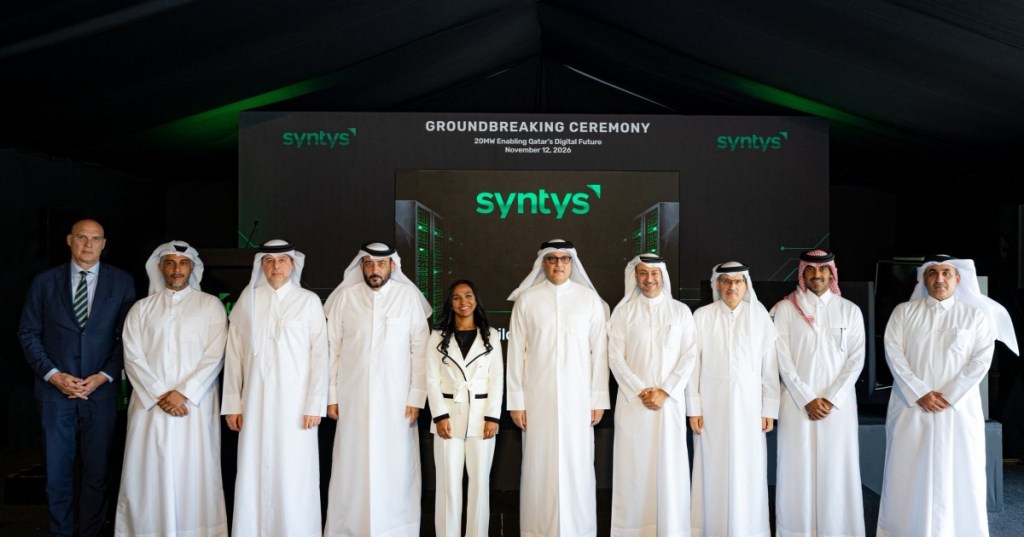
Qatar is expanding its domestic computing infrastructure with a facility designed for increasingly power-intensive artificial intelligence workloads. On November 12, 2026, Syntys announced the start of construction on a 20 MW data center at an existing campus. The project will accommodate cloud computing, high-performance computing (HPC) and configurations with elevated rack power densities.
The groundbreaking marks a construction milestone, not the delivery of operational computing capacity. Syntys has not disclosed the new facility’s commissioning date, construction budget, specific accelerator models or maximum rack density. Featured photograph: Syntys’ official November 12 groundbreaking ceremony.
Background: CNBC’s June 2024 interview with Ooredoo’s chief executive discusses the company’s NVIDIA partnership, not the new construction project.
Building on existing infrastructure
An established data center campus can provide access to electrical connections, telecommunications routes and personnel familiar with local operating requirements. Those advantages can shorten preparatory work, although additional substations, distribution equipment and cooling infrastructure may still be necessary. The presence of an existing utility connection does not establish that the full expansion load is available immediately.
Syntys’ January acquisition announcement reported 26 MW of live IT capacity in Qatar after purchasing two QData facilities. The transaction included 5 MW already active and 7.5 MW under development. As of November, the company reports operating four campuses in the country. The new project’s 20 MW rating is numerically equivalent to approximately 77% of the January live-capacity figure. The November announcement does not explicitly define its rating as critical IT capacity, so the comparison is indicative rather than a confirmed capacity-growth percentage.
What Tier III design means
The facility targets Tier III compliance. Under the Uptime Institute classification, a Tier III design allows scheduled maintenance on critical equipment and distribution paths without interrupting IT operations. Redundancy must extend across the supporting infrastructure, including electrical and mechanical systems. Tier III does not guarantee immunity from unexpected equipment failures, and a stated design objective is distinct from independent certification of a completed facility.
Syntys previously announced in July 2025 that its infrastructure hosts Ooredoo’s locally deployed NVIDIA Hopper GPU cloud. That operational experience is relevant to the expansion, but does not establish which processors the new building will host.
Power, cooling and network capacity
For illustration, if a 20 MW rating represented IT load operating continuously, annual computing electricity consumption would reach 175.2 GWh. Assuming a power usage effectiveness (PUE) of 1.3, total facility demand would be 26 MW, or 227.76 GWh annually. These are engineering scenarios, not Syntys forecasts or measured consumption. Higher rack densities can require specialized cooling, and summer ambient conditions in Qatar can influence heat rejection performance.
Earlier Ooredoo Qatar and Google Cloud customer story, included for context on cloud adoption rather than footage of the construction site.
The expansion joins an international construction cycle that includes Applied Digital’s first 25 MW AI hall and EdgeCore’s Reno campus. Data center economics also depend on networking, illustrated by 800 Gbit/s optical connectivity research, and power procurement, as discussed in our Texas AI infrastructure coverage.
Carrier neutrality allows customers to select telecommunications providers, although physical route diversity and service agreements still determine resilience. Domestic hosting can support data residency requirements, but does not automatically ensure cybersecurity or regulatory compliance. The project’s next meaningful milestones are construction progress, utility energization, commissioning and the delivery of usable capacity to customers.
We volunteer daily to ensure the credibility of the information on this platform is Verifiably True. If you would like to support to help further secure the integrity of our research initiative, please scan the QR code below.


Leave a Reply