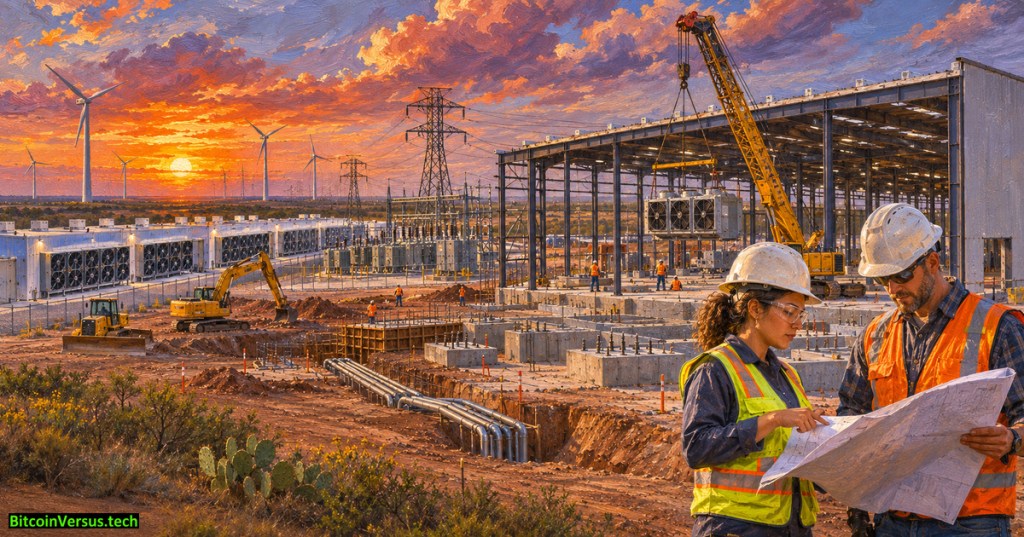
Soluna Holdings has moved beyond a paper proposal at Project Kati 2, its planned artificial-intelligence campus next to an operating Bitcoin mine in Willacy County, Texas. The company reported November 16, 2026 that civil and earthworks began in October. A separate Texas construction registration, filed October 7, identifies a 471,884-square-foot building designed for about 112 megawatts (MW) of critical IT load.
The state record lists an estimated $471.8 million construction cost, with an October 8, 2026 start and October 8, 2027 completion date. Those entries represent a filed project schedule and estimated building expenditure, not proof of completed construction, financing, energized megawatts or deployed GPUs.
An operating Bitcoin site beside a planned AI factory
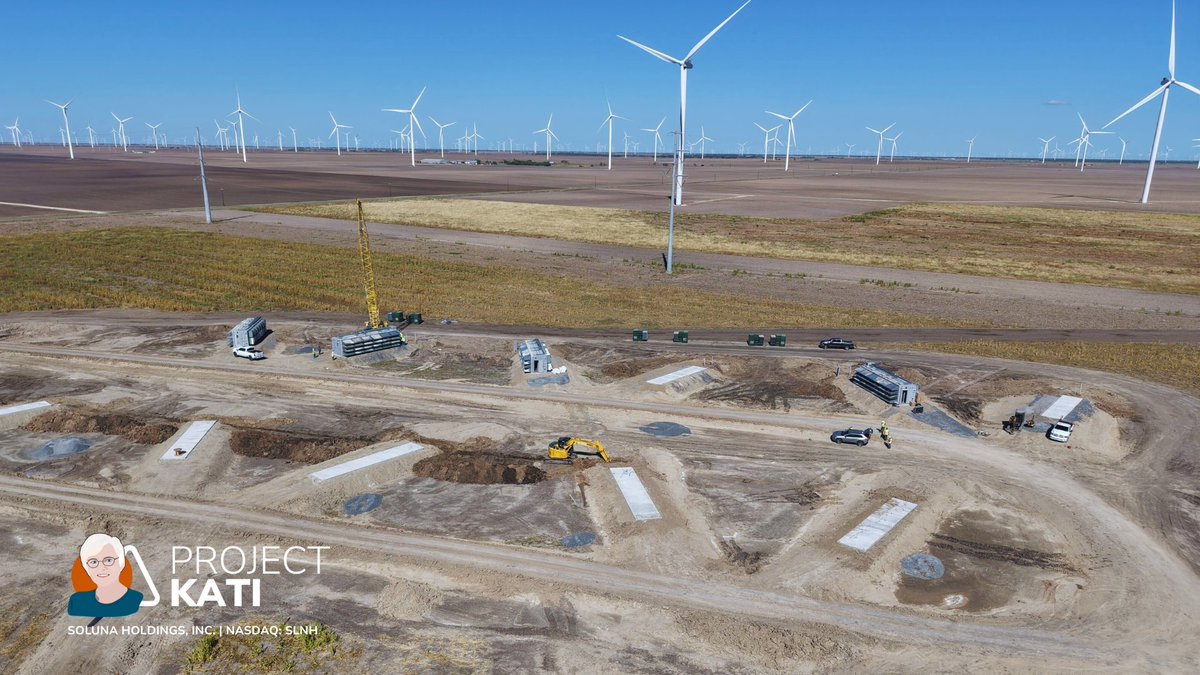
Directly across the road, Soluna’s Project Kati 1 reached 83 MW of energized Bitcoin-hosting capacity on September 8. The older facility gives the developer an established local operations footprint, but power availability for Bitcoin ASICs does not automatically establish reliable power for dense GPU clusters.
Official Soluna video, November 2025: introduces the original Kati development plan and Bitcoin-hosting phase. Its earlier phase-capacity forecasts have since evolved; the video is archival, not a 2026 commissioning record.
Kati 2 is being developed with Metrobloks, with the company now describing a potential 350-plus-MW AI campus across later phases. The Texas registration concerns one building with approximately 112 IT MW, while the larger campus figure is a long-term development target. Neither is equivalent to today’s electricity consumption.
A 118 MW prospective tenant, not an executed lease
Soluna says a previous prospective tenant did not satisfy its credit requirements, so the company let that party’s exclusivity lapse. In November it signed a new nonbinding letter of intent for 118 IT MW with a different prospective customer. A letter of intent expresses an intended deal but does not establish a binding colocation lease or guaranteed rent.
The proposed 118 MW tenancy should not be added to the 112 MW building filing. One number describes a prospective commercial requirement; the other describes the architectural scope of Building 1. Future design revisions, additional buildings, or a changed deployment could reconcile the figures, but Soluna has not announced an executed lease or a completed 118 MW hall.
The electrical milestones that matter
Soluna reported an ERCOT conditional Base Load classification covering 166 MW at the broader Kati campus, including the existing Kati 1 site. Separately, its development team is engineering a proposed 100 MW Las Majadas substation expansion, has ordered long-lead equipment and signed a gas-pipeline access agreement. Grid study designations and infrastructure agreements are milestones; they do not amount to new energized generating plants or 350 MW of deliverable IT power.
The engineering challenge is substantially different from Bitcoin hosting: AI installations require high-availability distribution, uninterruptible power, dense fiber connectivity, resilient heat removal and commissioning under sustained GPU demand. Company statements describe closed-loop cooling intended to minimize water use, but no verified annual water-consumption measurements have been published for the proposed Kati 2 halls.
Official Soluna June 2025 video explaining financing and development of Kati 1, the neighboring Bitcoin-mining phase. Historical context only; the funding described is not financing for the new Kati 2 AI building.
What $471.8 million actually buys
Dividing the registered construction estimate by designed IT capacity gives approximately $4.21 million per critical IT MW ($471.8 million ÷ 112 MW). The quotient is a filing-based building-cost ratio, not a complete cost per deployed megawatt: GPUs, servers, networking, project financing, land and other systems could materially change the ultimate investment.
Soluna’s November update notes a community open house held in Raymondville on November 12. Watch for a signed tenant lease, financed construction budget, substation engineering and interconnection updates, verified cooling specifications, and staged energization before treating Kati 2 as operational AI capacity.
How the project fits the mining-to-AI transition
BitcoinVersus.Tech previously covered Bitdeer’s 35 MW deployment at Kati 1, Soluna’s separate Dorothy 3 partnership, Bitdeer’s Tydal AI conversion and the engineering differences between ASIC mining and cloud computing. Kati 2’s distinct milestone is newly registered building work and a still-unsecured AI tenancy, adjacent to rather than replacing an energized Bitcoin facility.
Primary sources
Texas Department of Licensing and Regulation, registration TABS2027003019, October 7, 2026; Soluna November 16 SEC-filed results release; Soluna Q3 2026 investor update. The featured cover is an original editorial illustration; the attributed photograph is archival. All capacity targets and schedules are subject to change.
We volunteer daily to ensure the credibility of the information on this platform is Verifiably True. If you would like to support to help further secure the integrity of our research initiative, please scan the QR code below.

Financial disclaimer: Reporting is educational and informational, not investment advice.


Leave a Reply