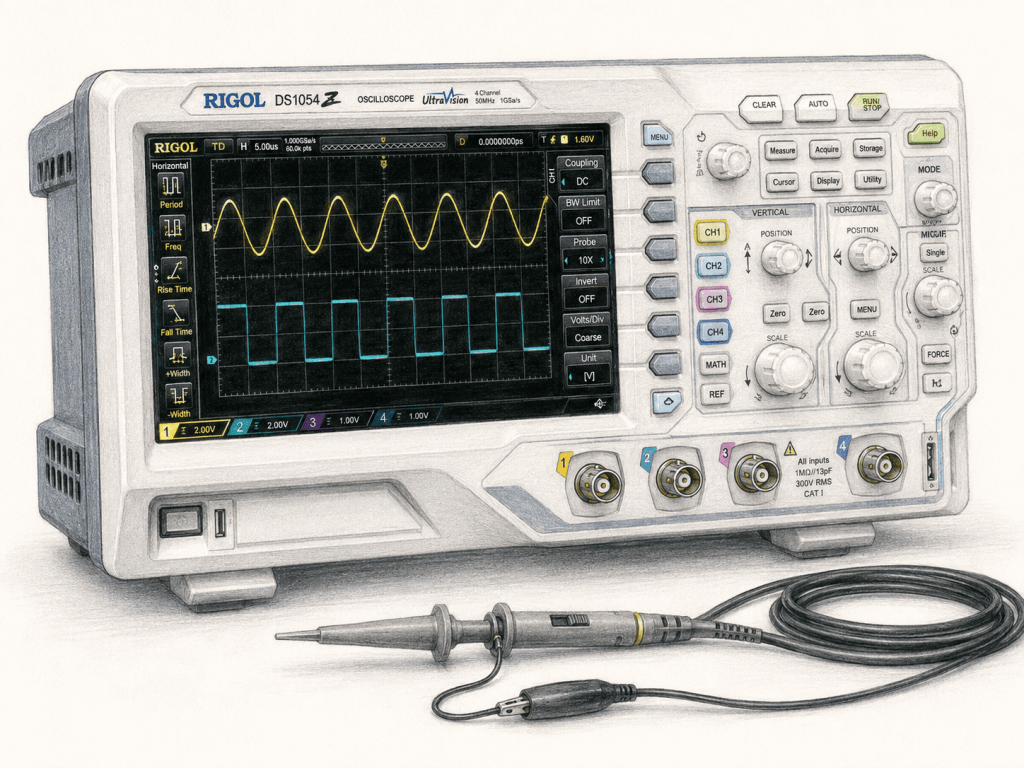
An oscilloscope is an electronic test instrument used to visualize how an electrical signal changes over time.
Instead of simply displaying a numerical voltage like a multimeter, an oscilloscope plots voltage vertically against time horizontally, creating a waveform that allows technicians and engineers to see the actual behavior of a signal.
This makes the oscilloscope particularly useful for diagnosing alternating current, digital signals, switching circuits, power supplies, control boards and communication systems.
A basic waveform can reveal several important characteristics of a circuit. Amplitude indicates the magnitude of the voltage, frequency shows how often a repeating signal completes a cycle, and period measures the time required for one complete cycle. Oscilloscopes can also reveal electrical noise, voltage spikes, unstable power rails, timing problems and distorted signals that may be impossible to identify using a conventional meter.
For technicians, the practical advantage is visibility. A multimeter might report that a circuit has 5 volts, while an oscilloscope can show whether that 5-volt supply is actually stable or contains ripple, spikes or intermittent drops. In modern electronics, embedded systems, power electronics and industrial troubleshooting, oscilloscopes provide a direct window into what a circuit is doing electrically.
BitcoinVersus.Tech Editor’s Note:
We volunteer daily to ensure the credibility of the information on this platform is Verifiably True. If you would like to support to help further secure the integrity of our research initiatives, please donate here: 3C9o19EH5HSiwEPyCTmEKzxhNCbo2X6TTb
BitcoinVersus.tech is not a financial advisor. This media platform reports on financial subjects purely for informational purposes.


Leave a Reply