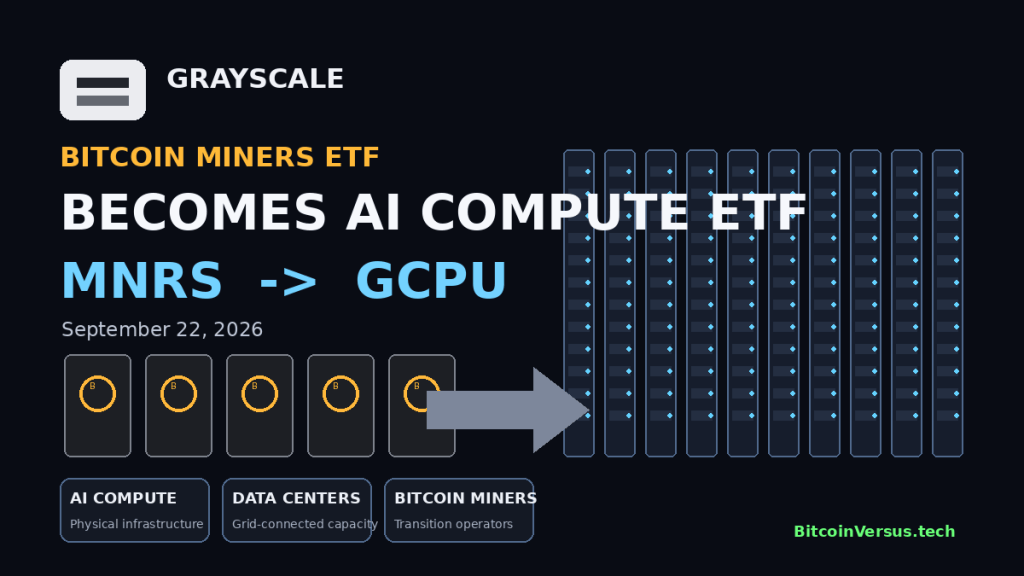
Grayscale has turned its Bitcoin Miners ETF into an AI infrastructure fund, changing the ticker from MNRS to GCPU and replacing a Bitcoin-miner index with one built around high-performance computing.
The firm’s September 22 announcement says the Grayscale AI Compute ETF now tracks the Indxx High Performance Computing Index, targeting companies that own or operate the physical infrastructure behind AI, GPU cloud services, data centers and accelerated computing.
The change is unusually direct evidence of how the investment market is beginning to classify some former or current Bitcoin-mining infrastructure as part of the AI compute buildout.
MNRS became GCPU on September 22
The fund did more than change its ticker. Its underlying benchmark moved from the Indxx Bitcoin Miners Index to the Indxx High Performance Computing Index, and its investment strategy was rewritten around AI compute infrastructure.
The regulatory filing identifies GCPU as the former Grayscale Bitcoin Miners ETF and lists a 0.59% annual management fee. The filing also makes clear that the fund does not invest directly in digital assets.
Grayscale’s own social announcement framed the transition around a shortage of physical compute capacity. The firm’s launch post specifically says the portfolio includes Bitcoin miners transitioning into AI infrastructure.
The old fund asked which public companies were exposed to Bitcoin mining. The new mandate asks which companies control scarce compute infrastructure, even when that infrastructure began with mining.
Bitcoin miners remain part of the strategy
Grayscale says GCPU is designed around two paths to more AI capacity. Roughly half of its target portfolio weight is aimed at companies built around GPU cloud and AI hosting from the start. The other portion targets infrastructure operators transitioning existing power, land and grid-connected facilities toward AI workloads, including companies with Bitcoin-mining roots.
That second category reflects a trend BitcoinVersus.tech has tracked closely. Hyperscale Data shut off its Michigan Bitcoin miners as the site pivoted toward AI, showing how grid-connected mining property can become valuable for a completely different compute workload.
Bitcoin mining and AI computing are not interchangeable businesses, but both place a premium on power availability, electrical infrastructure, cooling and data-center real estate.
Mining sites are becoming compute sites
The shift is visible at companies that continue mining while adding GPU infrastructure. BitcoinVersus.tech recently reported that Cango started AI GPU compute at a 50 MW Bitcoin-mining site, using an existing energy footprint as a base for another form of high-density computing.
Infrastructure providers are adapting too. Luxor’s expansion from Bitcoin mining into AI infrastructure illustrates how services built around mining operations can extend into the broader compute market.
GCPU effectively packages that transition into an ETF thesis: the valuable asset is increasingly the combination of power, land, interconnection and the ability to deploy compute quickly.
The fund no longer tracks Bitcoin miners as a category
The rename should not be read as a simple AI label placed on the old MNRS portfolio. GCPU’s benchmark and investment objective changed. Companies qualify because of high-performance computing, AI cloud, accelerated computing or supporting infrastructure rather than solely because they mine Bitcoin.
That distinction also means GCPU should not be treated as a proxy for Bitcoin’s price. Its returns depend on publicly traded infrastructure companies, their capital spending, customer demand, power access, execution and the economics of AI and high-performance computing.
For the mining industry, the notable signal is institutional rather than directional: an investment product originally organized around Bitcoin miners now defines the opportunity around compute infrastructure, with transitioning miners retained as one route to that capacity.
BitcoinVersus.Tech
Advertisement
BitcoinVersus.Tech Editor’s Note:
We volunteer daily to ensure the credibility of the information on this platform is Verifiably True. If you would like to support to help further secure the integrity of our research initiatives, please donate here: 3C9o19EH5HSiwEPyCTmEKzxhNCbo2X6TTb
BitcoinVersus.tech is not a financial advisor. This media platform reports on financial subjects purely for informational purposes.


Leave a Reply