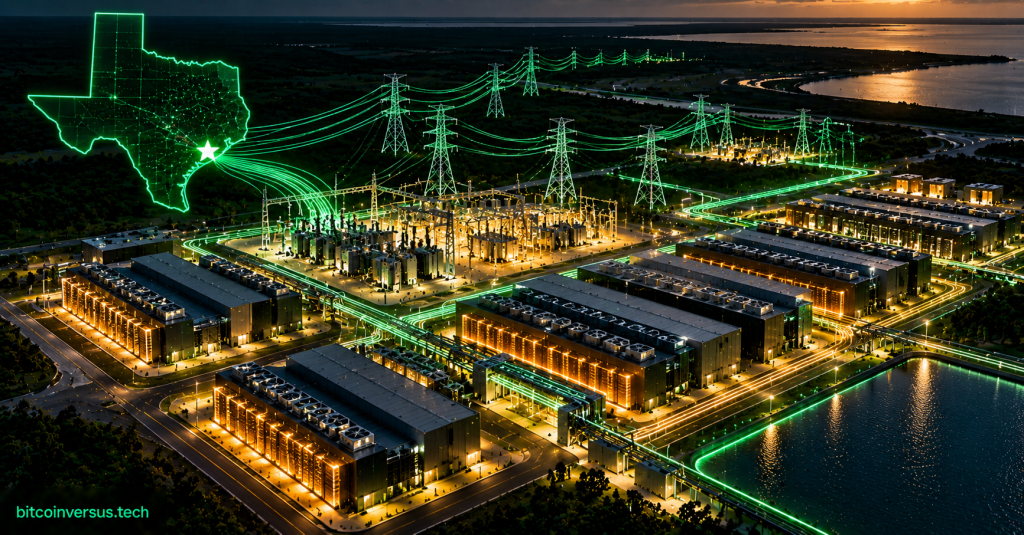
MARA has moved its proposed Matagorda County digital-infrastructure campus another step beyond the land-deal stage, posting a roughly ₿1,153.64 ($100 million) utility security deposit while rewriting key milestones around Texas grid review and the state’s scrutiny of large data-center loads.
According to MARA’s September 25 Form 8-K, subsidiary Volt Texas LLC, HIF USA LLC and MARA USA Corp amended their purchase agreement on September 21. The revised structure keeps the overall acquisition consideration capped at approximately ₿6,921.84 ($600 million) if all milestones are achieved, but changes when some payments become due and what happens if regulatory or interconnection conditions derail the project.
The utility deposit is not finished data-center capex
The most concrete new commitment is the utility deposit. MARA says Volt Texas posted ₿1,153.64 ($100 million) as security for power capacity contemplated for the site. That is significant because large digital-infrastructure projects can spend years accumulating land and conceptual power rights before money is actually placed behind a utility commitment.
But the deposit should not be confused with money permanently spent on buildings, miners or servers. The filing says the buyer may withdraw the security deposit at its sole discretion, subject to the terms governing the sale process. In other words, the money strengthens the project’s power position while preserving an exit path.
Up to 2 GW remains conditional
The Matagorda property spans more than 1,200 acres and is tied to a power roadmap of up to an initial 1 GW by October 2027 and up to 2 GW by April 2028, subject to ERCOT approval. That distinction matters: 2 GW is a targeted capacity pathway, not 2 GW of operating load today.
MARA’s original project announcement, preserved in a public status on X, described the campus as infrastructure for high-performance computing with flexible compute including Bitcoin mining.
Texas regulation is now written directly into the deal
The amendment ties certain milestone payments to two unusually explicit gates: successful conclusion of the applicable Texas regulatory data-center audit and MARA’s election to continue after the interconnection study. That puts state and grid review directly into the economic mechanics of the acquisition.
This follows the same pressure BitcoinVersus.Tech examined in Texas’ tightening review of large data-center development. Developers can control land and negotiate utility rights, but the usable value of those assets ultimately depends on whether transmission, generation and interconnection studies support the requested load.
TheEnergyMag reported that the revised agreement arrives as Texas audits large electricity users seeking grid access, and that the project’s acquisition payments remain tied to development milestones rather than functioning as one unconditional ₿6,921.84 ($600 million) check.
The downside structure changed too
The revised contract removes some earlier reconveyance provisions that would have returned project interests under specified circumstances. Instead, if certain audit or proceeding triggers occur, the project may be marketed to a third party through an agreed sale process, with HIF retaining a right of first offer and proceeds distributed through a negotiated waterfall.
That is an important change in risk allocation. If the project cannot advance as planned, the parties are no longer relying only on a simple asset-return mechanism. They have created a pathway to monetize the site and its development position in the market.
Bitcoin mining gives MARA something AI-only campuses do not have
MARA’s plan leaves room for both HPC and Bitcoin mining rather than forcing the property into one workload from day one. That flexibility matters because the two loads behave differently. A hyperscale AI tenant generally wants persistent capacity, while Bitcoin miners can curtail far more aggressively when grid conditions or electricity prices make it advantageous.
BitcoinVersus.Tech recently explored this in Bitcoin mining’s potential role as flexible power behind AI infrastructure. A mixed campus could theoretically use mining as an earlier or more interruptible load while the site progresses toward larger HPC deployments, though MARA has not yet announced that exact operating sequence for Matagorda.
MARA is increasingly behaving like a power-and-infrastructure developer
The Matagorda amendment fits a longer strategic arc. BitcoinVersus.Tech previously covered MARA’s earlier Ohio infrastructure expansion, when the company was still primarily framed around scaling mining capacity. A proposed 2 GW Texas campus pushes that model toward something broader: acquiring powered land, navigating grid processes and preserving optionality across multiple compute workloads.
For Bitcoin miners, that evolution may be as important as the next ASIC-generation efficiency gain. As electricity interconnection becomes one of the scarcest inputs in digital infrastructure, control of substations, transmission positions and approved megawatts can become strategic assets independent of which machines ultimately occupy the buildings.
The next milestones are regulatory, electrical and commercial
The next meaningful checkpoints are now clearer: completion of the Texas audit, results of the interconnection study, MARA’s decision on whether to proceed after that study, and eventual authorization for the site to receive the targeted power.
The ₿1,153.64 ($100 million) deposit shows MARA is willing to put significant capital behind the power opportunity. It does not guarantee a 2 GW campus. The value of the deal will be determined by how much power the project actually secures, how quickly that capacity becomes usable, and whether MARA fills it with Bitcoin mining, HPC tenants, or a combination of both.
BitcoinVersus.Tech
Advertisement
Editor’s Note
We volunteer daily to ensure the credibility of the information on this platform is Verifiably True. If you would like to support to help further secure the integrity of our research initiatives, please donate here: 3C9o19EH5HSiwEPyCTmEKzxhNCbo2X6TTb
BitcoinVersus.tech is not a financial advisor. This media platform reports on financial subjects purely for informational purposes.


Leave a Reply