Electronic paper is becoming a more credible substitute for printed photographs. On November 10, 2026, display maker E Ink introduced Spectra 6 9-Color, expanding its color system from six base colors to nine. Instead of giving every pixel millions of directly selectable colors, the technology uses a small palette of physical ink states and carefully arranged patterns to create convincing images. The upgrade targets digital photo frames, indoor signs and other surfaces where low electricity use matters more than video speed.
Official E Ink demonstration of the original six-color Spectra 6 platform, released before the nine-color upgrade. Background footage rather than a 2026 comparison. Watch directly on YouTube.
What three extra ink colors actually change
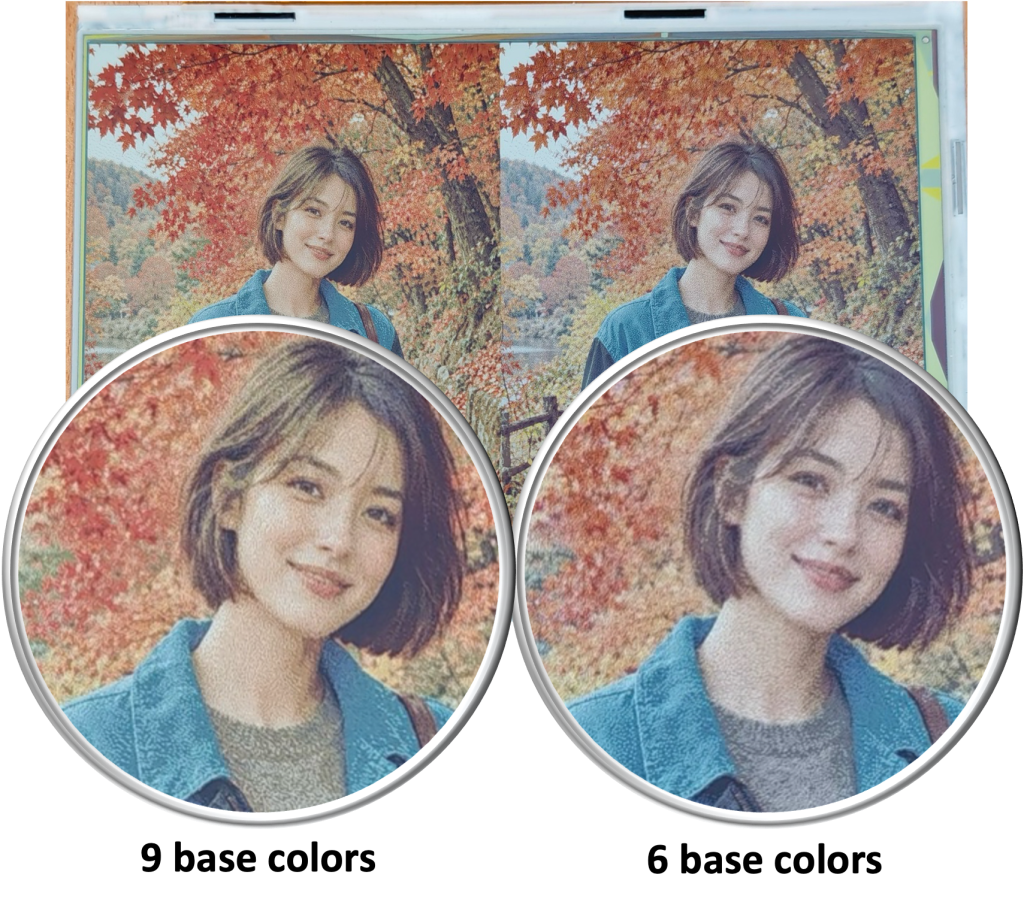
E Ink lists orange, cyan and light green as additions to the original black, white, red, yellow, blue and green set. Nine is 50% more base colors than six, but the count alone does not establish a 50% improvement in color accuracy or gamut. Color transitions still depend on image processing, the panel and the illumination around it.
A conventional LCD emits light through a color-filter system. Electrophoretic ePaper instead moves charged pigment particles using electric fields and reflects ambient light. Once an image is displayed, the pigments can remain in place without continuous power for the picture itself. Electronics, connectivity and optional front lighting still consume energy.
The added states require more sophisticated display driving. E Ink specifies a system-on-chip paired with an E Ink timing controller, or TCON, to coordinate the waveforms needed for the nine-color panel. Its initial module size is 10 inches; E Ink has not published a universal refresh-time or power-consumption benchmark for every nine-color implementation.
Aura’s first nine-color frame shows the tradeoffs
Aura’s cordless Ink 10 is among the first consumer products using the revised system. Its published specifications list a 10-inch, 1600 × 1200 display at 200 pixels per inch, versus 150 PPI on the larger Ink 13. Pixel density therefore rises by roughly 33%, although the screen is physically smaller. Aura advertises up to three months per charge; actual endurance depends on usage, connectivity, front-light operation and image updates.
An important detail: Aura describes its three customized extra base colors as off-white, mustard yellow and orange. E Ink describes the broader platform’s additions as orange, cyan and light green. The descriptions refer to different implementations of a nine-color system, not necessarily the same exact pigment palette in every product. Aura combines its panel with proprietary dithering, placing colored pixels in patterns that look like intermediate shades at normal viewing distances.
Independent hands-on test of a 13.3-inch earlier-generation Spectra 6 panel using Waveshare hardware. The video illustrates the refresh behavior of an older six-color product, not the new Aura Ink 10. Watch directly on YouTube.
More color does not turn ePaper into OLED
A static photo display gains relatively little from rapid refresh, but the limitation remains important for interactive screens. Color ePaper generally takes much longer to redraw an image than LCD or OLED, and new nine-color timings must be tested rather than assumed. Our coverage of E Ink’s Kaleido 4 concerns a different display architecture optimized for reading and faster changes.
For context, 720 Hz OLED gaming monitors prioritize motion, while high-peak-brightness phone screens target visibility and dynamic image quality. The engineering problem is different for color paper: look natural under room lighting, hold an image with minimal ongoing energy and avoid visible cords.
Aura Ink 10 launched at a reported $349. Independent early testing by Tom’s Guide found smoother tonal transitions than the previous model but darker-looking pictures, reminding buyers that improved color reproduction is not equivalent to LCD-like realism. For additional materials context, MicroLED manufacturing advances demonstrate another route to low-power displays built around emitted light.
Bottom line: Nine-color Spectra 6 is a meaningful step for screens expected to behave like framed photographs. Its success will depend on actual color quality, refresh performance, price and battery endurance in finished products, rather than the base-color count alone.
Sources: E Ink official announcement, November 10, 2026; Aura Ink 10 official specifications; Tom’s Guide product review; Invidis industry coverage.
Editor’s note: The original featured cover is a conceptual photorealistic illustration, not a product photograph. The company comparison visual is attributed, and the older videos are labeled as earlier-generation demonstrations rather than direct tests of the new panel.
We volunteer daily to ensure the credibility of the information on this platform is Verifiably True. If you would like to support to help further secure the integrity of our research initiative, please scan the QR code below.



Leave a Reply