
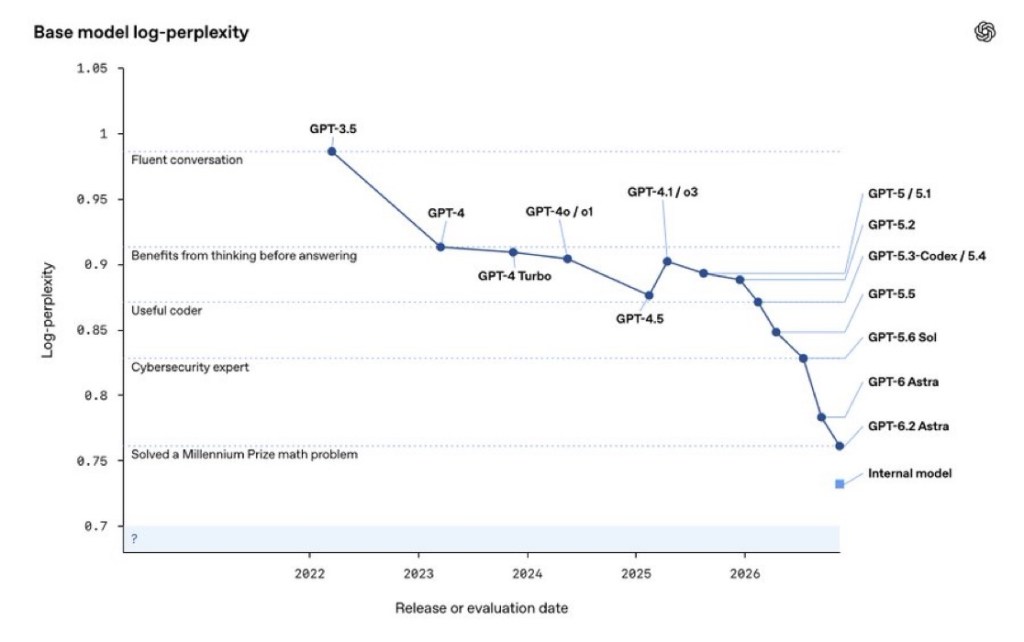
OpenAI has released a rare numerical view of its underlying model progress. In an essay dated November 22, 2026, chief scientist Jakub Pachocki charts base-model log-perplexity falling from approximately 0.986 for GPT-3.5 to 0.761 for GPT-6.2 Astra. A separate unreleased internal model is plotted near 0.732. The numbers describe how accurately models predict held-out code before later training stages, not electrical power consumption, percentage intelligence or a universal quality score.
Andrej Karpathy’s original GPT-building lecture explains language-model token prediction. Historical educational context, not OpenAI’s November evaluation. Watch on YouTube.
The mathematics behind a falling curve
A language model assigns probabilities to candidate next tokens. Log-perplexity, equivalent here to cross-entropy loss, averages the negative logarithm of the probability given to the actual next token. Lower values represent better predictions. OpenAI measures on a fixed snapshot of its internal codebase, held out from training. Data consistency makes successive OpenAI model values useful for a longitudinal comparison, but the test is not an independent public benchmark of other AI developers.
The change from 0.986 to 0.761 is (0.986 − 0.761) ÷ 0.986 = 22.8% less log-loss. Exponentiating both figures converts them to ordinary perplexities of approximately 2.68 and 2.14, about a 20.2% reduction. Neither figure establishes that the later model is 22.8% more intelligent, 22.8% more accurate on every task or 22.8% cheaper to operate.
Why the model sequence matters
Pachocki argues that better pretraining prediction has historically anticipated capabilities such as fluent conversation, reasoning, useful coding and difficult mathematical work. The graph associates those accomplishments with declining losses, but it does not prove universal capability thresholds. The series also includes a rise around GPT-4.5 and the GPT-4.1/o3 grouping, so its path is not strictly downward for every sequential release.
The chart’s annotation about solving a Millennium Prize mathematical problem points toward OpenAI’s September report on Navier–Stokes. That is an OpenAI research claim, not evidence of an official Clay Mathematics Institute prize award. OpenAI explicitly said it would not claim the prize; scientific review and prize recognition are separate questions.
Maths Academy’s 2026 educational lesson derives softmax, cross-entropy and perplexity. Independent mathematical background, not a replication of OpenAI’s private test. Watch on YouTube.
Acceleration, safety and unknown limits
OpenAI’s latest losses appear to decline more quickly through 2026. Pachocki attributes most of the acceleration to longer-term research and computing investments, and a smaller contribution to AI helping conduct research. He foresees a possible jump in pretraining breakthroughs if models become effective research assistants. His accompanying proposal asks frontier labs to establish shared evaluation methods and development limits tied to improvements in oversight. No industry-wide restriction has been adopted merely because he suggested one.
Important uncertainties remain. Model developers train and tokenize differently, making cross-laboratory comparisons difficult without shared datasets. Pretraining loss does not capture gains from inference-time reasoning or specialized finetuning. The irreducible entropy floor of the test data is unknown. Extrapolating the trend directly to zero loss would therefore be unjustified.
The missing energy measurement
A model’s prediction loss is not its joules per generated token. The OpenAI figure supplies no matching training electricity, GPU hours, inference throughput or energy per query. Our prior articles on token value per watt, AI-driven analog circuit optimization, scaling laws and economics, and compute per joule examine complementary dimensions.
The verified finding is a substantial reduction in base-model predictive loss on one consistent evaluation, together with a proposal to strengthen frontier-AI safety oversight. Our follow-up compares the trend with Bitcoin ASIC mining efficiency, where the physical unit J/TH measures something entirely different.
Primary sources: OpenAI, November 22 essay; OpenAI’s September Navier–Stokes analysis; Reuters report. Supplied social links: Sam Altman’s X post and Merettm’s X post; post contents could not be independently retrieved.
We volunteer daily to ensure the credibility of the information on this platform is Verifiably True. If you would like to support to help further secure the integrity of our research initiative, please scan the QR code below.



Leave a Reply