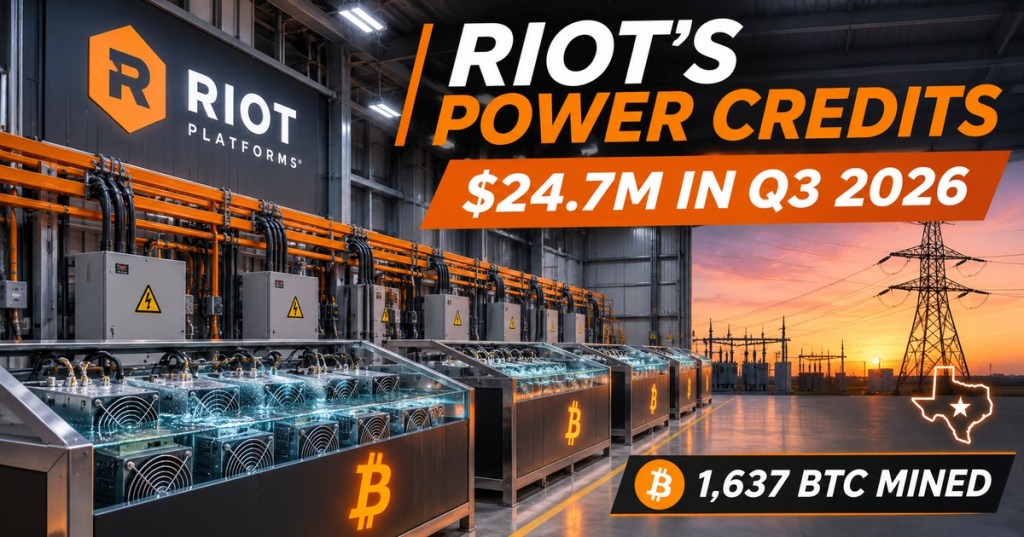
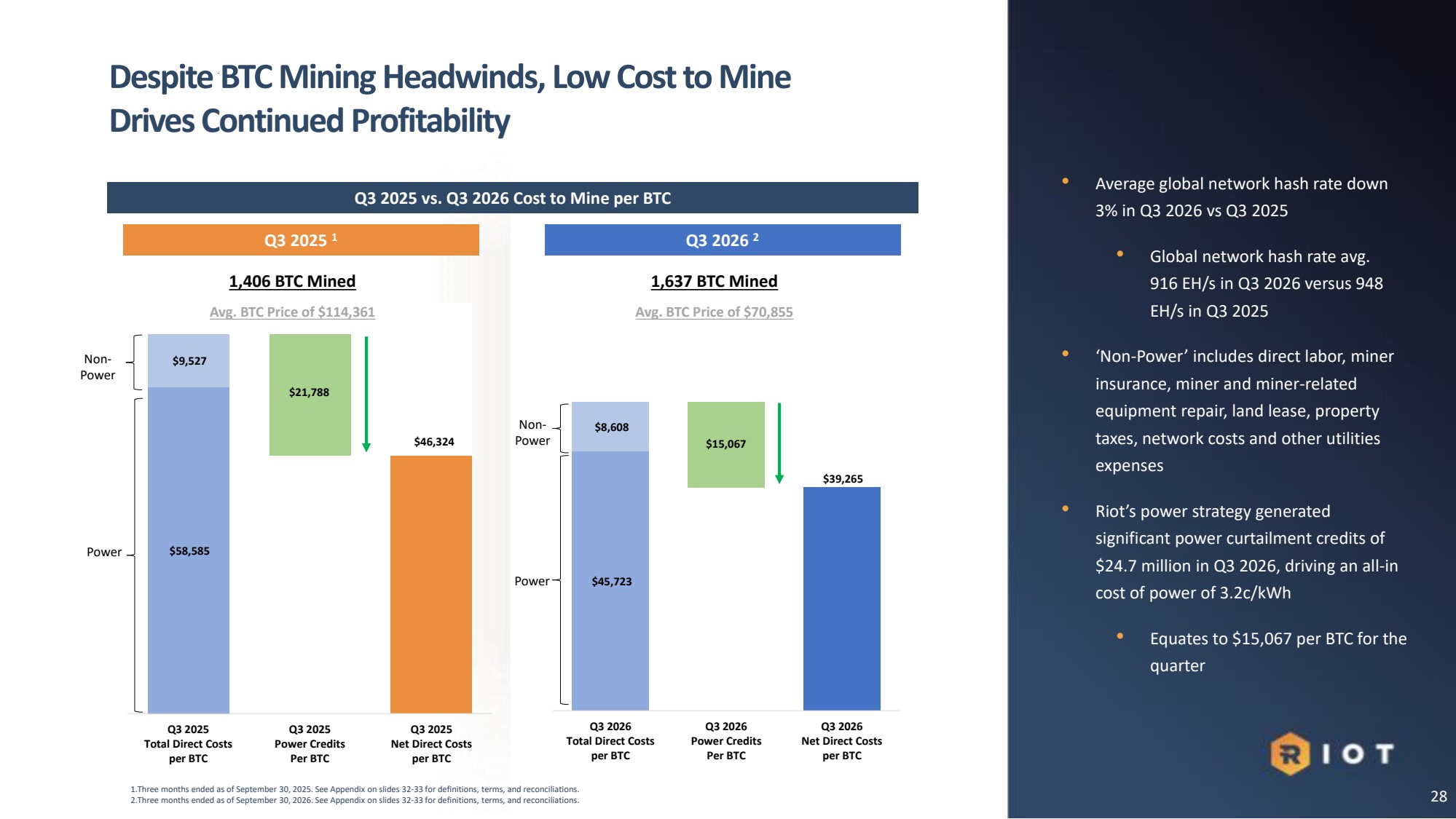
Riot Platforms recorded $24.7 million in power curtailment credits during the third quarter of 2026, reducing the reported cost of operating its Bitcoin mining fleet even as mining revenue fell. In its November 4 results, the Texas-focused miner said the credits equaled $15,067 per bitcoin produced, while its average mining cost excluding depreciation declined to $39,265 per coin from $46,324 a year earlier.
The credits reflect a strategy beyond simply running ASIC miners continuously. Large facilities purchase electricity under contracts and can reduce demand or sell unused contracted power when grid conditions make curtailment attractive. Riot’s Form 10-Q describes both unused-power sales under power purchase agreements and participation in grid ancillary services in ERCOT and MISO. The accounting credits vary with weather, fuel costs and demand.
Mining output rose, but revenue declined
Riot produced 1,637 BTC in July–September 2026, compared with 1,406 BTC in the corresponding 2025 period—an increase of roughly 16%. Yet Bitcoin mining revenue decreased to $116.0 million from $160.8 million, a decline of about 28%. The company cited a lower average production value of $70,855 per bitcoin compared with $114,361 a year earlier. Higher production therefore did not offset lower pricing.
Its SEC-filed earnings release reports the average cost per bitcoin excluding miner depreciation fell approximately 15% year over year. Power credits totaled $30.6 million during the 2025 quarter, compared with $24.7 million in 2026. Less credit income does not necessarily mean worse grid performance: the volume and value of interruptions depend on dispatch and wholesale conditions.
Depreciation changes the profitability picture
A crucial limitation is excluded equipment depreciation. Riot’s earnings presentation reports $78,805 in cost per bitcoin including miner depreciation, above the quarter’s $70,855 average production value. The reported $39,265 figure represents an operating-cost measure, not a complete accounting profit per coin. Mining hardware wears economically as newer equipment offers more hashes for each joule; BitcoinVersus.Tech recently examined the decade-long rise in mining efficiency.
Riot’s calculated net power cost was 3.2 cents per kilowatt-hour during the quarter after credits. Flexible demand can help balance electricity systems during tight operating conditions, although participation also reduces time spent hashing. BitcoinVersus.Tech previously reported on Texas grid proposals affecting mining curtailment and the grid value of flexible mining loads. Those debates concern policy and actual load response, not guaranteed payments.
Power infrastructure now has competing buyers
Riot is simultaneously redirecting significant development capacity toward AI data centers. Its signed Corsicana lease is worth approximately $28 billion over 15 years if performed as contracted, but represents future payments rather than third-quarter cash received. BitcoinVersus.Tech covered the separate AI lease agreement in detail.
The latest quarter shows why access to power can be financially valuable even when mining margins narrow. For investors, separate measures matter: bitcoins produced, realized mining revenue, operating power credits, depreciation and any contracted future lease revenue. Riot’s filings substantiate a meaningful curtailment benefit, but do not imply that every miner can earn identical credits or that electricity flexibility eliminates Bitcoin price and equipment-replacement risks.
Editor’s Note: The $24.7 million power-credit figure, $15,067 credit value per BTC, 1,637 BTC output, 3.2¢/kWh net power cost, revenue and depreciation-inclusive costs were checked against Riot’s September 30, 2026 Form 10-Q, its November 4 earnings exhibit and reconciliation presentation. Values reflect company-defined metrics and rounded disclosures; credit revenue and depreciation-adjusted mining costs are not interchangeable with GAAP net income. The cover is an editorial illustration; facility photographs and the 2024 company video are historical background. Saved video rendering does not independently verify playback or mobile layout.

To donate 5,000 sats, open the article on a separate display and scan the original QR code with a compatible Bitcoin wallet. On mobile, use another screen or your wallet’s supported image-scanning feature. Verify the destination 3C9o19EH5HSiwEPyCTmEKzxhNCbo2X6TTb before sending.
We volunteer daily to ensure the information on this platform is Verifiably True. If you would like to support the research, please scan QR code.
BitcoinVersus.tech is not a financial advisor. Coverage of mining, technology, and public-company results is provided for informational purposes.


Leave a Reply