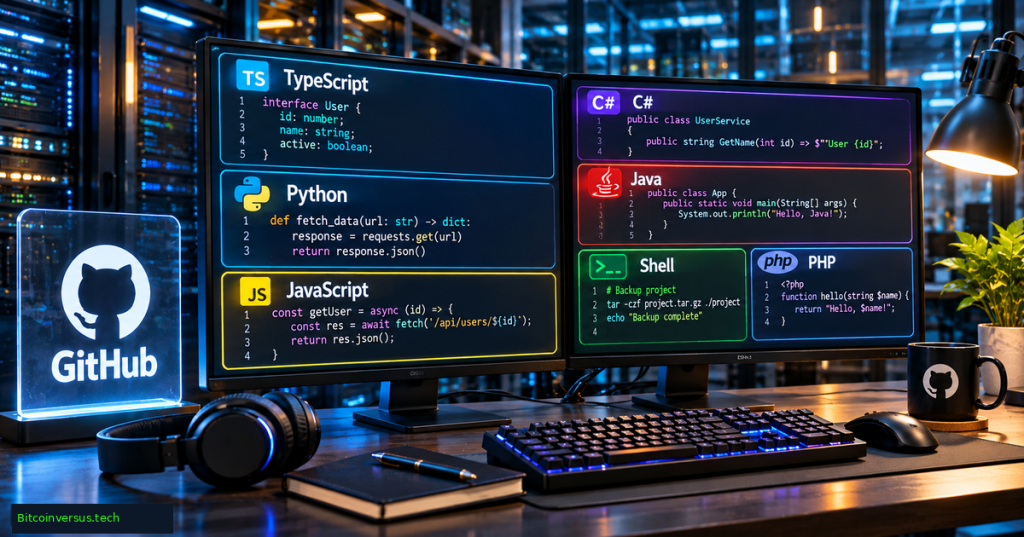
Programming languages organize instructions that computers can execute, but popularity rankings can measure very different activities: repository counts, code changes, survey responses or active contributors. GitHub’s October 2026 Octoverse report ranks languages by monthly contributing accounts and shows TypeScript, Python and JavaScript maintaining the three leading positions. GitHub’s chart also identifies C#, Java, Shell and PHP as the next four through September 2026. The results measure development participation on GitHub, not the worldwide number of programmers fluent in each language.
GitHub, “Opening keynote: building the next era of software at GitHub Universe 2026” (October 28, 2026) — Official event video discussing the developer platform and AI agents. The Octoverse ranking is sourced separately from GitHub’s published report.
How GitHub Counts Language Participation
GitHub counts distinct accounts that participate in pushes, pull requests, issues, reviews or comments during a month, attributing the activity to a repository’s primary language as identified by Linguist. An account can be counted in several languages. Rankings use observed activity through September 2026, whereas the later dotted lines in GitHub’s chart are forecasts through September 2027. The site’s Git and GitHub reference explains the repository and contribution model.
The Top Seven Programming Languages
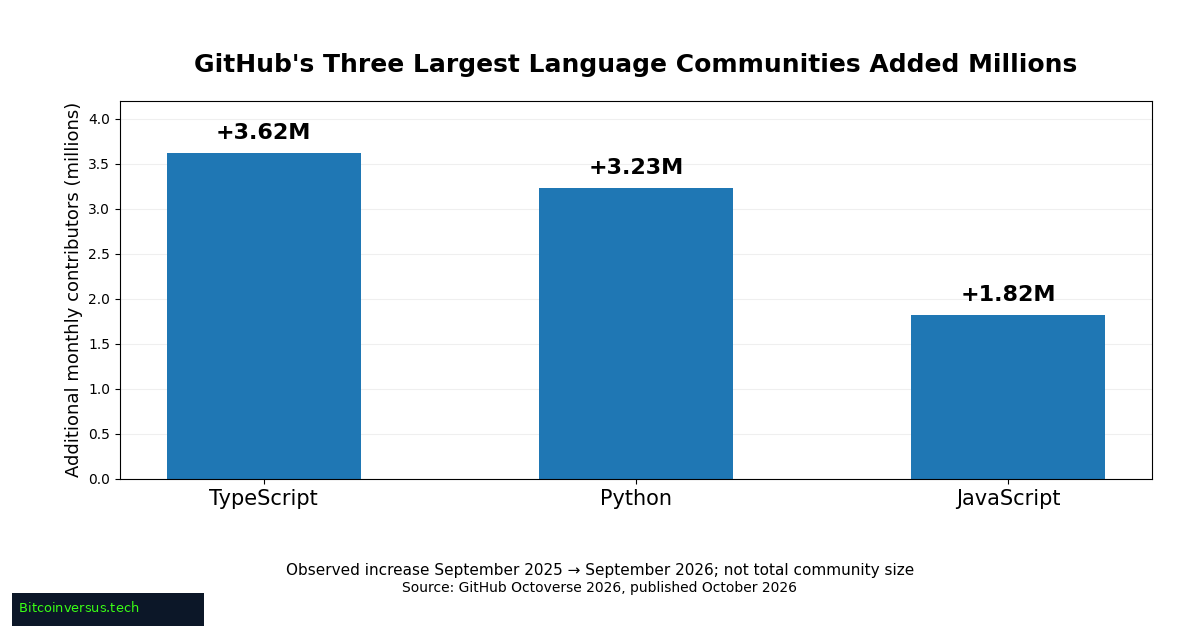
1. TypeScript. The typed extension of JavaScript leads GitHub by monthly contributors. Its community added 3.62 million monthly contributing accounts between September 2025 and September 2026. Static typing helps expose interface mismatches before execution; GitHub’s data also show strong adoption in repositories associated with coding agents.
2. Python. Python ranks second and added 3.23 million monthly contributors over the same period. Machine learning, automation and data processing remain major use cases. Ranking below TypeScript does not mean Python handles fewer artificial-intelligence workloads.
3. JavaScript. JavaScript is third after adding 1.82 million monthly contributors. Browsers execute JavaScript directly, while server runtimes make it useful beyond websites. Beginners can explore its runtime model in BitcoinVersus.Tech’s JavaScript fundamentals lesson.
4. C#. C# ranks fourth in GitHub’s 2026 chart, ahead of Java. Applications built with .NET span enterprise services, games and desktop software. The site’s C# control-flow lesson covers essential language structure.
GitHub, “Run code generation in the background with GitHub Copilot coding agents | GitHub Checkout” (February 18, 2026) — Official technical demonstration of agent-driven development. It illustrates evolving workflows rather than independently measuring the language rankings.
5. Java. Java remains prominent in long-lived enterprise applications and Android-related tooling. Its position is based on the same monthly-contributor metric, not an estimate of installed software or corporate spending.
6. Shell. Scripts used to operate development tools, automate servers and manage build pipelines contribute to Shell’s position. A repository’s primary-language classification can differ from the languages inside its supporting scripts.
7. PHP. PHP remains active in website back ends and content-management systems. BitcoinVersus.Tech’s PHP runtime introduction explains its command-line and web-development roles.
AI Is Reshaping Language Selection
GitHub found detected AI involvement in 44.1% of merged TypeScript pull requests and 41.1% for Python, compared with 21.2% for Java. The measure identifies GitHub-detectable involvement, not the percentage of code written by a model. Rust, although outside the seven leading communities, recorded 162% community growth and 40.4% AI involvement in merged pull requests.
Across repositories created in 2026, TypeScript was the primary language in 35% of projects with an observed agent signal versus 24% of those without one. Such correlations do not establish that AI agents caused the language shift. Readers can compare the earlier Octoverse news brief with the GitLab coding-agent study, which measures a different activity.
What the Ranking Cannot Prove
A popular language on GitHub is not necessarily the top choice for hiring, security, execution speed or maintenance cost. Surveys, code-search indexes and repository-star totals measure different populations. GitHub projects TypeScript and Python nearing 13 million monthly contributors each by September 2027, but those figures are forecasts, not achieved results. The observed ranking is a platform-specific snapshot, and participation can shift as GitHub’s user base and agent usage grow.
Primary sources: GitHub Octoverse 2026, October 2026; GitHub Octoverse methods and historical comparison; GitHub Linguist classification project.
BitcoinVersus.Tech Editor’s Note
Published November 8, 2026. Ranking positions are based on GitHub’s observed monthly-contributor chart through September 2026. The growth chart reproduces reported increases for the top three only; no unsupported contributor totals were estimated for C#, Java, Shell or PHP. AI-related percentages concern detected involvement in merged pull requests, not the proportion of generated code. The featured image is conceptual artwork rather than a captured developer workstation. GitHub video embeds supply relevant background but do not independently validate Octoverse data.
We volunteer daily to ensure the information on this platform is Verifiably True. If you would like to support the research, please scan QR code.

Support independent reporting with an optional donation of 5,000 satoshis. Scan the original QR on another screen with a Bitcoin wallet, or use a compatible saved-image scanner on mobile. Verify address 3C9o19EH5HSiwEPyCTmEKzxhNCbo2X6TTb and amount before sending.
BitcoinVersus.Tech is not a financial advisor. Financial coverage is provided purely for informational purposes.


Leave a Reply