Software-development teams store source code, merge requests, test results, deployment histories and security findings in separate workflows. AI coding agents can inspect files yet still miss the production system affected by a proposed change. On October 29, 2026, GitLab made GitLab Orbit generally available for GitLab.com Premium and Ultimate customers, offering a searchable context graph that connects those records. GitLab reports more than 3,500 organizations have used Orbit since its beta and their agents have submitted over 280,000 queries. The figures describe adoption and activity, not independently measured software quality.
GitLab’s official September 3, 2026 video, “GitLab Orbit Overview: Giving AI Agents Full Software Development Context.” Product demonstration explains connected code, pipelines, deployments and security findings; not a third-party benchmark.
One Graph Across the Software Lifecycle
GitLab Orbit indexes relationships between code symbols, merge requests, work items, pipelines, vulnerabilities and owners. A connected agent can ask which production services depend on vulnerable software or who owns a failed pipeline. Access remains filtered by the requester’s existing GitLab permissions. The approach extends beyond ordinary repository searches, a challenge also apparent in the site’s GitHub Octoverse reporting on growing automated coding activity.
GitLab says Claude Code, Codex, Cursor and other compatible agents can query Orbit through Model Context Protocol (MCP), the GitLab CLI or supported interfaces. A graph answer can reference a pipeline, its originating code change and a responsible team without forcing an agent to reconstruct the relationships through repeated file scans. The integration resembles, but is distinct from, the GitHub Agentic Workflows automation discussed previously.
What the Accuracy Tests Actually Measured
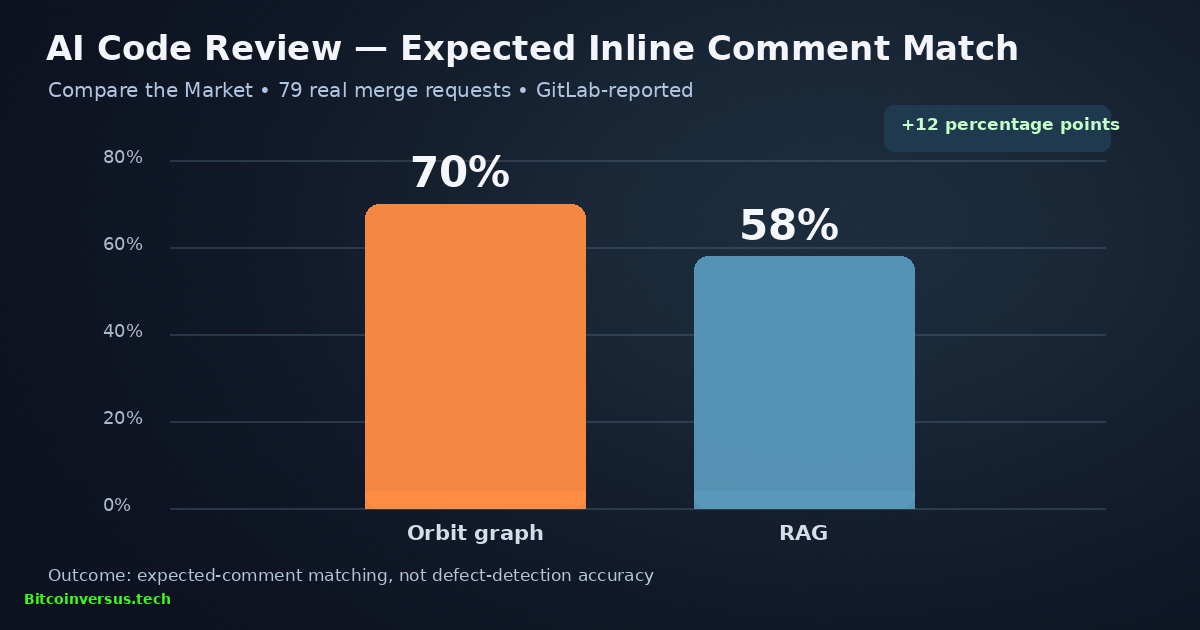
A customer example offers a concrete comparison. UK financial comparison company Compare the Market tested four context strategies for an AI code reviewer across 79 real merge requests. According to GitLab, the Orbit-backed reviewer matched approximately 70% of expected inline comments, versus 58% using retrieval-augmented generation (RAG). The difference is 12 percentage points, or approximately 20.7% higher relative matching against the RAG result. Comment matching is not equivalent to a universal vulnerability-detection rate or a production outage reduction.
GitLab separately reports up to 45 times fewer agent retries and up to 4.5 times fewer tokens for its internal same-task, same-model testing. Both figures represent vendor-described best cases, not guaranteed average savings. Publicly disclosed information does not provide enough task-level data to reproduce an independent benchmark, and token reductions do not necessarily translate linearly into subscription savings.
GitLab’s official July 6, 2026 video, “How GitLab Orbit Works (Architectural Overview).” Product and engineering staff describe a graph index, event-driven updates and permissions handling; performance claims require separate validation.
Security Coverage and Operational Limits
A context graph may help teams trace affected services when a dependency vulnerability appears, complementing the kinds of static-analysis findings addressed in the site’s CodeQL security tooling coverage. Graph results still depend on accurate indexing, appropriate permissions and current source records. Human review, reproducible tests and deployment checks remain necessary; connecting more context cannot guarantee safe code.
GitLab sells Orbit through organizational query packs rather than an unlimited feature for every account. Its October 29 launch announcement specifies Premium and Ultimate availability on GitLab.com first, with Self-Managed and Dedicated rollouts planned for subsequent weeks. Teams need to evaluate query consumption, graph coverage, access controls and actual engineering outcomes. The site’s VS Code remote-agent report examines another part of the expanding coding-agent ecosystem.
GitLab’s stated improvement is more complete software-lifecycle context, not a new AI model. Independent comparisons across larger repositories, different agents and varied development tasks would establish how consistently the claimed gains translate into practical delivery.
Primary sources: GitLab general-availability announcement, October 29, 2026; GitLab technical launch analysis, October 29; GitLab Orbit documentation; GitLab pricing and availability. The two accompanying videos come from GitLab’s verified YouTube channel.
BitcoinVersus.Tech Editor’s Note
Published November 8, 2026. Product availability, adoption counts and internal benchmark figures are attributed to GitLab. The 79-merge-request study comes from a customer example reported by GitLab and has not been independently reproduced by BitcoinVersus.Tech. Percentage-point and relative calculations use the published approximate results. The featured cover is an original conceptual illustration rather than a screenshot of a production system; the in-story chart is an editorial visualization. Both GitLab videos show product concepts and architecture, not independent proof of reported performance.
We volunteer daily to ensure the information on this platform is Verifiably True. If you would like to support the research, please scan QR code.

Support independent research with an optional donation of 5,000 satoshis. Scan the QR from a separate screen using your wallet, or use a compatible saved-image scanner on mobile. Confirm destination 3C9o19EH5HSiwEPyCTmEKzxhNCbo2X6TTb and the amount before sending.
BitcoinVersus.Tech is not a financial advisor. Financial coverage is provided purely for informational purposes.


Leave a Reply