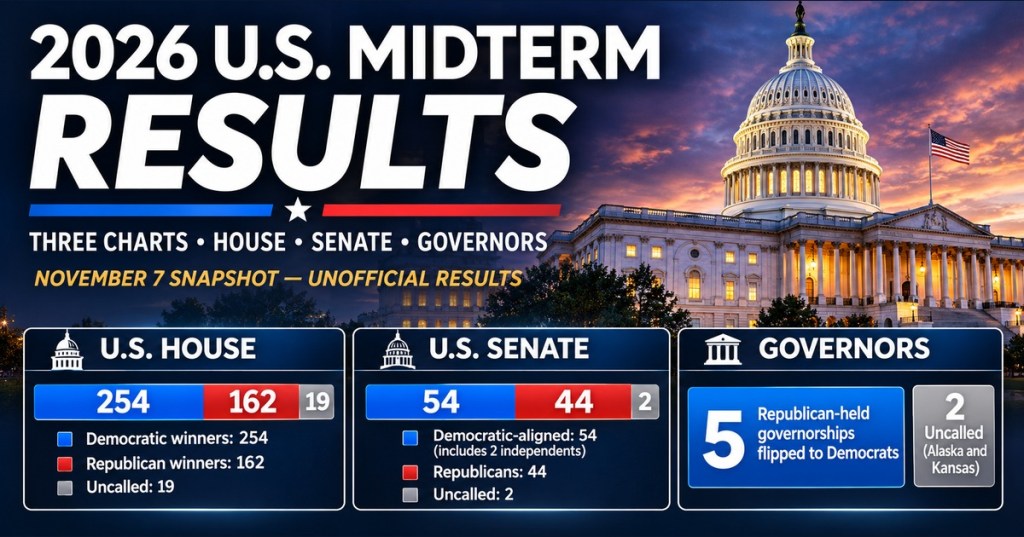
Democrats won control of both houses of Congress in the November 3, 2026 U.S. midterms, according to Associated Press projections. They also captured at least five Republican-held governorships. Three original charts tell the numerical story: 254 House seats called for Democrats, 54 Democratic-aligned Senate seats, and five governorships switching parties. Figures are fixed to a November 7 snapshot, with outstanding races explicitly marked. Projected winners are not official, state-certified results.
1. House majority: 254 Democrats, 162 Republicans
As of November 7 at 12:09 p.m. Eastern, the AP-based congressional tracker showed Democrats winning 254 seats, Republicans 162, and 19 of 435 districts not yet called. The House majority threshold is 218, placing Democrats 36 seats above it. Some outstanding contests may proceed to further counting or runoffs, and the final balance could change.
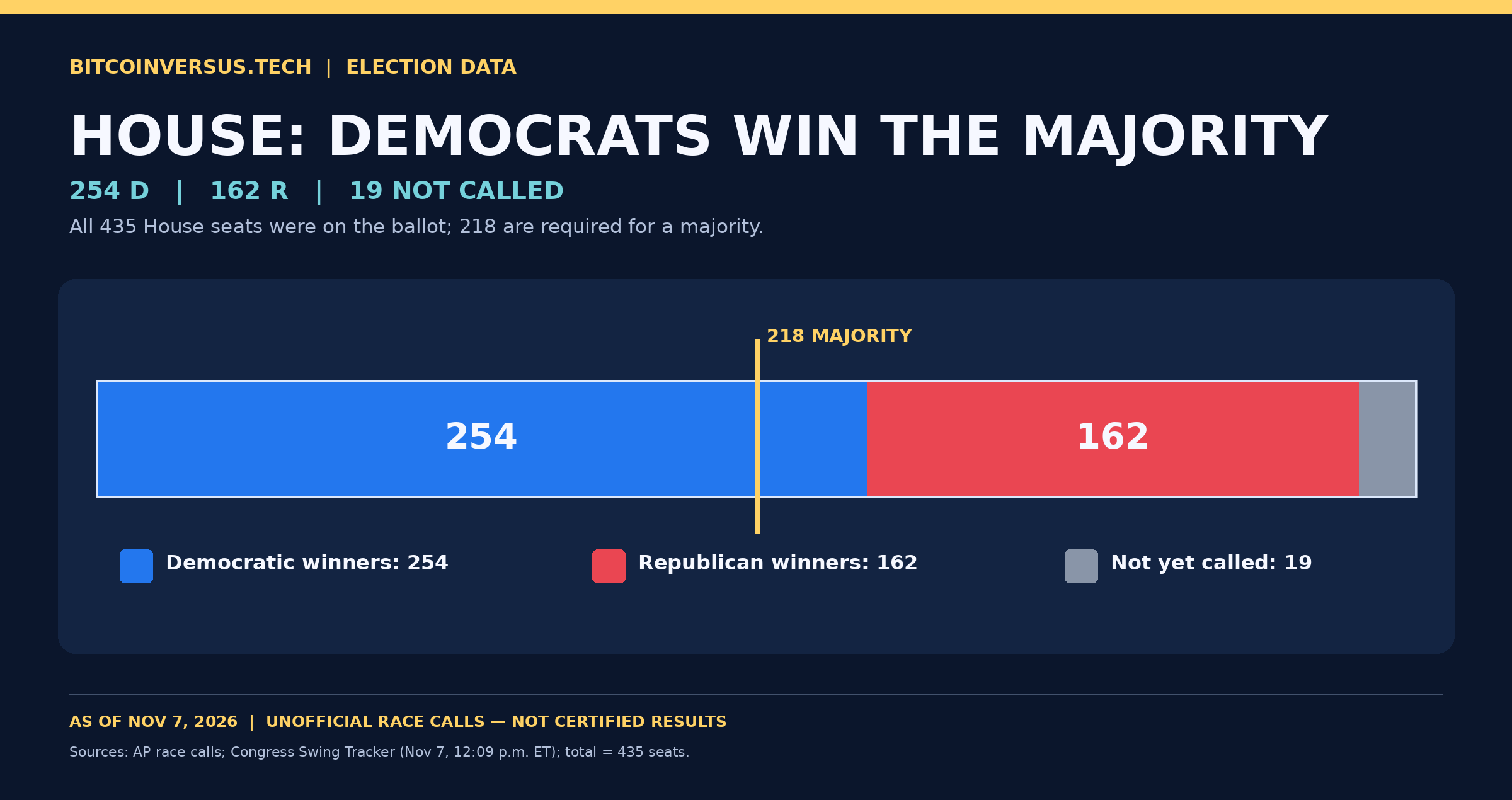
The Associated Press called House control at 1:24 a.m. ET on November 4. Its projection establishes the majority, but not a final national vote share, voter turnout total or certified seat margin. House leadership will shape committee agendas that may revisit cryptocurrency industry campaign priorities and digital-asset legislation.
Election technology was also a policy issue before voting began. BitcoinVersus.Tech previously covered an FCC petition concerning AI political robocalls. An altered congressional majority does not itself determine how such rules or proposed laws will evolve.
2. Senate shift: seven seats flip from Republicans
Senate control swung from 53 Republican to 47 Democratic-aligned seats before the election to 54 Democratic-aligned, 44 Republican and two uncalled after the November 7 race calls. The 54 total consists of 52 Democrats plus two sitting independents who caucus with Democrats. Alaska and Mississippi remained unresolved, and no projected leader in either state is counted as a winner.
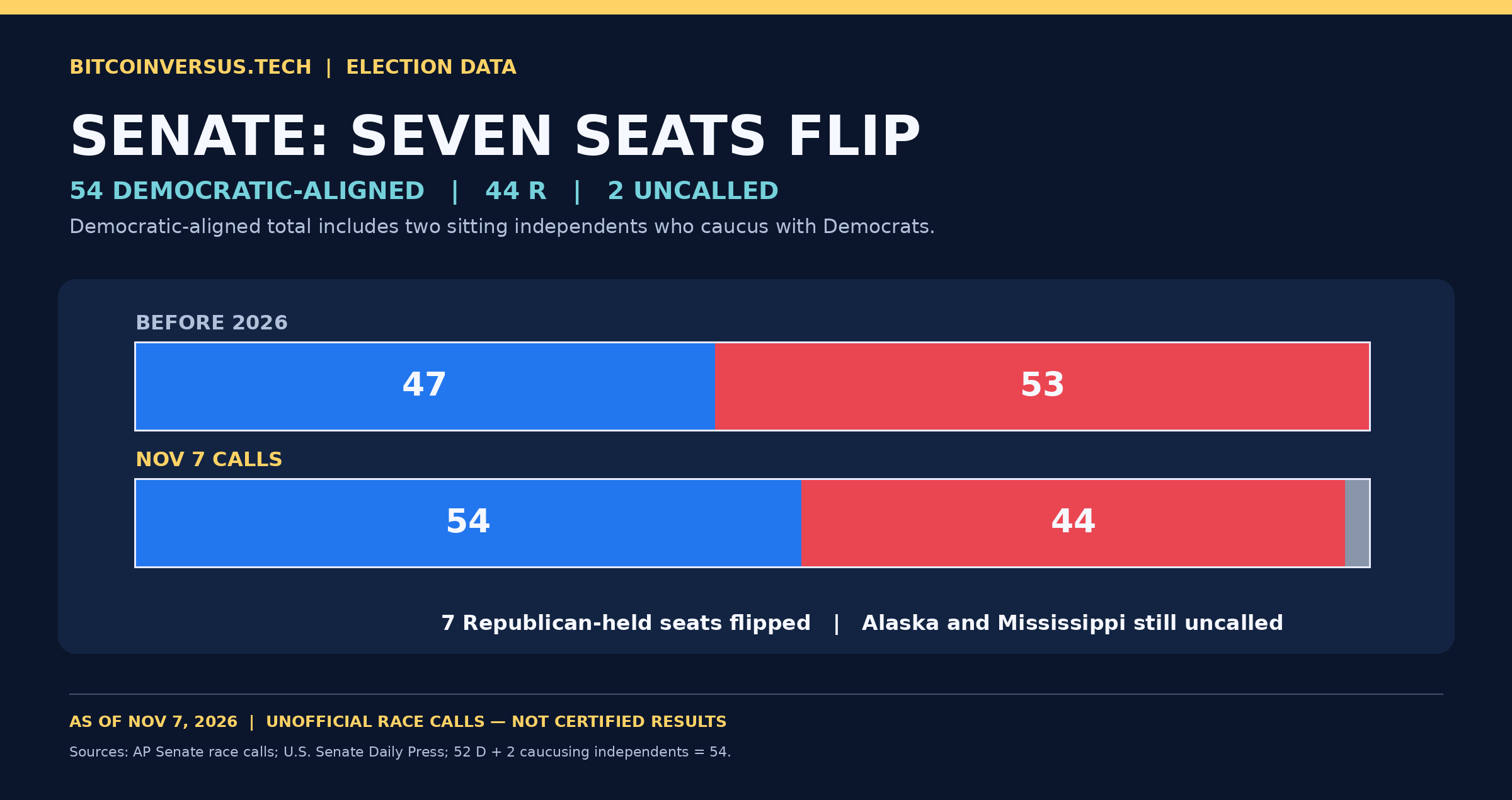
The AP called Democratic Senate control at 11:36 p.m. ET on November 3. The seven confirmed flips came in Iowa, Kansas, Maine, North Carolina, Ohio, South Carolina and Texas. A 51-seat majority is required in the 100-seat chamber; the Democratic-aligned caucus had already passed that threshold. Committee organization and confirmations could change, although Senate procedure and presidential vetoes remain constraints. An earlier BitcoinVersus.Tech report explored bipartisan Bitcoin ownership arguments, without implying party control resolves the debate.
3. Governorships: five Republican-held offices switch
Before Election Day, Republicans controlled 26 governorships and Democrats 24. The November 7 snapshot shows Democrats with 28 called offices, Republicans 20, and two unresolved contests in Alaska and Kansas. Five Republican-held offices flipped to Democrats: Georgia, Iowa, Nevada, Ohio and Texas. The missing uncalled states explain why 28 is not simply 24 plus five.
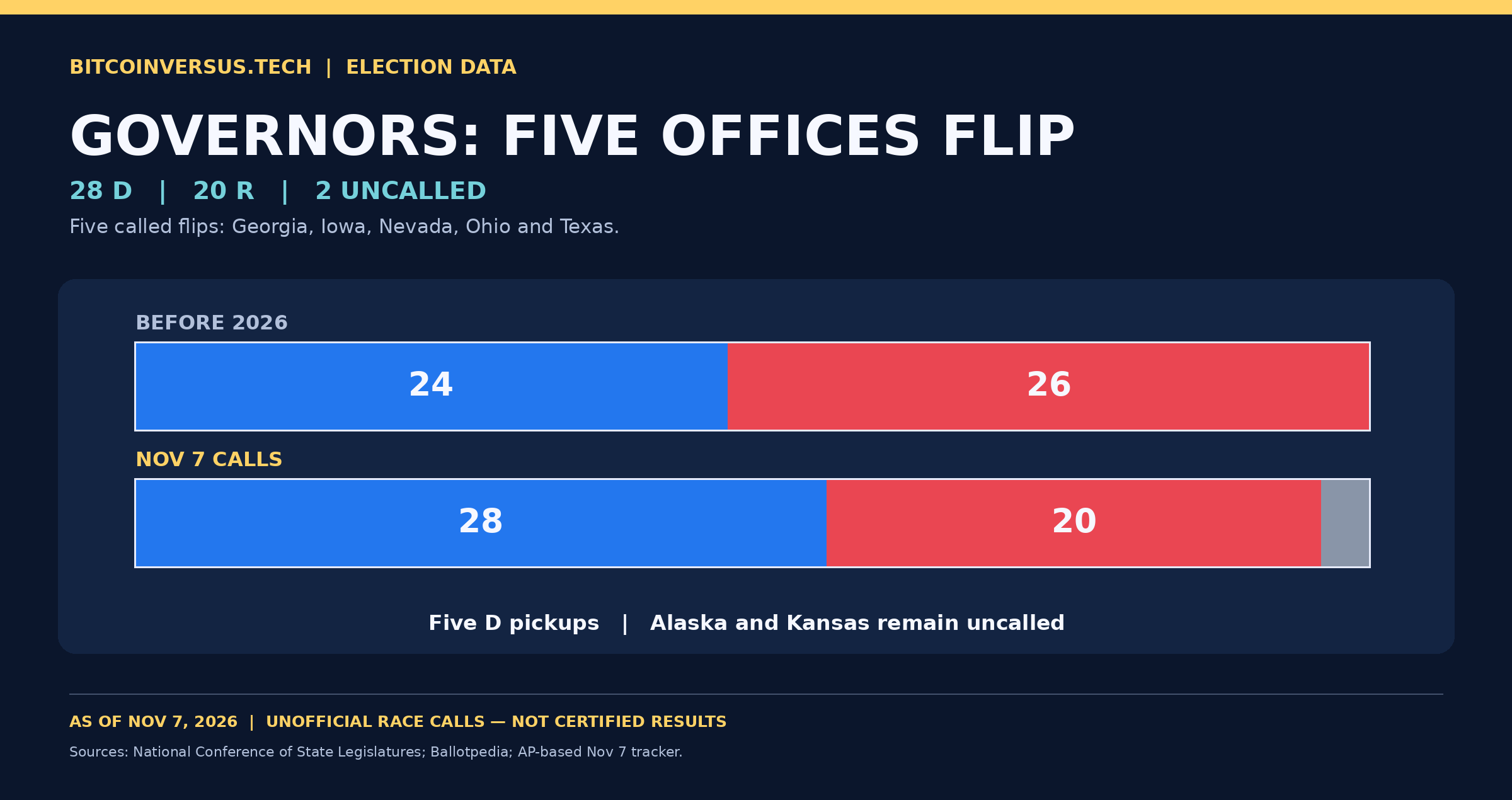
The nonpartisan National Conference of State Legislatures independently identified the same five pickups. Governors can influence data-center permitting, energy incentives, utility oversight and state budgets, subjects previously examined in BitcoinVersus.Tech’s data-center electricity-ratepayer coverage. Actual decisions will depend on state legislatures, regulators, and the incoming administrations rather than election-night projections alone.
Why the results remain provisional
The Ballotpedia election archive and individual state election offices will update their records as voting and certification processes conclude. Congressional control has been called, but 19 House districts, two Senate contests and two governor races remain uncalled in the chart snapshot. Race calls, certified outcomes, popular votes, and future policy outcomes represent distinct statistics. Keeping the undecided seats visible prevents misleading certainty.
Editor’s Note: November 7, 2026 election-night follow-up, based on the AP-based Congress Swing Tracker at 12:09 p.m. ET, Associated Press election-control chronology, U.S. Senate Daily Press, NCSL and Ballotpedia. Chart arithmetic was checked independently: 254+162+19=435 House seats; 54+44+2=100 Senate seats; 28+20+2=50 governorships. The Senate’s Democratic-aligned category includes two independent senators who caucus with Democrats. All chart data are unofficial snapshots rather than certification or final popular-vote tabulations. The featured U.S. Capitol scene is a conceptual editorial illustration rather than an actual election-night photograph. No unverified video or social-media post was used.

To donate 5,000 sats, open the article on a separate display and scan the original QR code with a compatible Bitcoin wallet. On mobile, use another screen or your wallet’s supported image-scanning feature. Verify the destination 3C9o19EH5HSiwEPyCTmEKzxhNCbo2X6TTb before sending.
We volunteer daily to ensure the information on this platform is Verifiably True. If you would like to support the research, please scan QR code.
BitcoinVersus.tech is not a financial advisor. Election, technology and policy reporting is informational and does not advocate for a candidate or political party.


Leave a Reply