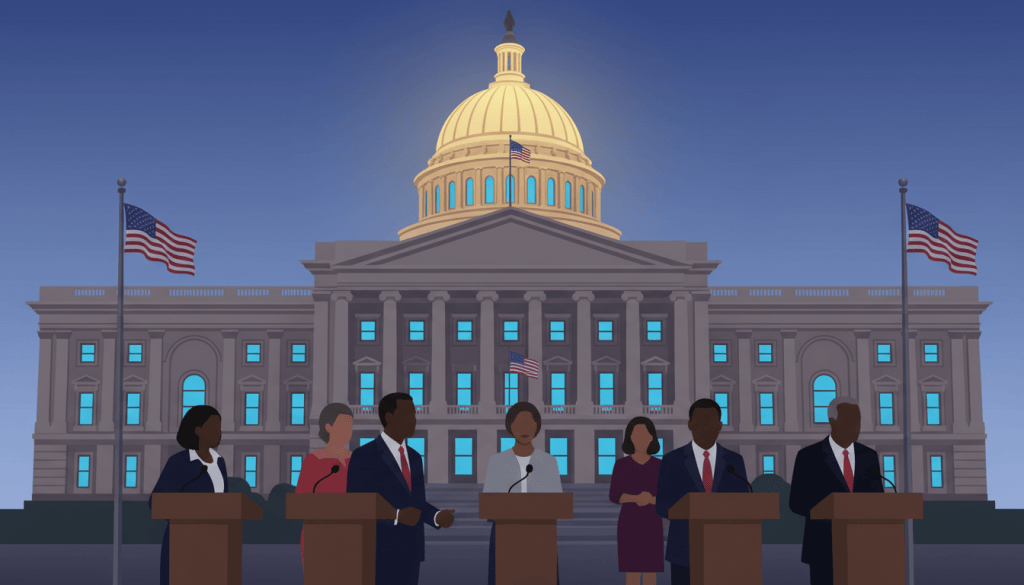
The November 3, 2026 midterm elections produced a historic Democratic advance in governors’ races, alongside unprecedented victories for Black, Native American, Latina and female candidates. The results were more than a partisan swing: they changed who can plausibly win executive power in states that had never elected governors from several of those communities.
Democrats flipped Georgia, Iowa, Nevada, Ohio and Texas without losing a governorship in the races counted in an early post-election analysis. That left Democrats with at least 28 governorships against 20 Republicans, while Alaska and Kansas remained unresolved in the cited November 5 accounting. The party was positioned to hold a majority of governors for the first time in 16 years. The totals are provisional, not certified final results.
The Democratic gains crossed familiar political boundaries
Georgia elected former Atlanta Mayor Keisha Lance Bottoms, ending a Democratic gubernatorial drought dating to 1998. Texas voters chose Democratic state legislator Gina Hinojosa over incumbent Republican Greg Abbott, a particularly consequential result because Texas had not elected a Democrat statewide for decades. Iowa elected Rob Sand and Ohio elected Amy Acton, ending Democratic gubernatorial droughts dating to 2006. Nevada elected Democratic Attorney General Aaron Ford over Republican Gov. Joe Lombardo.
The shift was not uniform. Florida elected Republican Byron Donalds, and Tennessee elected Republican Marsha Blackburn. Those results matter because the election’s historic representation gains were not exclusively Democratic. Earlier BitcoinVersus.Tech analysis of the midterms in three charts addresses broader partisan changes; the governor results warrant a separate examination of representation and state power.
Watch ABC News’ verified November 3 election-night victory address by Keisha Lance Bottoms. Source: ABC News. The publisher does not provide a working WordPress player on the site.
Official news photography: The Associated Press published a photo report showing Byron Donalds, Keisha Lance Bottoms and Deb Haaland. Images remain hosted by AP rather than reproduced without a verified reuse license. Credit: Associated Press.
ABC News: Keisha Lance Bottoms discusses the 2026 Georgia governor race following her May primary victory. Earlier footage, not her November victory address.
Georgia elected the nation’s first Black woman governor
1872–1873 — P. B. S. Pinchback serves as Louisiana’s acting governor
1875 — Romualdo Pacheco serves as California governor
1998–1999 — Nancy Hollister briefly serves as Ohio governor through succession
2026 — First Black woman and first Native American woman elected U.S. state governors
Bottoms became the first Black woman elected governor of any U.S. state and Georgia’s first woman governor. The Associated Press reported that Georgia’s preceding 83 governors were white men. Her election followed Stacey Abrams’s unsuccessful Democratic gubernatorial bids in 2018 and 2022 and marks a national milestone after 250 years of American history.
The achievement does not automatically guarantee her legislative program. Republican control of at least part of Georgia’s legislature could constrain proposals on Medicaid, wages, abortion policy and data center development. Her election changes representation immediately, while policy outcomes depend on budgets, legislation and courts.
Watch PBS NewsHour’s November 4 interview with Deb Haaland about becoming the first Native American woman elected governor. Source: PBS NewsHour. The publisher does not provide a working WordPress player on the site.
New Mexico elected the first Native American woman governor
Deb Haaland, a citizen of Laguna Pueblo and former U.S. interior secretary, became the first Native American woman elected governor in U.S. history. She was already among the first Native American women elected to Congress in 2018 and became the first Native American Cabinet secretary in 2021. New Mexico also elected an all-women-of-color gubernatorial leadership ticket, according to Rutgers University’s Center for American Women and Politics.
Haaland’s victory adds to a history in which Native American governors have been rare. Oklahoma previously elected Johnston Murray, a Chickasaw citizen, and Kevin Stitt, a Cherokee Nation citizen. Haaland’s win is specifically a first for Native American women, not the first Native American governor overall.
Four states elected their first Black governors
Georgia’s Bottoms, Florida’s Donalds, Nevada’s Ford and Wisconsin’s David Crowley became the first Black governors elected in their respective states. Donalds also became the first Black Republican elected governor in U.S. history, according to Stateline. Maryland’s Wes Moore won reelection. Together, the five are set to serve simultaneously, a record level of Black gubernatorial representation.
The distinction between being elected and briefly serving matters. P. B. S. Pinchback, a Black Republican, served as Louisiana’s acting governor during Reconstruction in 1872–1873 but was not elected governor. The 2026 election therefore marks a different milestone for Donalds.
Texas and California changed Latino representation
Women serving as U.S. governors
Hinojosa became Texas’s first Latina governor. California elected Xavier Becerra, its first Latino governor since Romualdo Pacheco held the office in 1875. Neither is the nation’s first Latino governor: the historical claim concerns the respective states and, in Hinojosa’s case, gender. The victories place Latino leaders in the top executive offices of the country’s two most populous states.
BitcoinVersus.Tech previously examined Georgia and Texas’s political realignment. Population growth, suburban voting and candidate-specific factors may contribute to election results, but no single cause has been established by the outcome alone.
Women set a national governors’ record
Rutgers University’s Center for American Women and Politics calculated that at least 17 women will serve as governors in 2027, compared with the prior record of 14. At least 14 will be Democrats and three Republicans, meaning women will hold at least 34% of governorships. That is an increase of three seats, or 21.4%, over the previous record. Two races involving women were still unresolved in the November 5 tally.
Georgia, Minnesota and Tennessee elected their first women governors. Ohio elected its first woman governor through a general election, Amy Acton, although Nancy Hollister briefly served as governor through succession in 1998–1999. Minnesota’s Amy Klobuchar and Tennessee’s Blackburn also established state-specific milestones. Rutgers reported 26 major-party women nominees for governor in 2026, a record, including 19 Democrats and seven Republicans.
Historic firsts extended beyond governors
The broader election produced the first Native American woman elected to the U.S. Senate, Minnesota’s Peggy Flanagan; the first Muslim U.S. senator, Michigan’s Abdul El-Sayed; and the first openly gay male U.S. senator, New Hampshire’s Chris Pappas. Illinois elected Juliana Stratton, joining Tammy Duckworth to make the state the first represented by two women of color in the Senate. These are congressional milestones, distinct from gubernatorial firsts.
Why governors matter for technology and the next election
Governors oversee executive agencies, propose budgets, appoint officials and shape economic-development incentives. Their administrations influence electric-grid planning, utility oversight, data center permitting, workforce investment and cybersecurity procurement, although specific powers vary by state. BitcoinVersus.Tech’s reporting on AI data center backlash during the midterms and Virginia’s 54.9 GW data center power pipeline illustrates why state executive decisions matter to technology infrastructure.
Governors also play roles in state election administration and legislation ahead of the 2028 presidential election, although secretaries of state, legislatures, courts and local officials retain important independent authority. Divided government will limit what newly elected governors can enact without legislative support.
The historical significance of 2026 lies in two measurable changes: a Democratic majority of governorships after a long period without one, and a wider range of Americans winning offices previously closed to their communities. Final certifications may adjust seat counts, but the confirmed firsts already represent enduring milestones in state political history.
Editor’s Note: Election outcomes and firsts were checked against Associated Press reporting dated November 5, Rutgers Center for American Women and Politics election results, Rutgers’ November 5 statistical release and a dated state-election analysis. Counts for Alaska and Kansas were unresolved in the referenced reporting; certified results can supersede provisional totals. The cover is an AI-generated editorial illustration, not a photograph of elected governors.

To donate 5,000 satoshis, open the QR on a second screen and scan it with a compatible Bitcoin wallet. On mobile, use another device or your wallet’s supported saved-image QR scanner. Confirm the destination before transferring funds.
We volunteer daily to ensure the information on this platform is Verifiably True. If you would like to support the research, please scan QR code.


Leave a Reply