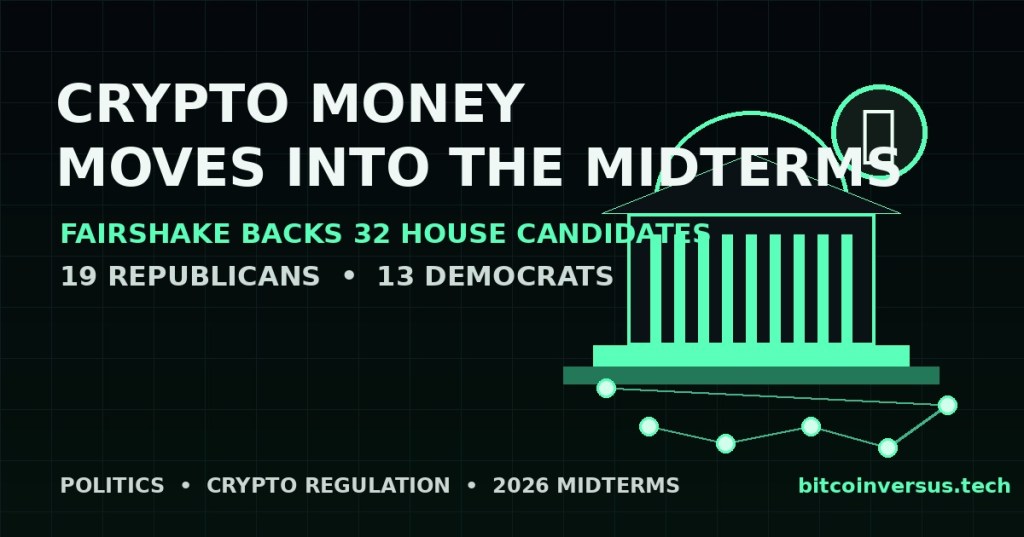
Crypto policy is moving from committee rooms into campaign spending. Fairshake, the industry-backed super PAC, is putting money behind a bipartisan slate of 32 U.S. House candidates as the fight over federal digital-asset rules heads into the final weeks of the 2026 midterm campaign.
The Associated Press reported that Fairshake’s new slate includes 19 Republicans and 13 Democrats. Six candidates are set to receive $1 million each in outside spending, while the PAC has not disclosed how much it plans to spend on the other 26 races.
The common denominator is crypto policy, not party
The unusual part of the slate is its balance across party lines. Fairshake’s strategy is centered on lawmakers it views as supportive of digital-asset legislation rather than on building a conventional Republican or Democratic coalition.
That matters because the industry’s central legislative objective remains unresolved. BitcoinVersus.Tech previously covered how the CLARITY Act moved toward a Senate decision after the House advanced a framework intended to define how federal agencies oversee digital-asset markets.
The legislation later stalled in the Senate, leaving market-structure rules unfinished before lawmakers broke for the election. That turns the composition of the next Congress into a direct policy variable for crypto companies, exchanges and investors that want a clearer split between securities and commodities oversight.
Fairshake still has a large war chest
AP reported that Fairshake and its affiliated political groups had about $120 million in cash on hand at the end of August after already spending more than $70 million during primaries this cycle. The new House push therefore represents only part of the money that could still enter competitive races before Election Day.
The broader industry’s political spending is even larger. Reuters reported in June that cryptocurrency companies had already supplied about $189 million to influence the 2026 election cycle, more than one-third of all corporate money contributed at that point.
Why the CLARITY fight matters so much
The crypto industry has spent years arguing that unclear jurisdiction between federal regulators makes it harder to launch products, operate exchanges and raise capital in the United States. Opponents of industry-backed legislation have focused on consumer protection, conflicts of interest, financial stability and whether proposed rules give regulators enough authority.
Congress has already shown that digital-asset legislation can move when a narrower issue reaches bipartisan agreement. BitcoinVersus.Tech covered the Senate passage of the GENIUS Act, which established a federal framework around stablecoins. Market structure has proved more difficult because it touches a wider set of agencies, products and political interests.
The election is becoming part of the regulatory process
Fairshake’s latest spending makes a simple point visible: when legislation stalls, industries do not stop pursuing policy. They shift some of the fight toward the lawmakers who will write and vote on the next version.
That dynamic is not limited to one bill. U.S. crypto policy has expanded from exchange regulation into stablecoins, banking access, taxation and federal holdings. BitcoinVersus.Tech previously documented the administration’s implementation of a U.S. crypto strategic reserve, another example of how digital assets have moved into mainstream federal policy.
What to watch after November 3
The immediate question is not whether Fairshake can elect an entirely pro-crypto Congress. It is whether the PAC can help preserve or expand a bipartisan bloc large enough to move digital-asset legislation through both chambers.
If the next Congress revives the CLARITY Act or a successor bill, the voting coalition may matter more than the party label attached to it. Fairshake’s 19-Republican, 13-Democrat slate is effectively a bet on that outcome.
BitcoinVersus.Tech
Advertisement
Editor’s Note
We volunteer daily to ensure the credibility of the information on this platform is Verifiably True. If you would like to support to help further secure the integrity of our research initiatives, please donate here: 3C9o19EH5HSiwEPyCTmEKzxhNCbo2X6TTb
BitcoinVersus.tech is not a financial advisor. This media platform reports on financial subjects purely for informational purposes.


Leave a Reply