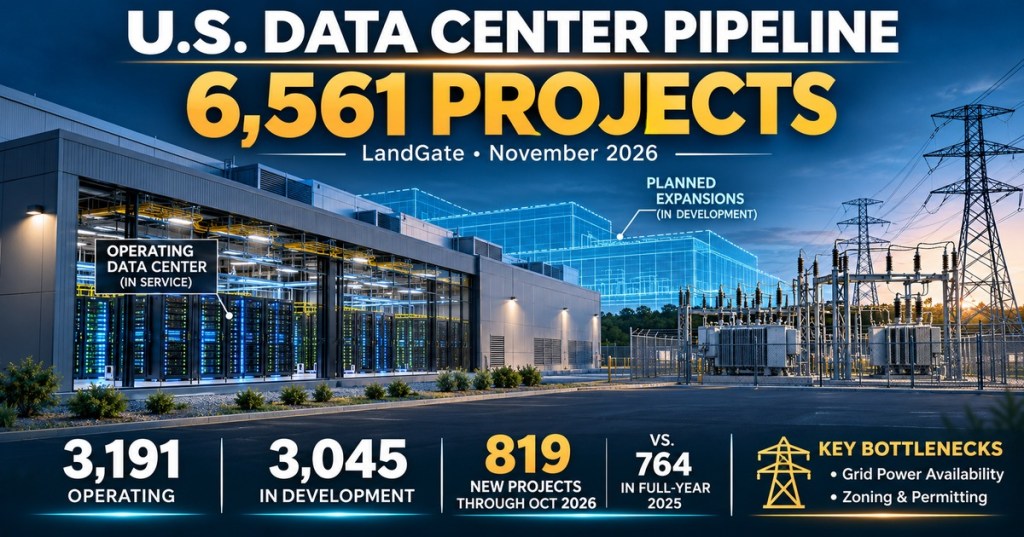
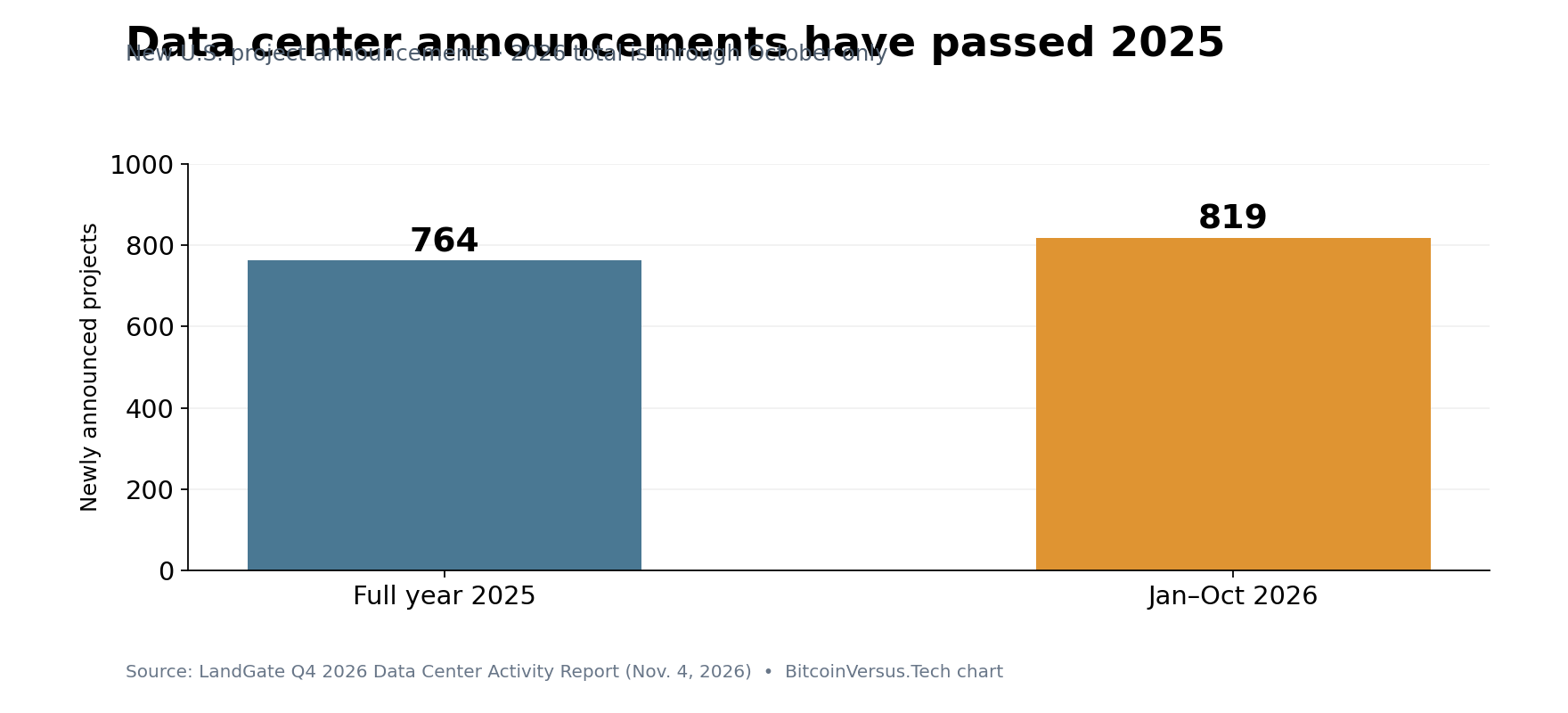
U.S. data center developers announced 819 new projects through October 2026, already surpassing the 764 announced during all of 2025, according to a November 4 report by infrastructure data provider LandGate, a Wood Mackenzie business. The difference is 55 projects, or 7.2% above the full-year 2025 tally, despite the shorter 2026 measurement period. The figures describe announcements, not completed construction or new operating power capacity.
Data centers combine compute servers, networking, storage, backup electricity and cooling. Expansion can take years because a planned campus needs suitable land, utility interconnection, transmission capacity, cooling systems, building permits and equipment procurement. A project entry should therefore not be read as one operational facility, one megawatt, or a guaranteed completion.
Nearly as many projects are planned as operating
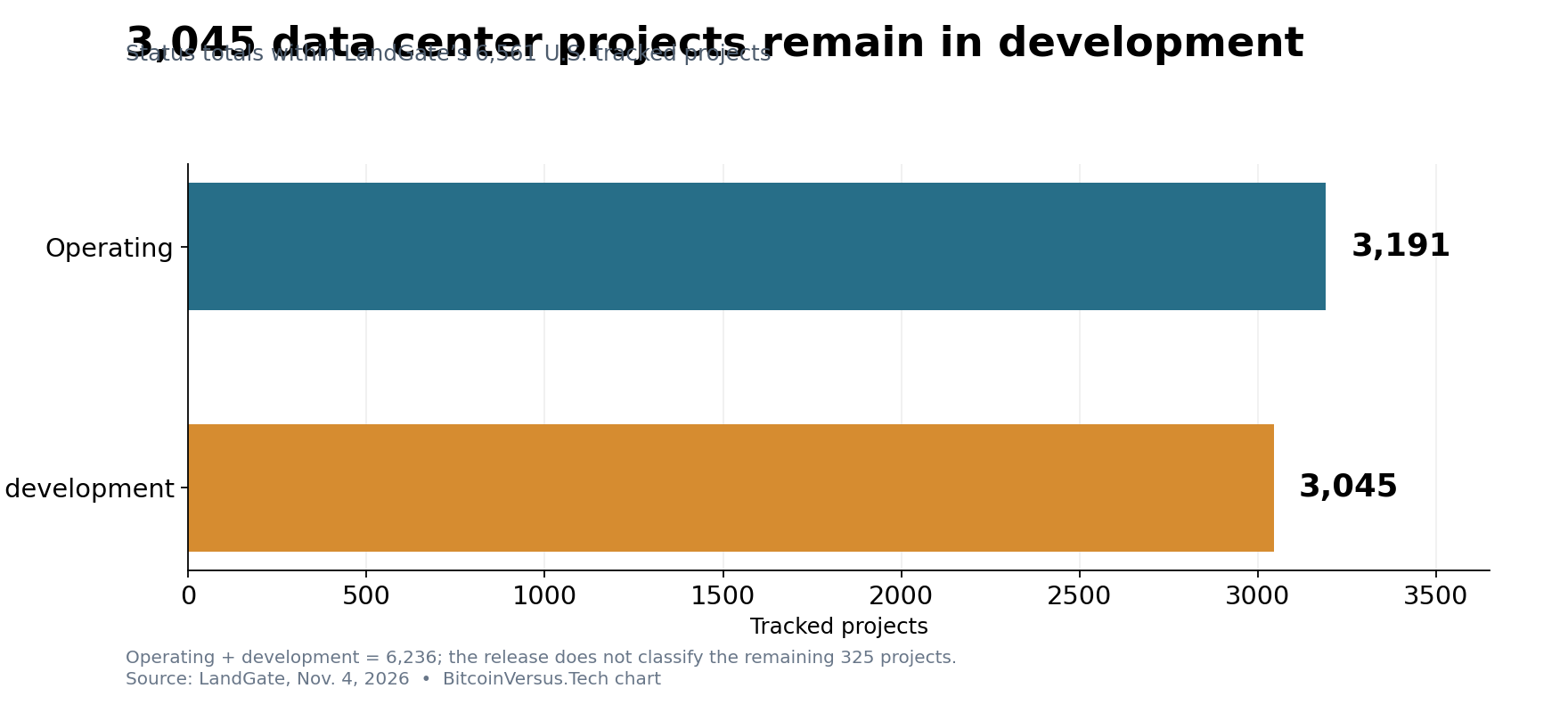
LandGate’s Q4 2026 project inventory covers 6,561 U.S. projects. Of those, 3,191 are operating and 3,045 are still in pre-operational development. The identified groups represent 48.6% and 46.4% of the total, respectively. Their sum is 6,236; the public summary does not assign a status to the remaining 325, so they should not be assumed to be operating or under construction.
The company classifies 2,154 developing projects as hyperscale, about 70.7% of its 3,045-project development inventory. Hyperscale sites typically involve larger computing deployments than conventional enterprise rooms, yet project count alone says nothing about connected megawatts, floor area, investment committed, or ultimate utilization. Earlier BitcoinVersus.Tech coverage examined AI racks approaching megawatt-scale power density, a different measurement from the number of facilities.
Five states hold about half the development pipeline
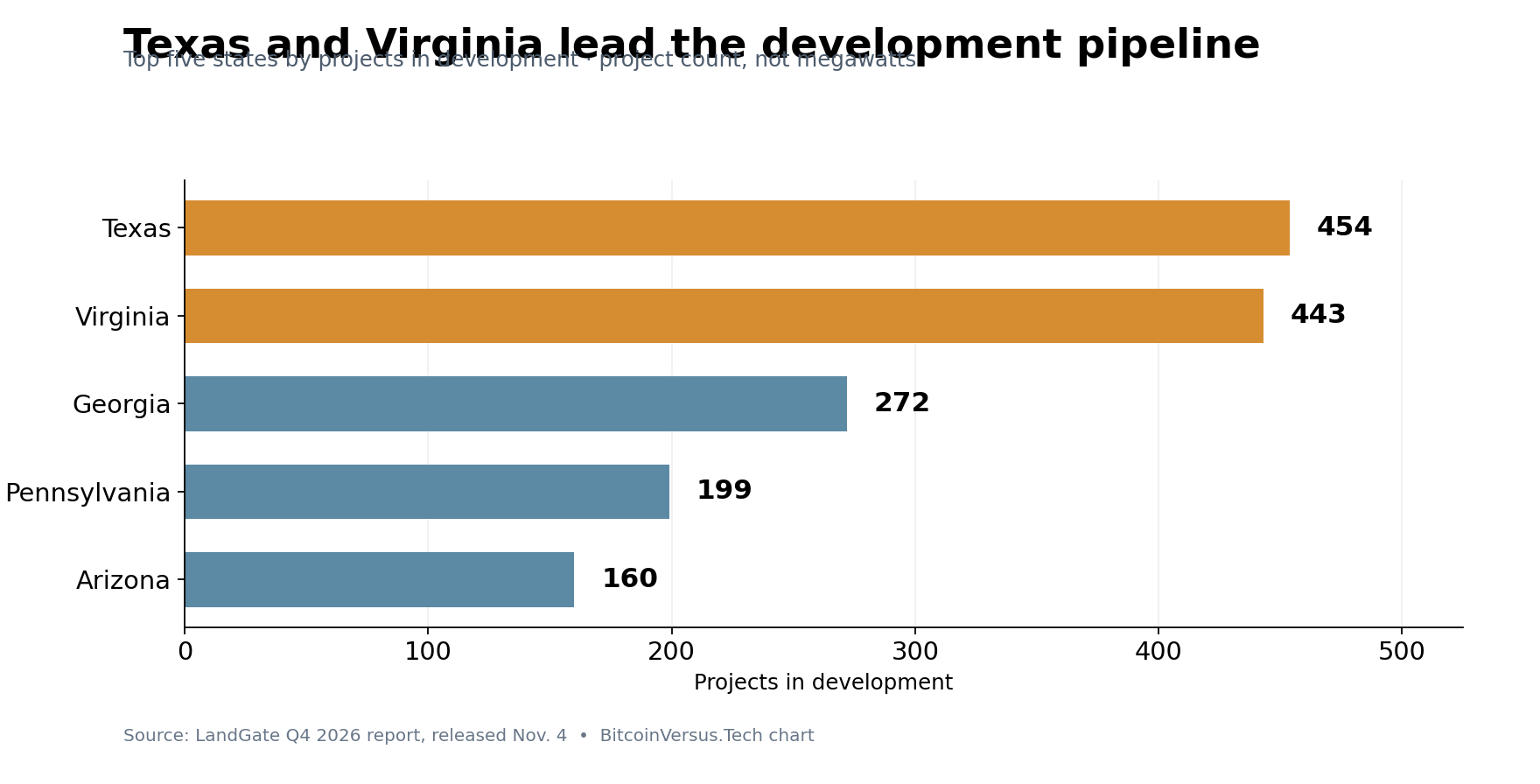
Texas leads with 454 projects in development, narrowly ahead of Virginia’s 443. Georgia follows with 272, Pennsylvania with 199 and Arizona with 160. Together those five states account for 1,528 projects, approximately 50.2% of LandGate’s reported national development count. The rankings complement BitcoinVersus.Tech’s Texas project analysis and Virginia project analysis, which examine individual campuses rather than LandGate’s wider inventory.
Across the Southeast grid region, 1,014 projects are developing compared with 690 operating. LandGate says development counts also exceed operating counts in ERCOT, MISO, SPP and PJM. The imbalance makes grid studies material: utilities must determine whether a location can safely serve a large new load and what infrastructure upgrades are needed. A separate MISO transmission project illustrates the scale and lead time of network investment.
Local approvals challenge record announcements
LandGate maps more than 400 local moratorium instruments across 42 states. The number does not mean 42 statewide bans; restrictions differ by locality, duration and permitting type. The company argues grid access and municipal approval, rather than financing alone, increasingly determine project viability. Its public summary does not provide independently audited completion probabilities or a uniform megawatt estimate for every tracked project.
The central engineering test is conversion: how many announced projects secure interconnection, permits, construction financing and reliable electricity, then become operational load. Electricity-demand forecasts help frame the broader consequences, but should not be calculated by multiplying LandGate’s project count by an assumed facility size. Announcements measure developer interest; commissioned capacity and electricity consumed measure infrastructure actually delivered.
Editor’s Note: Primary sources are LandGate’s November 4, 2026 Q4 Data Center Activity Report summary and press release. The 7.2% announcement difference, 70.7% hyperscale share and 50.2% five-state share are BitcoinVersus.Tech calculations from published counts. LandGate’s coverage and classifications have not been independently audited. Charts are original, zero-baseline visualizations; the featured cover is a conceptual editorial illustration, not a photograph of a specific facility. No video was added without reliable identity and playback evidence.
To support our volunteer research with 5,000 satoshis, display the original QR code on another screen and scan it with a compatible Bitcoin wallet. Mobile readers using a single phone may save the QR image and scan it from the wallet’s gallery feature, if supported. Check the destination address and payment amount in your wallet before confirming.

We volunteer daily to ensure the information on this platform is Verifiably True. If you would like to support the research, please scan the QR code.
BitcoinVersus.Tech reports on technology and financial topics for informational and educational purposes and does not provide financial advice.


Leave a Reply