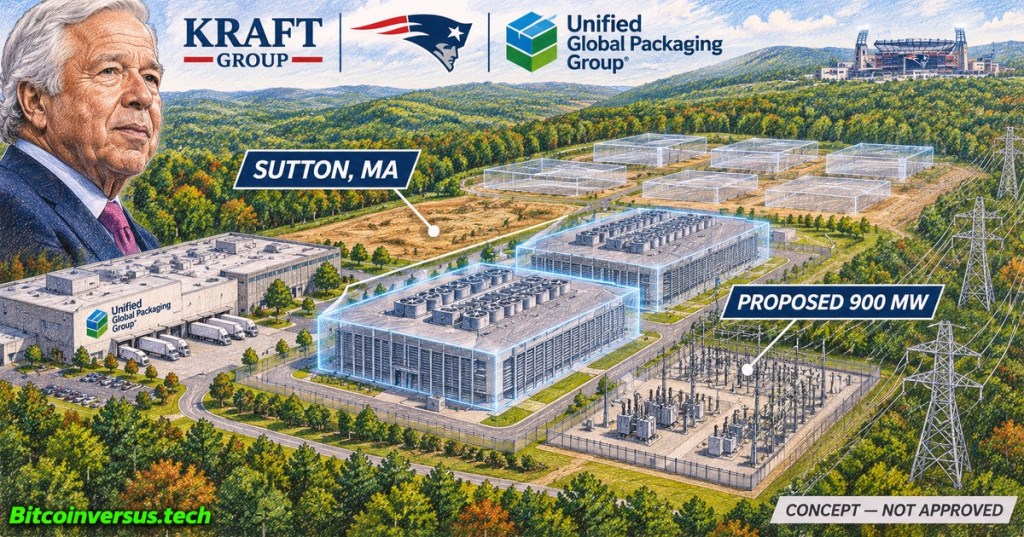
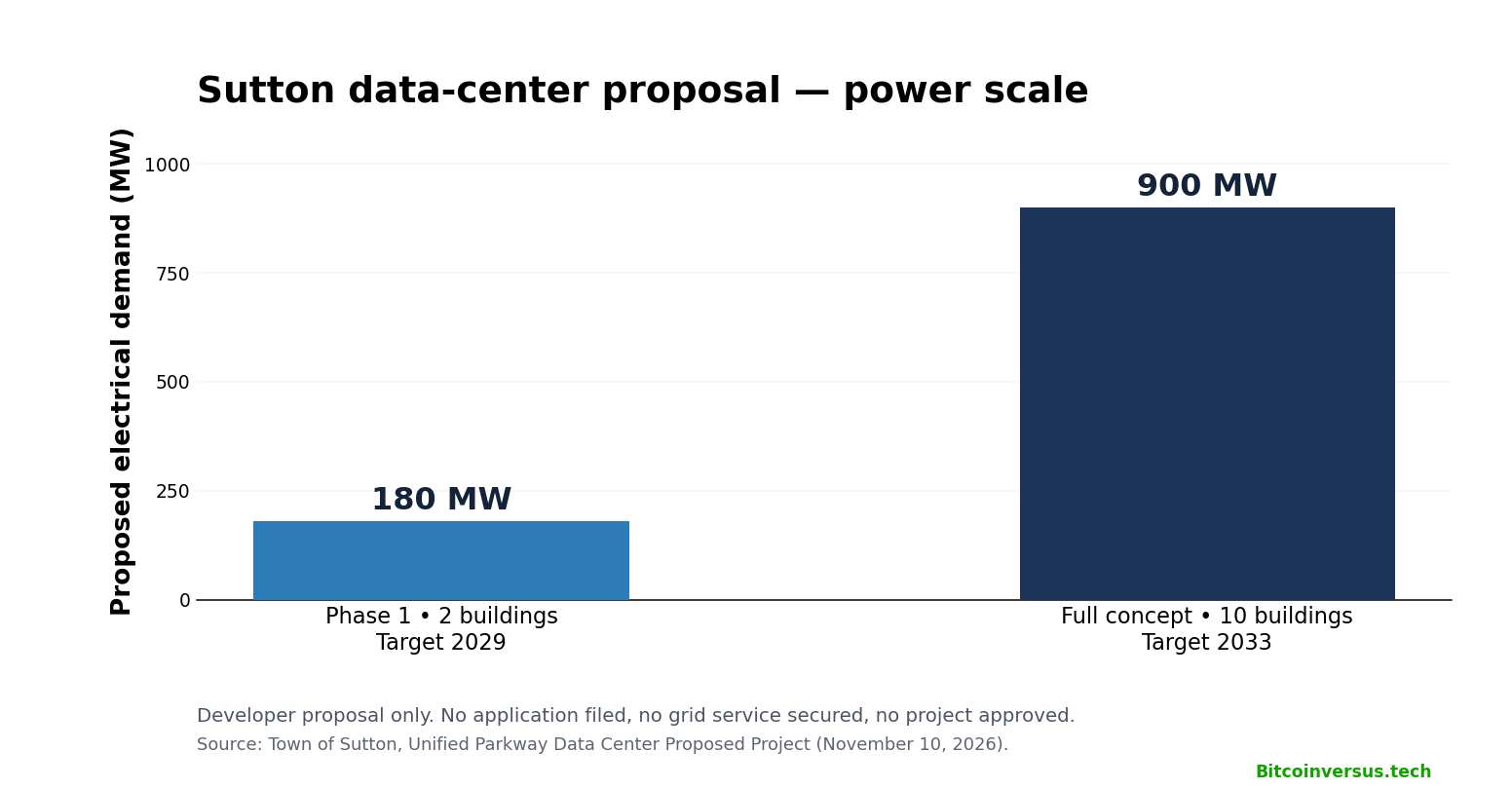
Robert Kraft’s business group, best known for owning the New England Patriots, has proposed a massive data-center campus in Sutton, Massachusetts. The Kraft Group and affiliate Unified Global Packaging Group envision ten buildings drawing up to 900 megawatts of electricity. Sutton officials disclosed the proposal on November 10, 2026, and stressed again on November 13 that no formal application has been filed and no project has been approved.
Authentic November 10, 2026 Sutton Select Board meeting recording, linked by the Town of Sutton as the official public discussion of the proposal. Credit: Town of Sutton / YouTube. Video is a meeting record, not a promotional construction rendering.
Ten buildings, beginning with two
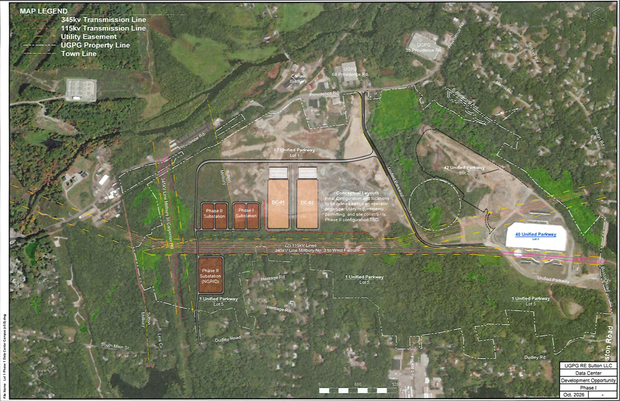
The proposed Unified Parkway site lies near Boston Road and Providence Road, south of Worcester. Town documents describe two 250,000-square-foot buildings, each requiring approximately 90 MW, for a first phase potentially opening in 2029. Eight additional buildings, if approved and financed, could follow at two per year through 2033. Full development would encompass approximately 2.5 million square feet.
Sutton Town Manager Austin Cyganiewicz’s November 9 fiscal memorandum places the developer’s projected investment at about $3.35 billion for Phase 1 and $16.75 billion for all ten buildings, including estimated computer equipment. Figures are preliminary cost assumptions in 2026 dollars, not committed construction spending.
A 900 MW grid question
Existing 345-kV and 115-kV transmission lines cross the property, but proximity to high-voltage infrastructure does not mean 900 MW of deliverable electric service has been secured. The prospective operator is in discussions with ISO New England; power availability, connection schedules and operating energy use remain unresolved.
Comparable bottlenecks affect Virginia’s expanding data-center power pipeline and projects facing new large-load grid-connection requirements. Analysts also expect data centers to contribute heavily to rising electricity demand, making grid cost allocation an important public-policy question.
Tax revenue faces local approval hurdles
Sutton’s preliminary model projects approximately $10.4 million in annual property taxes from the first two buildings in fiscal 2031 and $27.8 million from all ten by fiscal 2035. The forecast depends on valuation, depreciation, construction timing and future budgets; residents have not been promised specific tax reductions.
The town’s November 13 statement says data centers are currently prohibited under local zoning. A change would require a two-thirds vote of Sutton Town Meeting, followed by relevant permits, environmental review and a community benefits agreement. Residents have already raised concerns about power prices, water use, noise, generators and the community’s character.
A cooling-water plan, ultimate tenant, electrical-service timetable and detailed noise assessment remain unspecified. The debate echoes broader efforts to establish public reporting on data-center water, power and community impacts. The proposed campus also changes the scale of Massachusetts data-center development amid a nationwide increase in announced facilities.
Bottom line: Kraft-linked companies have proposed a potentially $16.75 billion, 900 MW facility, not secured approval to build one. Sutton’s zoning vote, independent power-and-water review and local consent will determine whether the proposal advances.
Primary sources: Town of Sutton project dashboard; town manager’s original November 9 fiscal and regulatory memorandum; November 13 official town statement; November 10 Select Board meeting recording; CBS Boston’s November 13 reporting; Boston Globe reporting on the developer’s statement and resident reaction.
Editor’s Note: The Kraft Group and Unified Global Packaging Group have presented a preliminary proposal only. Sutton has received no formal application, adopted no data-center zoning amendment and issued no project approval. The estimated investment, load, tax receipts and construction timetable are planning assumptions rather than commitments. The featured 1200 × 630 colored-pencil illustration is conceptual artwork and does not show an existing campus or an approved design; the site-plan image is authentic developer-supplied material, also unapproved. The original power comparison reflects proposed loads, not contracted grid service. The linked Select Board meeting video is authentic public-session media. Independent player playback and phone-screen layout must be tested separately.

BitcoinVersus.Tech is volunteer-run and publishes independent educational technology reporting. An optional 5,000-satoshi donation supports ongoing research. Scan the original QR from a second screen with a compatible Bitcoin wallet; on mobile, use a wallet that supports scanning a saved image. Independently verify the recipient address 3C9o19EH5HSiwEPyCTmEKzxhNCbo2X6TTb and the payment amount before sending. Bitcoin transfers are generally irreversible.
We volunteer daily to ensure information on the BitcoinVersus.Tech platform is Verifiably True. Coverage is educational and informational and does not constitute financial or investment advice.


Leave a Reply