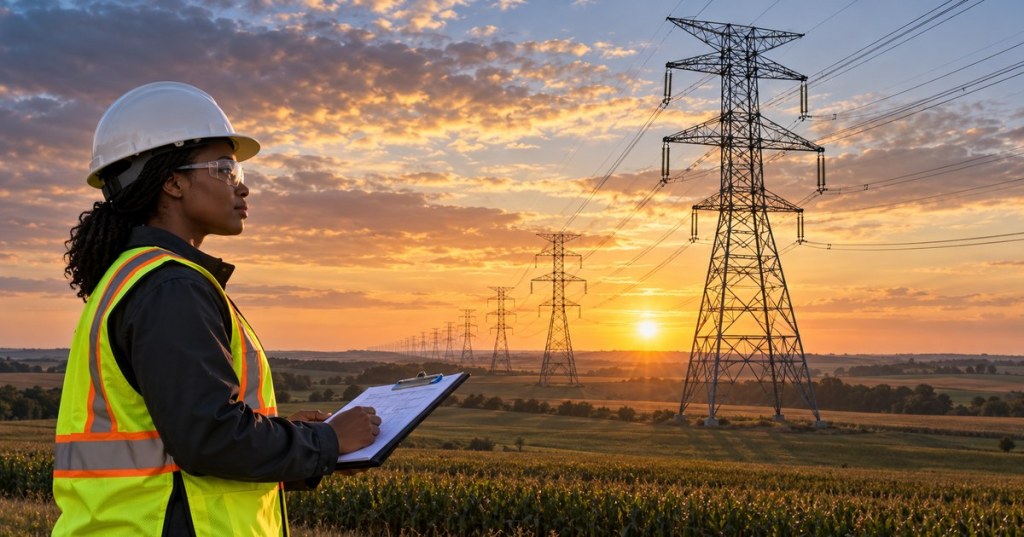
- Key Takeaways: MISO selected Ameren Transmission Company of Illinois, GridLiance Heartland and Dairyland Power Cooperative for Iowa’s EASL transmission project.
- The proposed work spans about 187 miles of 765-kV lines, 22 miles of 345-kV lines and a new East Adair substation.
- MISO estimates a $1.23 billion project cost; the planned 345-kV and 765-kV service dates are 2032 and 2034, subject to review.
October 24, 2026 — Iowa. The Midcontinent Independent System Operator (MISO) has selected three transmission developers to deliver the East Adair–Minnesota/Iowa State Line–Arbor Hill–York Avenue (EASL) project, an approximately $1.23 billion investment in long-distance grid infrastructure. The consortium announced the selection on October 22.
What Will Be Built
The plan includes a new 187-mile, 765-kilovolt transmission route from southern Iowa toward the Minnesota state line, a new 345/765-kV East Adair substation, and two 345-kV connections totaling roughly 22 miles. The higher-voltage route forms part of a proposed Midwest transmission backbone intended to move bulk electricity across longer distances.
The ownership shares are 42.5% Ameren Transmission Company of Illinois, 42.5% GridLiance Heartland and 15% Dairyland Power Cooperative. MISO awarded the project through a competitive developer selection; the announcement is not the same as obtaining every construction permit.
Related community discussion about 765-kV corridors in neighboring Wisconsin reflects landowner concerns; it does not identify the route of Iowa’s EASL project.
Timelines and Grid Demand
The developers target June 1, 2032 for the 345-kV elements and June 1, 2034 for the 765-kV line. Regulatory filings, landowner engagement, routing decisions, easements and construction remain ahead. Benefits such as better reliability and transmission flexibility are expected outcomes, not measured improvements from an operating line.
The project belongs to MISO’s long-range transmission program, approved as part of Tranche 2.1 in December 2024. It fits the wider national discussion about meeting demand from homes, industry and new computing facilities without mistaking a planned grid upgrade for generation capacity.
A second discussion about a separate MISO 765-kV proposal in Wisconsin illustrates wider Midwest interest in transmission routing and capacity; it is not an Iowa project announcement.
For background, see BitcoinVersus.Tech’s report on growing demand for power lines, the transmission versus subtransmission lesson, and our explanation of electricity capacity metrics.
BitcoinVersus.Tech Editor’s Note: We volunteer daily to ensure the credibility of the information on this platform is Verifiably True. If you would like to support to help further secure the integrity of our research initiatives, please donate using the QR code provided

For best QR-code scanning results, please scan this donation code from a desktop or larger screen. Mobile screens may prevent camera recognition.


Leave a Reply