
Atomic layer deposition (ALD) relies on precisely separated precursor exposures. In OSSTC.012, semiconductor technicians learn to read a pulse → purge → reactant → purge sequence, distinguish surface saturation from incomplete dosing, and recognize trace patterns that deserve investigation. This focused lesson follows OSSTC.011: Deposition Equipment Basics.
Key Takeaways
- An ALD cycle separates two self-limiting surface reactions with purge or evacuation intervals.
- Insufficient precursor exposure can reduce growth per cycle (GPC); inadequate purging can create overlapping chemistry and non-ALD reactions.
- Technicians compare approved valve-command traces, chamber pressure, temperature, flow and film metrology before escalating faults.
ASM’s official ALD explainer visualizes sequential surface reactions; educational context, not a service instruction.
Learning Objectives
- Identify the four phases of a typical two-reactant thermal ALD cycle.
- Explain what surface saturation and growth per cycle mean.
- Identify trace symptoms without changing a qualified recipe.
One ALD Cycle Has Four Phases
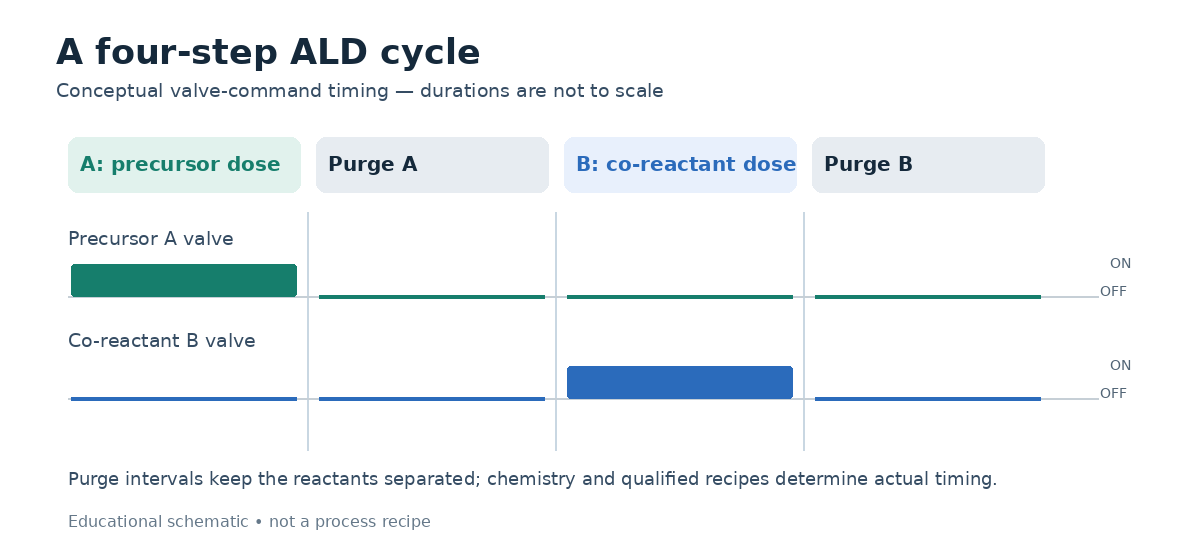
According to ASM and Oxford Instruments, the two reactants arrive in separate doses. In the common training example of an aluminum-oxide process, precursor A attaches to available surface sites, a purge removes residual gas and byproducts, reactant B completes the surface reaction, and a second purge clears the chamber. The cycle repeats to achieve the required film thickness. Real industrial chemistry and equipment designs vary.
- Precursor A dose: surface sites react until the dose becomes self-limiting.
- First purge: remove precursor A and reaction byproducts.
- Co-reactant B dose: transform the surface into the next reactive state.
- Second purge: remove reactant B and byproducts before the next cycle.
SemiSlides’ ALD lesson covers surface adsorption, purge timing and GPC; see its pulse and purge sections.
Saturation Is Not the Same as a Long Pulse
A self-limiting reaction reaches a plateau when additional precursor exposure no longer materially increases growth per cycle (GPC). Longer pulses can waste chemistry without adding useful film. If a purge is too short, lingering reactants may meet and produce unwanted CVD-like growth. The University of Michigan’s LNF equipment guide and AtomicLimits process-development tutorial explain how qualified saturation studies distinguish these cases.
Sungho Kim’s semiconductor-process ALD lesson demonstrates the fundamentals of cyclic growth.
Read the Trace Before Touching the Tool
- Expected: isolated A and B valve-command events, with purge intervals between them and stable qualified process conditions.
- Weak or missing pressure transient: compare the logged valve command, gas availability, appropriate pressure sensor and validated historical trace. One sensor alone cannot prove whether a valve opened.
- Slow return toward baseline: review approved purge/exhaust telemetry, pressure-control state and possible sensor or pumping issues.
- Unexpected thickness or GPC: compare wafer metrology, starting surface, cycle count, source delivery and chamber history; do not infer one root cause from GPC alone.
Safe Technician Response
- Confirm the tool and chamber identity, wafer lot, selected approved recipe and alarm timestamp.
- Capture read-only event logs and pressure, flow and valve-command traces before resetting anything.
- Compare the traces with the qualified reference and recent chamber maintenance records.
- Check the wafer metrology report and communicate symptoms to the tool owner or process engineer.
- Observe chemical, vacuum, heated-surface and electrical hazards. Follow site-approved isolation, lockout/tagout, purge and gas-handling procedures; never bypass interlocks or adjust precursor timing without authorization.
Community Context
Community discussion of ALD equipment needs for gate-all-around transistors; market estimates are opinions, not verified tool counts.
An authentic community post showing the interior of an ALD chamber; discussion is illustrative, not maintenance guidance.
Knowledge Check
- What separates the two reactant exposures? (A) a purge/evacuation interval, (B) wafer dicing, or (C) a mask alignment step?
- What does a GPC plateau generally indicate? (A) rising gas-phase reactions, (B) a saturated surface reaction, or (C) no precursor delivery?
- What should a technician do if a chamber trace differs from the qualified baseline? (A) bypass the interlock, (B) change the pulse duration immediately, or (C) preserve traces and escalate under site procedure?
Answer Key
- 1. A — separate the reactants.
- 2. B — surface reaction saturation.
- 3. C — document and escalate; do not improvise a recipe change.
Continue Learning
- Review OSSTC.004: Semiconductor Gas Delivery Systems for MFCs, valves, purges and safety interlocks.
- Review OSSTC.003: Vacuum Systems for pumps and pressure indications.
- Review OSSTC.008: Metrology and Inspection for the wafer measurements used to verify deposited films.
BitcoinVersus.Tech Editor’s Note: We volunteer daily to ensure the credibility of the information on this platform is Verifiably True. If you would like to support to help further secure the integrity of our research initiatives, please donate using the QR code provided

For best QR-code scanning results, please scan this donation code from a desktop or larger screen. Mobile screens may prevent camera recognition.


Leave a Reply