
OSSTC.017 explains how a residual gas analyzer (RGA) helps semiconductor technicians distinguish water outgassing, possible air ingress and process-gas contamination inside a vacuum system. A pressure gauge measures total pressure, while an RGA reports ion signals at selected mass-to-charge ratios. Interpreting the pattern matters more than treating a single peak as proof of a leak. The chapter follows OSSTC.016 on vacuum leak testing.
Pfeiffer Vacuum+Fab Solutions, “Functional principle of the PrismaPro quadrupole mass spectrometer,” February 27, 2018. Official manufacturer animation explaining ionization, mass selection and signal detection; not a measured semiconductor process run. Credit: Pfeiffer / YouTube.
Inside a quadrupole residual gas analyzer
INFICON’s gas-analysis guide describes three principal functions: an ion source creates charged fragments, a quadrupole filter separates ions by mass-to-charge ratio, and a detector measures the remaining ion current. Standard RGA heads typically operate below about 10⁻⁴ Torr; higher-pressure analysis may require a specialized sensor or pressure-reducing inlet. Always apply the actual instrument’s pressure and filament interlocks.
A common reference list includes hydrogen at m/z 2, helium at 4, water at 18, nitrogen or carbon monoxide at 28, oxygen at 32 and argon at 40. Peaks can overlap, and ionization produces fragments. The Stanford Research Systems RGA manual identifies water fragments around 16–18 and warns that mass 28 has multiple possible contributors.
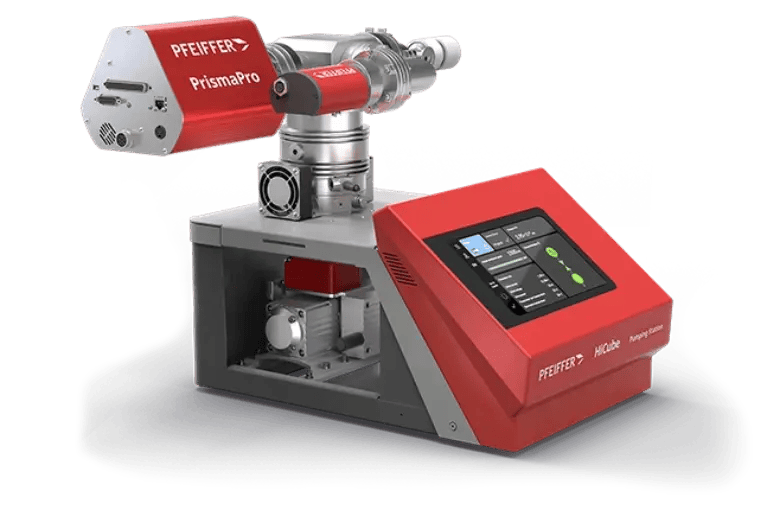
Air leak or ordinary chamber outgassing?
After an authorized pumpdown, a strong water signal near 18 can indicate desorption from chamber surfaces, especially after opening the tool. Rising signals near 28, 32 and 40 together may suggest atmospheric ingress, but pumping speeds, background gases and instrument sensitivity influence their relative sizes. A mass-28 peak by itself cannot identify nitrogen. The Solar Manufacturing vacuum analysis guide distinguishes gas release from leak-related patterns.
Before diagnosing contamination, review the pressure trend and valve states from OSSTC.015, and compare gas-flow conditions with OSSTC.014. RGA data supports a hypothesis, but cannot identify a leaking flange without additional authorized localization tests.
Sam Zeloof, “RGA Residual Gas Analyzer (Mass Spectrometer) Experiments and Helium Leak Checking,” December 30, 2017. Real high-vacuum experiments with an INFICON Transpector analyzer illustrate spectra and tracer-gas response. Credit: Sam Zeloof / YouTube; independent educational demonstration.
A technician’s safe diagnostic record
Record tool ID, chamber status, total pressure, analyzer pressure limit, scan range, measurement time and instrument settings. Save a reference spectrum and compare later observations under equivalent conditions. For contamination questions, consult OSSTC.013 on particles and OSSTC.012 on pulse and purge traces; particle readings and gas signals describe different mechanisms.
Never defeat a chamber interlock, ignite an analyzer filament above its rated pressure, open a hazardous process line or improvise a helium spray around production equipment. Such tasks require approved procedures, chemical hazard controls and qualified personnel. RGA comparisons may also require calibration, fragment-pattern analysis and corrections for gas-dependent sensitivity.
Conclusion: Residual gas analysis provides chemical clues that a pressure gauge cannot. Reliable troubleshooting combines multiple mass peaks, process history, instrument limits and independent confirmation.
Editor’s Note: Technical descriptions were checked against INFICON, Pfeiffer Vacuum, Stanford Research Systems and Solar Manufacturing references. The original photorealistic 1200 × 630 cover has the neon-green Bitcoinversus.tech watermark; its displayed spectrum is illustrative rather than recorded process data. The in-story equipment photograph is genuine manufacturer imagery. No process chamber was tested, and browser playback is separate from WordPress iframe verification.

BitcoinVersus.Tech is volunteer-run and publishes independent technical education. An optional 5,000-satoshi donation supports research. Scan the original QR from another screen with a compatible Bitcoin wallet; on the same phone, use a wallet capable of importing a saved QR image. Confirm recipient 3C9o19EH5HSiwEPyCTmEKzxhNCbo2X6TTb and amount independently before sending. Bitcoin transfers are generally irreversible.
We volunteer daily to ensure the information on BitcoinVersus.Tech is Verifiably True. The article is educational, not permission to service hazardous process equipment. BitcoinVersus.tech is not a financial advisor. This media platform reports on financial subjects purely for informational purposes.


Leave a Reply