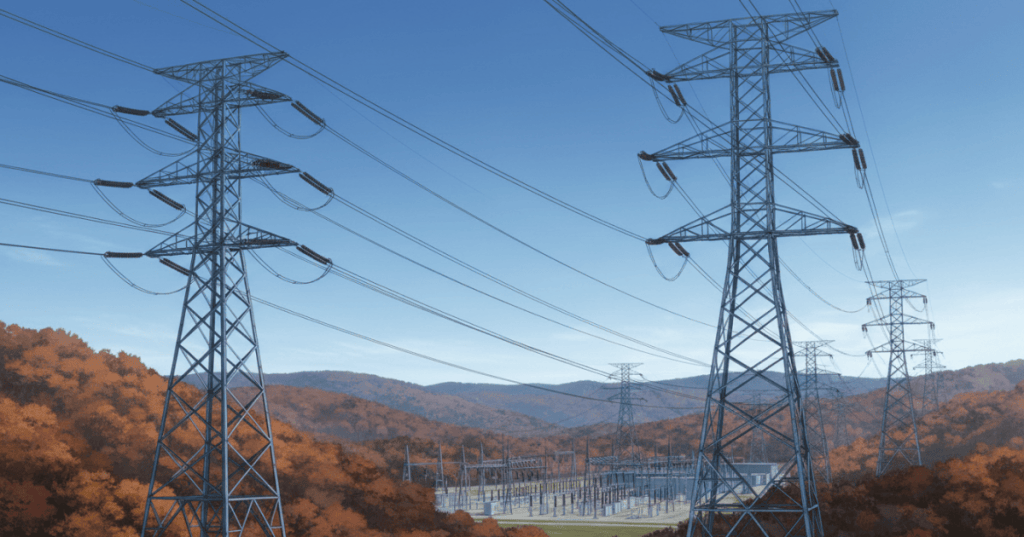
Potomac Edison announced on November 2, 2026, that it has filed for Virginia approval to rebuild about 29 miles of 138-kilovolt transmission lines in Frederick, Clarke and Loudoun counties. The October 30 filing with the State Corporation Commission advances the three-state Gore–Doubs–Goose Creek Improvements Project. It is a regulatory application, not authorization to start construction.
Two voltage levels along an existing corridor
The plan would place new 500-kV transmission circuits along upgraded existing corridors while retaining 138-kV service. It also includes two new 138-kV lines connecting the existing Stonewall Substation to the proposed Woodside Substation near Clear Brook, Virginia. Higher voltage can transport substantial electrical power efficiently over long distances; the voltage rating is not itself a megawatt capacity figure.
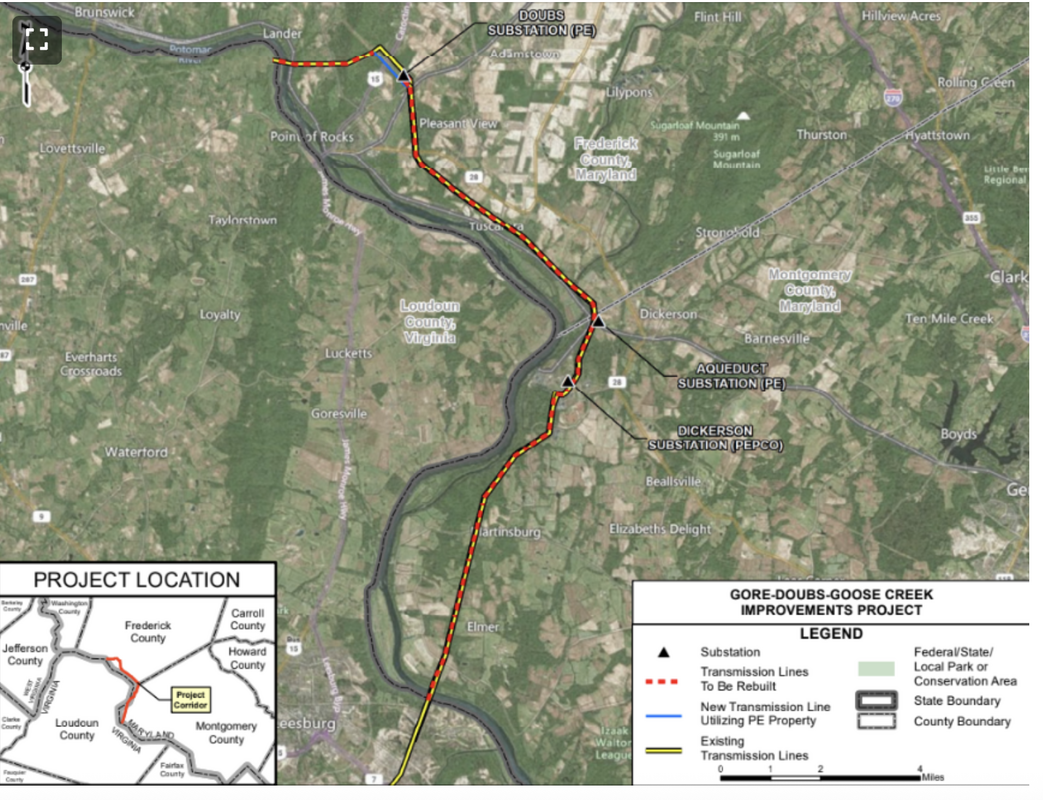
Aerial project map shows power-line rebuild sections and substations near the Potomac River. Source: FirstEnergy project material, reproduced by StopPATH WV (2025).
FirstEnergy’s route descriptions divide approximately 44 miles of existing Virginia–West Virginia corridor among Frederick County, Virginia (17.9 miles), Clarke County, Virginia (0.2), Jefferson County, West Virginia (15.4), and Loudoun County, Virginia (10.5). The Virginia pieces total 28.6 miles, consistent with the company’s rounded 29-mile announcement. An additional Maryland segment is being considered separately.
What the route lengths show
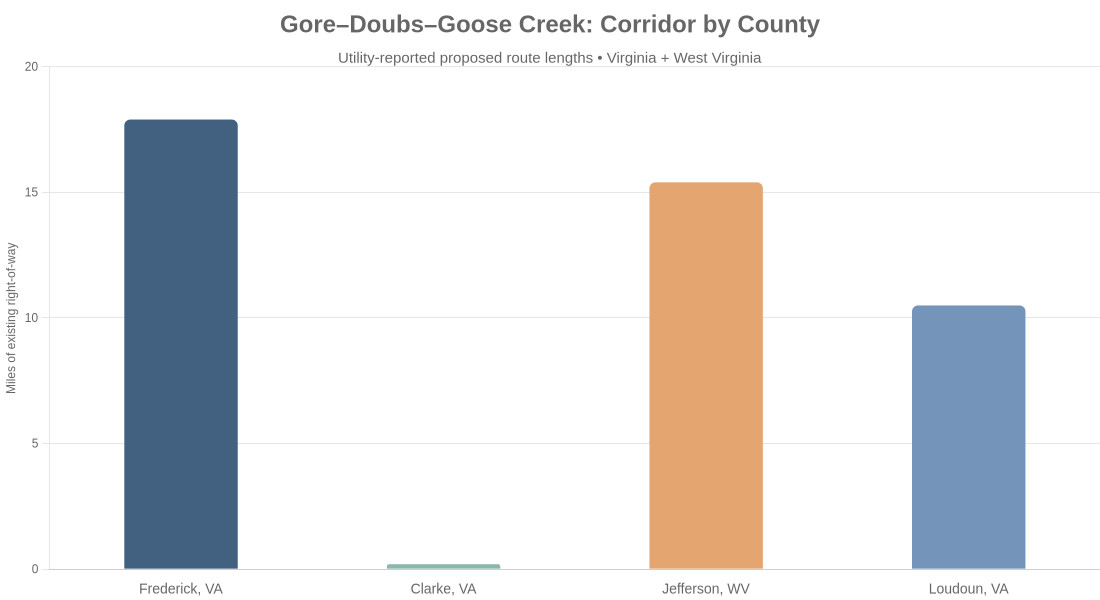
Four-county corridor lengths total 44.0 miles. Data: FirstEnergy project descriptions. Chart: zero-baseline vertical columns for comparable categorical magnitudes, following visualization-of-amounts guidance; values are corridor miles, not installed line capacity.
The regional grid operator PJM awarded the project in 2023 to respond to reliability and electricity-demand pressures. The planned reinforcement intersects a region where Virginia data-center construction adds urgency to transmission planning. It may also support connections from new power plants, but the new facilities and wires have not yet been commissioned.
Approval and construction dates
Regulatory timing matters. Potomac Edison filed in Maryland in March 2026, lodged the Virginia application October 30, and expects a West Virginia application in December. FirstEnergy says construction could begin in 2028, with the Virginia portion in service in December 2030, assuming approvals. Its cited $36 billion investment plan covers broader corporate projects, not a committed price for this line.
Grid buildouts have consequences for landowners and utility customers. Although most work follows existing rights of way, clearances, substation construction and local permitting still require review. Recent grid sensor upgrades and high-voltage equipment investments address different pieces of the same infrastructure challenge.
The next milestones are state commission proceedings, any route or easement revisions, and confirmed construction authorization. The project demonstrates why large transmission expansions can take years between selection and service.
BitcoinVersus.Tech Editor’s Note: We volunteer daily to ensure the credibility of the information on this platform is Verifiably True. If you would like to support our work and help further secure the integrity of our research initiatives, please scan the QR code below to donate 5,000 sats. For best results, scan the QR code from a laptop or larger screen.

Original BitcoinVersus.Tech donation QR code. Bitcoin address: 3C9o19EH5HSiwEPyCTmEKzxhNCbo2X6TTb. Verify the address and amount in your wallet before sending. On a phone, display the QR image on another screen or use an image-based QR scanner.
BitcoinVersus.tech is not a financial advisor. This media platform reports on financial subjects purely for informational purposes.


Leave a Reply