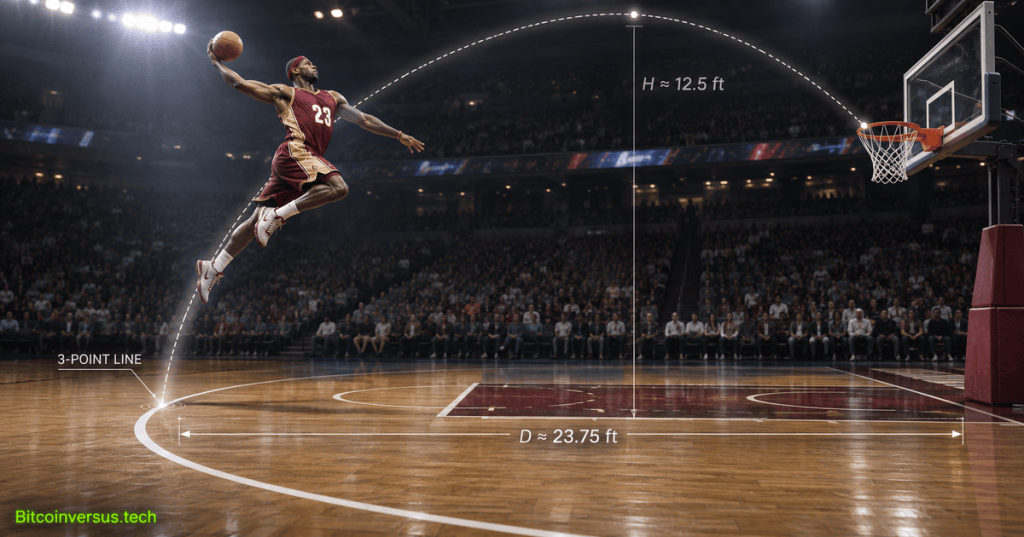
A dunk from behind the NBA three-point line would demand a combination of sprint speed, horizontal distance, vertical lift and ball control far beyond an ordinary leap. Yet the idea is not forbidden by physics. The decisive question is whether an athlete could carry enough forward momentum while keeping the ball above a 10-foot rim at the far end of the flight.
The NBA rulebook places the main three-point arc 23 feet, 9 inches (7.24 meters) from the center of the basket. At the sidelines, the line is closer. The free-throw line, by comparison, is only 15 feet from the plane of the backboard. A dunk launched from the top of the arc would therefore be a substantially different athletic achievement from the legendary foul-line dunk.
LeBron’s 2008 Cleveland dunk is the strongest reality check
On November 11, 2008, LeBron James broke away against Milwaukee and finished a spectacular one-handed dunk. The contemporary upload, published November 12, shows the actual Cavaliers-era play.
LeBron James against the Milwaukee Bucks, November 11, 2008. Archival footage uploaded by FiftyFiv3 on November 12, 2008; the angled broadcast view does not support a precise launch-distance measurement.
Contemporaneous Yahoo Sports reporting specifically described the takeoff as short of the foul line, not from it. The November 11 official game account records the fourth-quarter steal and dunk with 4:46 remaining. The famous leap was nowhere near a verified three-point-line takeoff. Perspective distortion also makes a single oblique broadcast angle unsuitable for measuring the precise location of a player’s final planted foot.
The world long-jump record clears the distance on paper
Mike Powell jumped 8.95 meters (29.36 feet) at the 1991 World Championships, exceeding the NBA arc-to-hoop distance by approximately 1.71 meters (5.61 feet). The women’s world record, Galina Chistyakova’s 7.52 meters from 1988, also exceeds the 7.24-meter arc radius. Those results establish that humans can travel the required horizontal distance under specialized conditions; they do not establish a feasible dunk.
Official World Athletics footage of the 1991 Tokyo long-jump final featuring Mike Powell and Carl Lewis. Credit: World Athletics/YouTube.
Long jumpers land in sand, with their body and feet dropping to ground level. Dunkers must arrive near the basket with the ball high enough to descend through the rim, while controlling its forward position. The hand and ball can extend ahead of the athlete’s center of mass, reducing the required body travel, but the vertical requirement sharply limits useful flight time.
An engineering estimate of the required flight
Consider a hypothetical elite athlete with a 2.69-meter standing reach, a 3.5 m/s vertical takeoff velocity, and a target hand height near 3.14 meters. Treating flight as a simple ballistic arc without air resistance, the hand rises 0.45 meter above its standing reach at approximately 0.17 seconds and descends through that height again at approximately 0.55 seconds. The later instant represents the approximate window for a long-range finish, assuming the arm remains extended.
If forward arm-and-ball extension reduces the athlete’s required body displacement to roughly 5.5–6.5 meters, reaching the rim in 0.55 seconds calls for horizontal speed around 10–12 m/s (22–27 mph). An elite sprinter may attain exceptional track speed, but replicating such speed while carrying a basketball, jumping for height, and executing a controlled finish is a far more severe demand. A different vertical impulse, hand reach or ball position would change the result. The calculation is an illustrative model, not a measurement of LeBron or a proof of human impossibility.
What actual NBA tracking tells us
The NBA now measures takeoff distance through its Dunk Score tracking system, which analyzes player body positions and ball motion. Among its published examples, Justin Champagnie’s December 4, 2025 dunk began 9.7 feet from the rim, paired with a 30.9-inch vertical. That is verified tracking evidence for an in-game dunk, but not an all-time longest-dunk record. A February 19, 2026 report, citing a February 18 distance leaderboard, put Jalen Johnson’s jump against New Orleans at 10.6 feet and described it as the season leader at that point. That secondary-season ranking is not a certified all-time record. Historical games lack comparable continuous pose-tracking coverage, and no authenticated, league-wide maximum was established for the whole history of basketball.
James White launches from the free-throw line during the 2013 NBA Slam Dunk Contest. Official NBA Phantom-camera footage; a contest demonstration rather than an in-game takeoff-distance record.
Modern analysis could resolve disputed footage more accurately using multiple synchronized cameras, court calibration and pose estimation. The distinction between takeoff position and shot distance also matters in NBA three-point shooting statistics, which count completed attempts rather than where a player finishes in the air. Related 360-degree basketball replays and AI shot-tracking hardware demonstrate why camera geometry and measured body positions matter more than viral claims.
Would a three-point-line dunk count for three?
Potentially, yes. NBA Rule No. 5 awards three points for a legal field-goal attempt originating outside the arc, provided the shooter is not touching the line or the inside area on the relevant floor contact. Landing inside after releasing the ball does not by itself change a three into a two. A true running-launch dunk would still require a legal gathering sequence and an official determination of where the airborne attempt began.
For now, the verdict remains narrow: physically conceivable under extreme assumptions; not demonstrated in a verified NBA game from the three-point arc. Powell proves the raw horizontal distance lies inside human jumping capabilities. LeBron and White demonstrate exceptional basketball-specific flight. Neither example combines the full three-point distance, ball control and rim-height finish in one authenticated attempt.
Sources and measurement notes
Primary references: NBA court dimensions, NBA scoring rules, World Athletics record history, NBA player-tracking methodology and NBA 2025–26 Dunk Score reporting. Model assumptions are identified separately from measured records; feet and meters are rounded.
Editor’s Note: The featured 1200 × 630 illustration is hypothetical artwork, not an authentic photograph of a three-point-line dunk. Historic video can corroborate a game and its sequence without fixing exact launch coordinates. The calculations assume a simplified projectile model and should not be interpreted as experimentally observed human performance.
Support BitcoinVersus.Tech
To make an optional 5,000-satoshi donation, scan the original BitcoinVersus.Tech QR below with a compatible Bitcoin wallet. Verify the payment address and amount before authorizing.

We volunteer daily to ensure the information on this platform is Verifiably True. If you would like to support the research, please scan QR code.
Sports-science calculations are informational estimates, not records or safety guidance. Unsupervised extreme-jump attempts can cause serious injury.


Leave a Reply