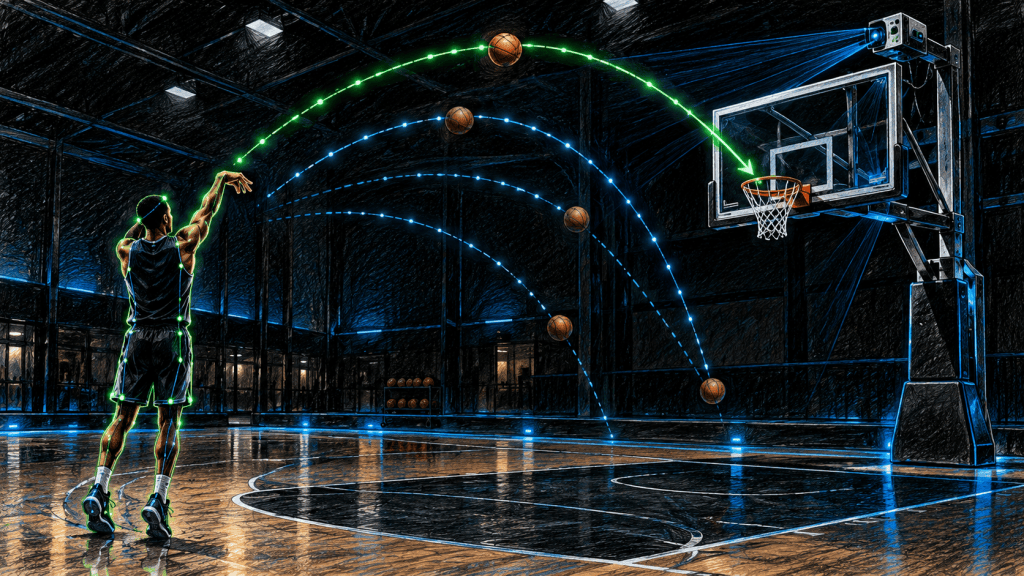
Huupe is trying to move smart basketball technology beyond specialized backboards and onto hoops players already own.
The company’s new $699 Arena Upgrade Kit attaches a sensor hub and LED system to an existing backboard, then tracks shooting performance, builds shot charts and offers AI-powered form analysis. Tracy McGrady, who joined Huupe as chief innovation officer in 2025, has become one of the most visible faces of the rollout.
The interesting part is the technology underneath the marketing. The National reported on October 12 that Huupe’s Mini and Pro systems use advanced radar and LiDAR for shot tracking. Earlier versions of Huupe’s full-size system also used six cameras and computer vision to follow a shooter’s body and the ball, according to prior reporting and the company’s own development history.
That means the basic idea is close to the standard AI pipeline now appearing across sports: sensors capture the physical event, software turns the raw measurements into structured data, and machine-learning models classify what happened and produce feedback.
Huupe’s patent filings make that pipeline more concrete. One patent describes image processing, line detection and a trained machine-learning model that identifies characteristics of a basketball action. Other Huupe patents describe combining sensor data and imaging data to decide whether a shot was successful and generate recommendations for future attempts. The underlying patent points to conventional computer vision and machine learning rather than a black-box “AI coach.”
The system can then turn repeated shots into metrics such as field-goal percentage, shot location, rim impact, trajectory, shot angle and form analysis. Huupe’s own FAQ says the Arena kit can provide interactive shot charts and AI-powered shot-form analysis.
One assumption needs more caution. There is no public evidence that Huupe trains its models directly on a database of the greatest NBA shooters. That would be technically possible, but elite shooting mechanics are not identical from player to player. A more useful model may compare a player against their own best repetitions while using broader examples only as reference points.
So the technology guess was mostly right: sensors, computer vision and machine learning are clearly part of the stack, and LiDAR appears in at least some Huupe systems. The newer question is whether putting that stack into a $699 add-on can move AI shot analysis from premium training equipment into ordinary gyms and driveways.
That shift also fits a broader trend BitcoinVersus.Tech has tracked in sports, from AI biomechanics in tennis to computer-vision player tracking and AI-assisted sports analysis.
BitcoinVersus.Tech Editor’s Note:
We volunteer daily to ensure the credibility of the information on this platform is Verifiably True. If you would like to support to help further secure the integrity of our research initiatives, please donate using the QR code provided

For best QR-code scanning results, please scan this donation code from a desktop or larger screen. Mobile screens may prevent camera recognition.
BitcoinVersus.tech is not a financial advisor. This media platform reports on financial subjects purely for informational purposes.


Leave a Reply