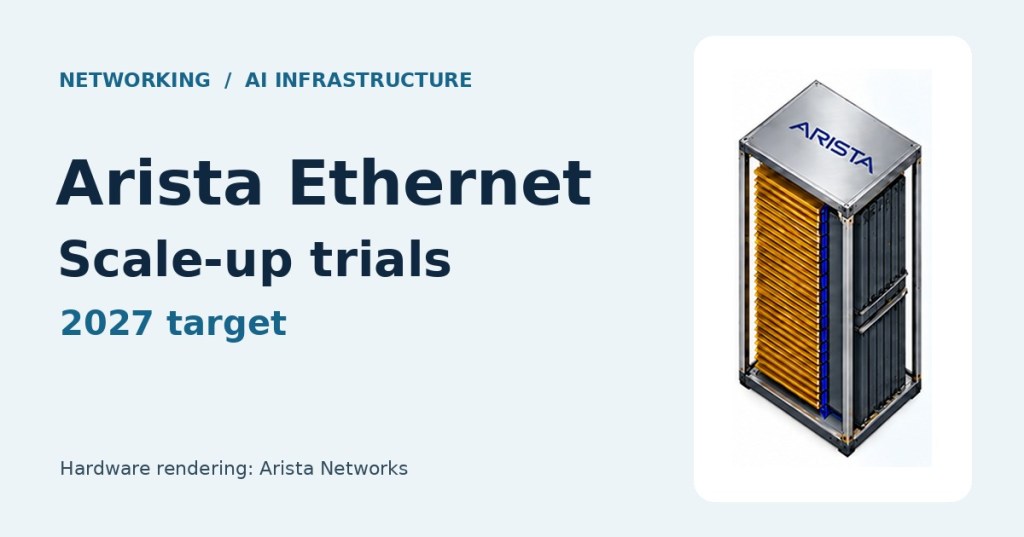
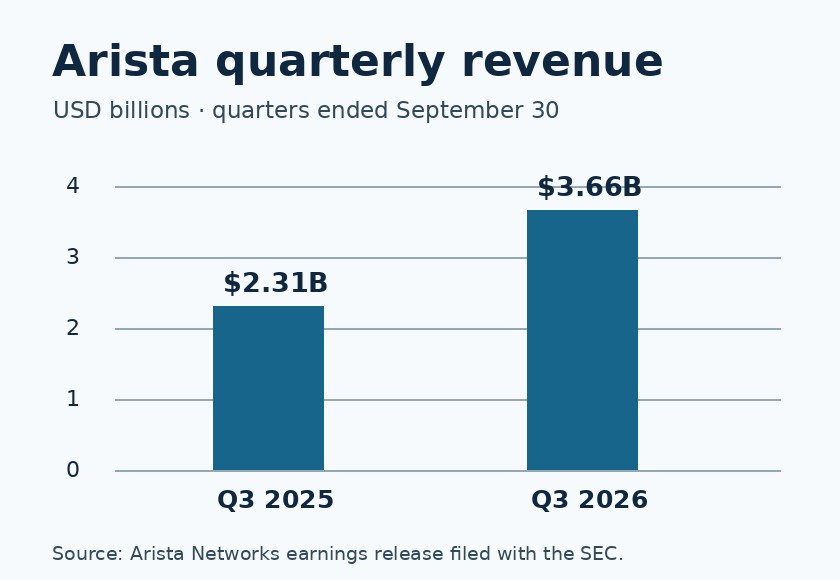
Arista Networks expects trials of its scale-up Ethernet technology for AI accelerators to begin in 2027, with production expected in 2028, Chief Executive Jayshree Ullal said on the company’s November 3 earnings call. The timetable puts a date on the next test for the Etherlink rack designs Arista introduced in October. The company also reported third-quarter revenue of $3.66 billion, up 58.5% from a year earlier.
A scale-up network connects accelerators closely enough to work together on a single job, such as splitting an AI model across multiple chips. Scale-out networking connects servers or racks across a larger cluster. A conventional top-of-rack switch illustrates the latter role. Scale-up traffic can be more sensitive to delay because accelerators may have to wait for data from their peers before moving on to the next operation.
Ethernet moves inside the rack
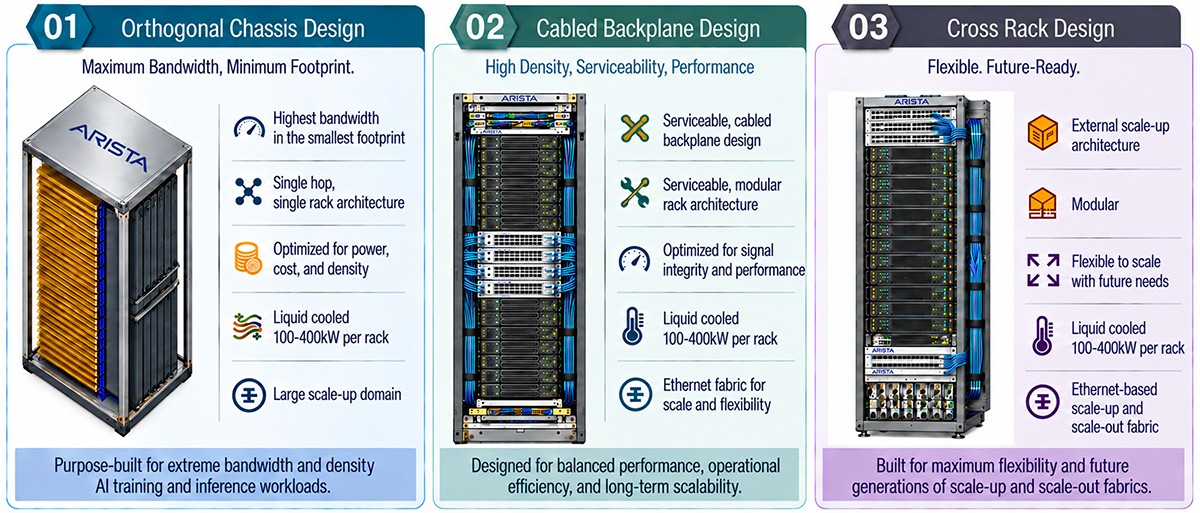
Arista’s October architecture announcement described Etherlink SU-144 as supporting up to 144 accelerators through a single switching hop, with cross-rack designs reaching up to 1,024 accelerators. Arista showed three physical approaches: an orthogonal chassis, a cabled backplane and a cross-rack design. The announcement gave design limits. Trials will provide the first opportunity on the stated schedule to see how the technology behaves under customer workloads.
A larger group of directly connected accelerators can give operators more room to divide up a model. The tradeoffs include how the network handles congestion and failed links, plus the practical work of cooling, cabling and servicing dense racks. Earlier coverage of the Open Switch Platform Architecture examined a related effort to make switch hardware easier to integrate. The d-Matrix 1,024-chip cluster offers another example of accelerator networking at rack scale. Neither establishes how Arista’s proposed configurations will perform. Dense rack designs also need to leave technicians room to replace a failed component without taking a larger share of the cluster out of service.
The trial timetable and the power forecast
Ullal also forecast deployments exceeding 10 gigawatts by the end of 2027 across at least ten types of compute accelerator, a broader outlook that The Next Platform reported on November 5. Gigawatts measure power. The forecast describes the anticipated scale of AI systems served by Arista networking and cannot be read as the switch fleet’s electricity consumption, an energy total in gigawatt-hours or an installed capacity figure for Etherlink SU-144.
The useful milestones are customer trials in 2027 and production in 2028. Trial results could show how well accelerators from different suppliers communicate, whether a failing link interrupts a job and how quickly operators can isolate faults. The site’s coverage of Ciena’s optical interconnect designs addresses a related question at longer distances: how to increase network capacity within a practical power budget.
Editor’s Note. The deployment figures and trial dates are Arista management forecasts. The featured cover incorporates an Arista Networks hardware rendering.

Scan the donation code from another device if your phone cannot scan its own screen.
We volunteer daily to ensure the information on this platform is Verifiably True. If you would like to support the research, please scan QR code.


Leave a Reply