How we ranked them
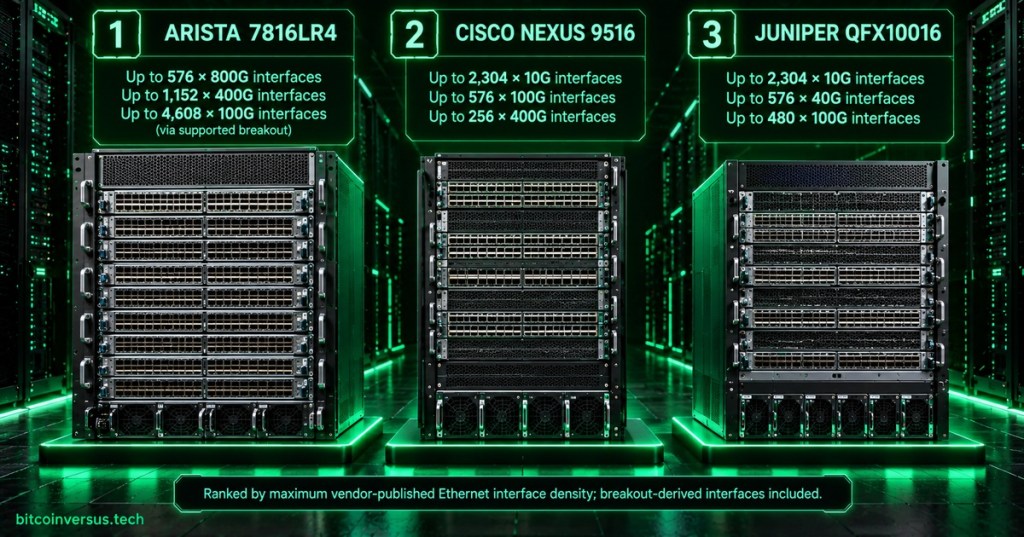
BitcoinVersus.Tech ranked currently marketed modular Ethernet switches by the maximum number of vendor-supported interfaces in one chassis. That includes supported breakout, so one 800G or 40G physical cage can count as several lower-speed interfaces. We therefore list both the maximum interface density and the native high-speed port count.
#1 — Arista 7816LR4: up to 4,608 x 100G interfaces
The Arista 7816LR4 is the clear leader. Arista’s current 7800R4 specifications list 576 native 800GbE interfaces and 1,152 x 400GbE interfaces in the 16-slot chassis. Its 36-port 800G line cards can expose as many as 288 x 100G interfaces each through supported breakout, taking a fully populated system to 4,608 x 100G interfaces.
The chassis also reaches 460 Tbps of switching capacity, or 920 Tbps full duplex. This is a fundamentally different density class from older modular switches because the platform starts with hundreds of 800G physical ports and then multiplies those into lower-speed links.
That direction matches the physical-layer roadmap BitcoinVersus.Tech covered in OIF’s push toward 448G electrical lanes and 1.6T optics.
#2 — Cisco Nexus 9516: up to 2,304 x 10G interfaces
Cisco’s current Nexus 9516 specifications list up to 2,304 x 10GbE interfaces, 576 x 40GbE, 576 x 100GbE and 256 x 400GbE in a 21RU chassis with 16 line-card slots.
Cisco technically ties Juniper for the highest total interface count at 2,304. It takes second place here because the Nexus 9516 supports a higher 100GbE ceiling: 576 x 100G versus 480 x 100G on Juniper’s QFX10016.
The speed mix also shows why raw port count alone can be deceptive. At 400G, Cisco tops out at 256 interfaces, while Arista’s newer 7816LR4 reaches 1,152. The best “largest switch” therefore depends on whether a network values total interface count or high-speed radix.
BitcoinVersus.Tech recently examined that shift in HPE’s AI-networking growth outlook, where 800G and 1.6T Ethernet are becoming part of the accelerator fabric itself.
#3 — Juniper QFX10016: up to 2,304 x 10G interfaces
Juniper’s QFX10016 also reaches 2,304 x 10GbE interfaces. Its current published specification lists 16 line-card slots, 96 Tbps of switching capacity, 576 x 40GbE and 480 x 100GbE in a 21RU chassis.
The maximum 10G count comes from breakout on high-density 40G line cards, so the chassis does not contain 2,304 separate physical sockets. That distinction is central to modern port-density comparisons: physical cages and logical Ethernet interfaces are no longer the same number.
Top 3 ranking
1. Arista 7816LR4 — 4,608 x 100G via supported breakout; 1,152 x 400G; 576 x 800G.
2. Cisco Nexus 9516 — 2,304 x 10G; 576 x 100G; 256 x 400G.
3. Juniper QFX10016 — 2,304 x 10G; 576 x 40G; 480 x 100G.
Why port count is exploding
At older Ethernet speeds, one socket generally meant one interface. At 400G and 800G, a single cage can break into four or eight lower-speed links. High-speed modular switches therefore gain both more bandwidth and more logical radix from the same faceplate.
This is increasingly important in AI clusters, where thousands of accelerators need low-latency connectivity. The same pressure is reaching carrier networks: BitcoinVersus.Tech recently reported that 88% of surveyed service providers say network upgrades are urgent as AI traffic grows.
The bottom line is simple: by maximum vendor-published Ethernet interface density, Arista currently leads by a wide margin. Cisco and Juniper still operate at enormous chassis scale, but the newest AI-era switches are pushing both port speed and port count upward at the same time.
BitcoinVersus.Tech
Advertisement
Editor’s Note
We volunteer daily to ensure the credibility of the information on this platform is Verifiably True. If you would like to support to help further secure the integrity of our research initiatives, please donate here: 3C9o19EH5HSiwEPyCTmEKzxhNCbo2X6TTb
BitcoinVersus.tech is not a financial advisor. This media platform reports on financial subjects purely for informational purposes.


Leave a Reply